PRESS-NEWS.org - Press Release Distribution
PRESS RELEASES DISTRIBUTION

NASA, NOAA satellites show Odile's remnant romp through southern US

NASA, NOAA satellites show Odile's remnant romp through southern US
2014-09-19
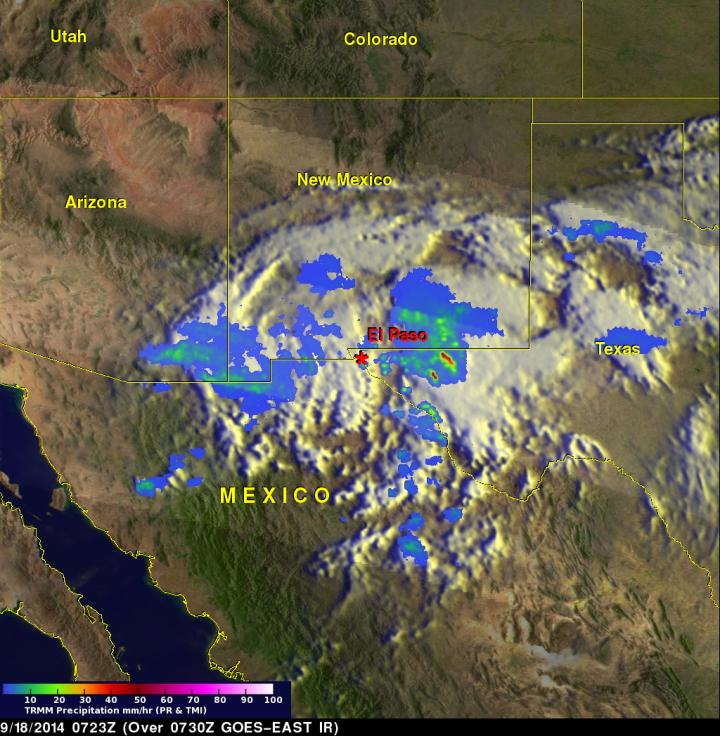
(Press-News.org) Former Hurricane Odile may be a bad memory for Baja California, but the remnants have moved over New Mexico and Texas where they are expected to bring rainfall there. NASA's TRMM satellite measured Odile's heavy rainfall rates on Sept. 18, and NOAA's GOES-West satellite saw the clouds associated with the former storm continue to linger over the U.S. Southwest on Sept. 19.

The remnants of Hurricane Odile were dropping heavy rain in the area from southern Arizona to western Texas when NASA-JAXA's Tropical Rainfall Measuring Mission or TRMM satellite flew over on September 18, 2014 at 0723 UTC (00:20 PDT). Some rain was found by TRMM's Precipitation Radar (PR) instrument to be falling at a rate of over 111 mm (4.4 inches) per hour in one downpour east of El Paso, Texas. A 3-D look with TRMM PR found that a few thunderstorm tops were pushing to heights above 13 km (8 miles) that were dropping heavy rainfall.

The GOES-West infrared image was taken on Sept. 19 at 11:15 UTC (7:15 a.m. EDT) showed a large area of clouds associated with the remnants over New Mexico and Texas. The image was created by the NASA/NOAA GOES Project at NASA's Goddard Space Flight Center in Greenbelt, Maryland.

The National Weather Service (NWS) cautioned on the morning of Sept. 18 that heavy rainfall from the remnants of Odile will continue to impacts parts of New Mexico and Texas into the early weekend (Sept. 20-21).

Odile's remnant center is expected to keep moving eastward into New Mexico and then western Texas through the early weekend. NWS noted "Moderate rainfall with pockets of heavier rainfall will continue to increase the flash flood threat for a large portion of New Mexico and West Texas. Expect the rainfall to begin tapering off from west to east across New Mexico Friday night and West Texas into Saturday."

INFORMATION: Hal Pierce / Rob Gutro
NASA's Goddard Space Flight Center

[Attachments] See images for this press release:
NASA, NOAA satellites show Odile's remnant romp through southern US

ELSE PRESS RELEASES FROM THIS DATE:

NASA sees Tropical Storm playing polo with western Mexico

NASA sees Tropical Storm playing polo with western Mexico
2014-09-19
Tropical Storm Polo is riding along the coast of western Mexico like horses in the game of his namesake. NASA's Aqua satellite saw Polo about 300 miles south-southeast of Baja California on its track north. NASA's Aqua satellite flew over Polo on Sept. 18 at 4:35 p.m. EDT and the Moderate Resolution Imaging Spectroradiometer captured a visible image of the storm that showed that much of the clouds, thunderstorms and showers were west and south of the center of circulation, and away from the coast. That's an indication that easterly wind shear had increased and were pushing ...

NASA eyes Tropical Storm Fung-Wong move through Northwestern Pacific

NASA eyes Tropical Storm Fung-Wong move through Northwestern Pacific
2014-09-19
Tropical Storm Fung-Wong continued to affect the Philippines while moving north through the Northwestern Pacific Ocean. NASA's Aqua satellite provided infrared data on the storm's clouds that showed some high, strong thunderstorms with the potential for heavy rainfall over the northern and central regions of the country. The storm is now expected to affect three more countries over the next several days. The AIRS instrument aboard NASA's Aqua satellite uses infrared light to read cloud top temperatures in tropical cyclones. When Aqua passed over Fung-Wong infrared data ...

Dwindling wind may tip predator-prey balance

Dwindling wind may tip predator-prey balance
2014-09-19
MADISON, Wis. — Bent and tossed by the wind, a field of soybean plants presents a challenge for an Asian lady beetle on the hunt for aphids. But what if the air — and the soybeans — were still? Rising temperatures and shifting precipitation patterns may get the lion's share of our climate change attention, but predators may want to give some thought to wind, according to a University of Wisconsin Madison zoologist's study, which is among the first to demonstrate the way "global stilling" may alter predator-prey relationships. "There are all sorts of other things that ...

A two generation lens: Current state policies fail to support families with young children

2014-09-19
September 19, 2014 -- Recent two-generation approaches to reducing poverty that help children and their parents are receiving increasing attention from researchers, advocates, and foundations. By combining education and training for parents to enable them to move to jobs that offer a path out of poverty with high-quality early care and education for children, these programs aim to improve the life opportunities of both. However, according to a new report from the National Center for Children in Poverty (NCCP), State Policies through a Two-Generation Lens, while research ...

Soft robotics 'toolkit' features everything a robot-maker needs

Soft robotics toolkit features everything a robot-maker needs
2014-09-19
A new resource unveiled today by researchers from several Harvard University labs in collaboration with Trinity College Dublin provides both experienced and aspiring researchers with the intellectual raw materials needed to design, build, and operate robots made from soft, flexible materials. With the advent of low-cost 3D printing, laser cutters, and other advances in manufacturing technology, soft robotics is emerging as an increasingly important field. Using principles drawn from conventional rigid robot design, but working with pliable materials, engineers are pioneering ...

Fingertip sensor gives robot unprecedented dexterity

2014-09-19
CAMBRIDGE, Mass-- Researchers at MIT and Northeastern University have equipped a robot with a novel tactile sensor that lets it grasp a USB cable draped freely over a hook and insert it into a USB port. The sensor is an adaptation of a technology called GelSight, which was developed by the lab of Edward Adelson, the John and Dorothy Wilson Professor of Vision Science at MIT, and first described in 2009. The new sensor isn't as sensitive as the original GelSight sensor, which could resolve details on the micrometer scale. But it's smaller — small enough to fit on a robot's ...

Mayo researchers reveal pathway that contributes to Alzheimer's disease

2014-09-19
JACKSONVILLE, Fla. — Researchers at Jacksonville's campus of Mayo Clinic have discovered a defect in a key cell-signaling pathway they say contributes to both overproduction of toxic protein in the brains of Alzheimer's disease patients as well as loss of communication between neurons — both significant contributors to this type of dementia. Their study, in the online issue of Neuron, offers the potential that targeting this specific defect with drugs "may rejuvenate or rescue this pathway," says the study's lead investigator, Guojun Bu, Ph.D., a neuroscientist at Mayo ...

A refined approach to proteins at low resolution

A refined approach to proteins at low resolution
2014-09-19
Membrane proteins and large protein complexes are notoriously difficult to study with X-ray crystallography, not least because they are often very difficult, if not impossible, to crystallize, but also because their very nature means they are highly flexible. The result is that when a structure can be obtained it is often of low resolution, ambiguous and reveals a mosaic-like spread of protein domains that sometimes create more puzzles than they solve. [Schröder, Levitt & Brunger. (2014), Acta Cryst. D70, 2241-2255; doi: 10.1107/S1399004714016496 ] Now, Gunnar Schröder ...

Reflected smartphone transmissions enable gesture control

Reflected smartphone transmissions enable gesture control
2014-09-19
With almost all of the U.S. population armed with cellphones – and close to 80 percent carrying a smartphone – mobile phones have become second-nature for most people. What's coming next, say University of Washington researchers, is the ability to interact with our devices not just with touchscreens, but through gestures in the space around the phone. Some smartphones are starting to incorporate 3-D gesture sensing based on cameras, for example, but cameras consume significant battery power and require a clear view of the user's hands. UW engineers have developed a ...

Patients with advanced, incurable cancer denied palliative care

2014-09-19
Many patients with advanced, incurable cancer do not receive any palliative care, reveals new research to be presented later this month at the ESMO 2014 Congress in Madrid, Spain, 26-30 September. The findings are astonishing as they come at the same time as 15 new oncology centres in Europe, Canada, South America and Africa are being awarded the prestigious title of 'ESMO Designated Centre of Integrated Oncology and Palliative Care.' SR I Dr Alexandru Grigorescu, medical oncology consultant at the Institute of Oncology Bucharest, Romania, member of the ESMO Palliative ...

LAST 30 PRESS RELEASES:

Making lighter work of calculating fluid and heat flow

Normalizing blood sugar can halve heart attack risk

Lowering blood sugar cuts heart attack risk in people with prediabetes

Study links genetic variants to risk of blinding eye disease in premature infants

Non-opioid ‘pain sponge’ therapy halts cartilage degeneration and relieves chronic pain

AI can pick up cultural values by mimicking how kids learn

China’s ecological redlines offer fast track to 30 x 30 global conservation goal

Invisible indoor threats: emerging household contaminants and their growing risks to human health

Adding antibody treatment to chemo boosts outcomes for children with rare cancer

Germline pathogenic variants among women without a history of breast cancer

Tanning beds triple melanoma risk, potentially causing broad DNA damage

Unique bond identified as key to viral infection speed

Indoor tanning makes youthful skin much older on a genetic level

Mouse model sheds new light on the causes and potential solutions to human GI problems linked to muscular dystrophy

The Journal of Nuclear Medicine ahead-of-print tip sheet: December 12, 2025

Smarter tools for peering into the microscopic world

Applications open for funding to conduct research in the Kinsey Institute archives

Global measure underestimates the severity of food insecurity

Child survivors of critical illness are missing out on timely follow up care

Risk-based vs annual breast cancer screening / the WISDOM randomized clinical trial

University of Toronto launches Electric Vehicle Innovation Ontario to accelerate advanced EV technologies and build Canada’s innovation advantage

Early relapse predicts poor outcomes in aggressive blood cancer

American College of Lifestyle Medicine applauds two CMS models aligned with lifestyle medicine practice and reimbursement

Clinical trial finds cannabis use not a barrier to quitting nicotine vaping

Supplemental nutrition assistance program policies and food insecurity

Switching immune cells to “night mode” could limit damage after a heart attack, study suggests

URI-based Global RIghts Project report spotlights continued troubling trends in worldwide inhumane treatment

Neutrophils are less aggressive at night, explaining why nighttime heart attacks cause less damage than daytime events

Menopausal hormone therapy may not pose breast cancer risk for women with BRCA mutations

Mobile health tool may improve quality of life for adolescent and young adult breast cancer survivors

[Press-News.org] NASA, NOAA satellites show Odile's remnant romp through southern US