To know the enemy
Published 2014-12-15 · Original archive entry · Explore research explainers

This news release is available in Japanese.
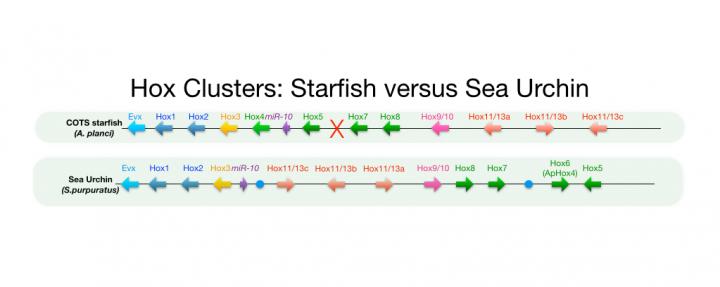
New research published in the journal genesis, by Kenneth Baughman, Dr. Eiichi Shoguchi, Professor Noriyuki Satoh of the Marine Genomics Unit at the Okinawa Institute of Science and Technology Graduate University, and collaborators from Australia, reports an intact Hox cluster in the Crown of Thorns starfish, Acanthaster planci. This surprising result contrasts with the relatively disorganized Hox cluster found in sea urchins, which are also echinoderms, classification of animals including starfish, sea lilies, and sea cucumbers. Stanford University Professor Christopher Lowe, who studies developmental biology in echinoderms, summarizes the paper: "The translocation of the Hox cluster in echinoderms has been a major red herring for understanding their evolution. It's really good to have some hard data showing that some echinoderms exhibit some oddities that are not representative of all echinoderms."
The Hox cluster is a classic example of an 'evo-devo' genetic toolkit. The term "evo-devo" refers to the study of genetic programs that control development, which can be compared between species, and thus, across evolutionary time. The Hox genes coordinate segmental identity along the head to tail (anterior-posterior) axis. The Hox cluster is evolutionarily conserved and has been repurposed repeatedly during the evolution of the animal body plan, or how animals are shaped. Past studies have shown that Hox clusters organize the development of brain and central nervous system regions in chordates, limb bud identity in vertebrates, and, classically, antennae or wing segment identity in fruit flies.
Generally, the Hox cluster shows "colinearity," in which gene order correlates with the location of expression, or the developmental stage of expression. "For example, anterior Hox genes are expressed in regions that are closer to the head of an embryo, and are expressed sooner during development, versus the posterior Hox genes," explained Baughman. "Thus, we were surprised to see chordate-like Hox cluster organization in starfish, which have a radial body plan." Echinoderms are classical model organisms for embryology, and more recently evo-devo. Baughman added, "Interacting with the speakers and students of the OIST Winter Course 'Evolution of Complex Systems' (OWECS) allowed me to appreciate the importance of finding an intact Hox cluster in starfish."
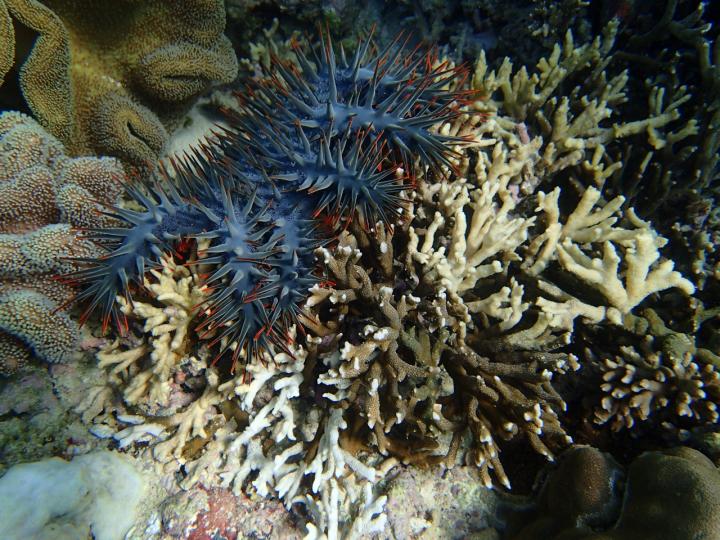
The Crown of Thorns starfish, a predatory starfish which feeds on corals, is famous for its dramatic changes in population density on the reefs near Australia, as well as Okinawa. Over the past 50 years, this has resulted in a measurable loss of coral reefs. A recent 27-year reef monitoring study of the Great Barrier Reef estimated that the starfish accounts for 42% of the loss in coral cover, 2nd only to typhoons. While population control was the initial motivation for Crown of Thorns genome research, the Hox cluster report is one of the first to show that the species can be useful for studies in evolutionary-developmental biology. "We were excited to see the entire Hox cluster on a single genomic scaffold, a result which confirmed the remarkably high quality of the genomic data," said Prof. Satoh.
As is often the case with science, the discovery raises more questions than it answers. If starfish have a collinear Hox cluster, what accounts for their dramatic departures in body plan organization? Do starfish express Hox genes during development in a manner similar to chordates, as indicated by the organization of their Hox cluster? Baughman looks forward to addressing these questions and many more as part of his doctoral research. "I look forward to pursuing developmental biology studies that may suggest methods for mitigating damage to the coral reef caused by the Crown of Thorns starfish."
More research is being conducted at OIST on the Crown of Thorns starfish in the Marine Biophysics Unit by Masako Nakamura in cooperation with local fishermen. In addition to the research collaboration highlighted by the Hox publication, recent efforts by the Okinawa Prefectural Government and Australian Institute of Marine Science are also working on projects to protect the existing coral reefs from the Crown of Thorns starfish.
New research published in the journal genesis, by Kenneth Baughman, Dr. Eiichi Shoguchi, Professor Noriyuki Satoh of the Marine Genomics Unit at the Okinawa Institute of Science and Technology Graduate University, and collaborators from Australia, reports an intact Hox cluster in the Crown of Thorns starfish, Acanthaster planci. This surprising result contrasts with the relatively disorganized Hox cluster found in sea urchins, which are also echinoderms, classification of animals including starfish, sea lilies, and sea cucumbers. Stanford University Professor Christopher Lowe, who studies developmental biology in echinoderms, summarizes the paper: "The translocation of the Hox cluster in echinoderms has been a major red herring for understanding their evolution. It's really good to have some hard data showing that some echinoderms exhibit some oddities that are not representative of all echinoderms."
The Hox cluster is a classic example of an 'evo-devo' genetic toolkit. The term "evo-devo" refers to the study of genetic programs that control development, which can be compared between species, and thus, across evolutionary time. The Hox genes coordinate segmental identity along the head to tail (anterior-posterior) axis. The Hox cluster is evolutionarily conserved and has been repurposed repeatedly during the evolution of the animal body plan, or how animals are shaped. Past studies have shown that Hox clusters organize the development of brain and central nervous system regions in chordates, limb bud identity in vertebrates, and, classically, antennae or wing segment identity in fruit flies.
Generally, the Hox cluster shows "colinearity," in which gene order correlates with the location of expression, or the developmental stage of expression. "For example, anterior Hox genes are expressed in regions that are closer to the head of an embryo, and are expressed sooner during development, versus the posterior Hox genes," explained Baughman. "Thus, we were surprised to see chordate-like Hox cluster organization in starfish, which have a radial body plan." Echinoderms are classical model organisms for embryology, and more recently evo-devo. Baughman added, "Interacting with the speakers and students of the OIST Winter Course 'Evolution of Complex Systems' (OWECS) allowed me to appreciate the importance of finding an intact Hox cluster in starfish."
The Crown of Thorns starfish, a predatory starfish which feeds on corals, is famous for its dramatic changes in population density on the reefs near Australia, as well as Okinawa. Over the past 50 years, this has resulted in a measurable loss of coral reefs. A recent 27-year reef monitoring study of the Great Barrier Reef estimated that the starfish accounts for 42% of the loss in coral cover, 2nd only to typhoons. While population control was the initial motivation for Crown of Thorns genome research, the Hox cluster report is one of the first to show that the species can be useful for studies in evolutionary-developmental biology. "We were excited to see the entire Hox cluster on a single genomic scaffold, a result which confirmed the remarkably high quality of the genomic data," said Prof. Satoh.
As is often the case with science, the discovery raises more questions than it answers. If starfish have a collinear Hox cluster, what accounts for their dramatic departures in body plan organization? Do starfish express Hox genes during development in a manner similar to chordates, as indicated by the organization of their Hox cluster? Baughman looks forward to addressing these questions and many more as part of his doctoral research. "I look forward to pursuing developmental biology studies that may suggest methods for mitigating damage to the coral reef caused by the Crown of Thorns starfish."
More research is being conducted at OIST on the Crown of Thorns starfish in the Marine Biophysics Unit by Masako Nakamura in cooperation with local fishermen. In addition to the research collaboration highlighted by the Hox publication, recent efforts by the Okinawa Prefectural Government and Australian Institute of Marine Science are also working on projects to protect the existing coral reefs from the Crown of Thorns starfish.
INFORMATION:
Attachments