SA fossil is the long-awaited link to the evolution of turtles
Published 2015-09-03 · Original archive entry · Explore research explainers
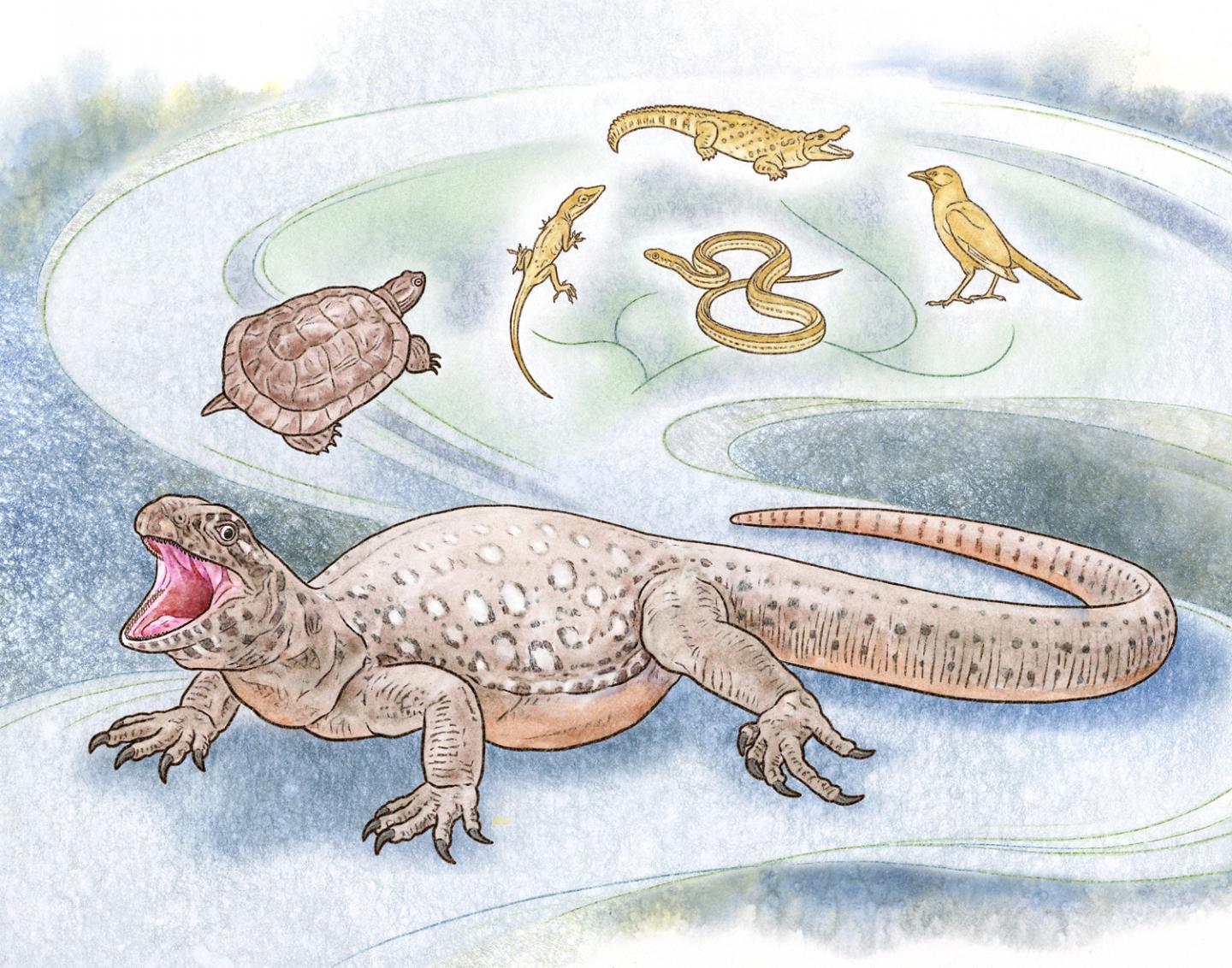
A 260-million-year-old fossil species found in South Africa's Karoo Basin continues to provide information into the murky origins of turtles whose evolution fascinates scientists.
The fossil of an extinct reptile, named Eunotosaurus africanus, is the earliest known branch of the turtle tree of life.
"Eunotosaurus is a critical link connecting modern turtles to their evolutionary past," says Dr Gaberiel Bever an Honorary Research Associate at Wits University's Evolutionary Studies Institute (ESI) and scientist at the New York Institute of Technology.
Previous studies on Eunotosaurus have provided answers on how the turtle got its shell. In a new study titled: Evolutionary origin of the turtle skull published in Nature, Bever and his colleagues focus their attention on the skull of Eunotosaurus.
Their findings indicate that the complex anatomy of the head houses convincing evidence of the important role played by Eunotosaurus in the deep history of turtle evolution.
Using high-resolution computed tomography, Bever digitally dissected the bones and internal structures of multiple Eunotosaurus skulls, all of which are housed in South African museums. He then incorporated his observations into a new analysis of the reptile tree of life. The process took the better part of four years, but according to Bever, the results were well worth the effort. "Using imaging technology gave us the opportunity to take the first look inside the skull of Eunotosaurus. What we found not only illuminates the close relationship of Eunotosaurus to turtles, but also how turtles are related to other modern reptiles," says Bever. Key findings
One of the study's key findings is that the skull of Eunotosaurus has a pair of openings set behind the eyes that allowed the jaw muscles to lengthen and flex during chewing. Known as the diapsid condition, this pair of openings is also found in lizards, snakes, crocodilians and birds. The skull of modern turtles is anapsid - without openings - with the chamber housing the jaw muscles fully enclosed by bone. This means that early turtles had a quicker bite than do most modern turtles.
The anapsid-diapsid distinction strongly influenced the long-held notion that turtles are the remnants of an ancient reptile lineage and not closely related to modern lizards, crocodiles and birds who have a diapsid ability. The new data from Eunotosaurus rejects this hypothesis. "We can now draw the well-supported and satisfying conclusion that Eunotosaurus is the diapsid turtle." In linking turtles to their diapsid ancestry, the skull of Eunotosaurus also reveals how the evidence of that ancestry became obscured during later stages of turtle evolution.
"The skull of Eunotosaurus grows in such a way that its diapsid nature is obvious in juveniles but almost completely obscured in adults. If that same growth trajectory was accelerated in subsequent generations, then the original diapsid skull of the turtle ancestor would eventually be replaced by an anapsid skull, which is what we find in modern turtles."
Although the new study represents a major step towards understanding the reptile tree of life, Bever emphasises that it will not be the final chapter in the science of turtle origins. Bever and Dr Tyler Lyson, co-author of the study and Honorary Research Fellow at ESI who is based at the Denver Museum of Nature and Science, have for several years been involved in a collaborative project led by Wits University's Professor Bruce Rubidge.
Their collaboration explores biodiversity change in the Middle Permian Period more than 260 million years ago. They have been particularly interested in understanding the biology of Eunotosaurus, which is known from Middle Permian rocks of the South African Karoo Supergroup.
"This is a major step towards understanding the interrelationships of reptiles. Also of great significance is that Eunotosaurus, which is known only from South Africa, is a critical transitional form in the origin of tortoises and this finding indicates that the tortoise lineage had its origins in Gondwana," says Rubidge.
"There is still much we don't know about the origin of turtles or which of the other diapsid groups form their closest cousin? What were the ecological conditions that led to the evolution of the turtle's shell and anapsid skull? And how much of the deep history of turtle evolution can be discovered by studying the genes and developmental pathway of modern turtles," adds Bever.
The fossil of an extinct reptile, named Eunotosaurus africanus, is the earliest known branch of the turtle tree of life.
"Eunotosaurus is a critical link connecting modern turtles to their evolutionary past," says Dr Gaberiel Bever an Honorary Research Associate at Wits University's Evolutionary Studies Institute (ESI) and scientist at the New York Institute of Technology.
Previous studies on Eunotosaurus have provided answers on how the turtle got its shell. In a new study titled: Evolutionary origin of the turtle skull published in Nature, Bever and his colleagues focus their attention on the skull of Eunotosaurus.
Their findings indicate that the complex anatomy of the head houses convincing evidence of the important role played by Eunotosaurus in the deep history of turtle evolution.
Using high-resolution computed tomography, Bever digitally dissected the bones and internal structures of multiple Eunotosaurus skulls, all of which are housed in South African museums. He then incorporated his observations into a new analysis of the reptile tree of life. The process took the better part of four years, but according to Bever, the results were well worth the effort. "Using imaging technology gave us the opportunity to take the first look inside the skull of Eunotosaurus. What we found not only illuminates the close relationship of Eunotosaurus to turtles, but also how turtles are related to other modern reptiles," says Bever. Key findings
One of the study's key findings is that the skull of Eunotosaurus has a pair of openings set behind the eyes that allowed the jaw muscles to lengthen and flex during chewing. Known as the diapsid condition, this pair of openings is also found in lizards, snakes, crocodilians and birds. The skull of modern turtles is anapsid - without openings - with the chamber housing the jaw muscles fully enclosed by bone. This means that early turtles had a quicker bite than do most modern turtles.
The anapsid-diapsid distinction strongly influenced the long-held notion that turtles are the remnants of an ancient reptile lineage and not closely related to modern lizards, crocodiles and birds who have a diapsid ability. The new data from Eunotosaurus rejects this hypothesis. "We can now draw the well-supported and satisfying conclusion that Eunotosaurus is the diapsid turtle." In linking turtles to their diapsid ancestry, the skull of Eunotosaurus also reveals how the evidence of that ancestry became obscured during later stages of turtle evolution.
"The skull of Eunotosaurus grows in such a way that its diapsid nature is obvious in juveniles but almost completely obscured in adults. If that same growth trajectory was accelerated in subsequent generations, then the original diapsid skull of the turtle ancestor would eventually be replaced by an anapsid skull, which is what we find in modern turtles."
Although the new study represents a major step towards understanding the reptile tree of life, Bever emphasises that it will not be the final chapter in the science of turtle origins. Bever and Dr Tyler Lyson, co-author of the study and Honorary Research Fellow at ESI who is based at the Denver Museum of Nature and Science, have for several years been involved in a collaborative project led by Wits University's Professor Bruce Rubidge.
Their collaboration explores biodiversity change in the Middle Permian Period more than 260 million years ago. They have been particularly interested in understanding the biology of Eunotosaurus, which is known from Middle Permian rocks of the South African Karoo Supergroup.
"This is a major step towards understanding the interrelationships of reptiles. Also of great significance is that Eunotosaurus, which is known only from South Africa, is a critical transitional form in the origin of tortoises and this finding indicates that the tortoise lineage had its origins in Gondwana," says Rubidge.
"There is still much we don't know about the origin of turtles or which of the other diapsid groups form their closest cousin? What were the ecological conditions that led to the evolution of the turtle's shell and anapsid skull? And how much of the deep history of turtle evolution can be discovered by studying the genes and developmental pathway of modern turtles," adds Bever.
INFORMATION:
Other authors that contributed to the study are Daniel Field (PhD candidate, Department of Geology & Geophysics, Yale University) and Bhart-Anjan Bhullar (Assistant Professor, Department of Geology & Geophysics, Yale University).