Deep Vision: Near-infrared imaging and machine learning can identify hidden tumors
Near-infrared hyperspectral imaging combined with machine learning can visualize tumors in deep tissue and covered by a mucosal layer, scientists show
Published 2021-02-02 · Original archive entry · Explore research explainers
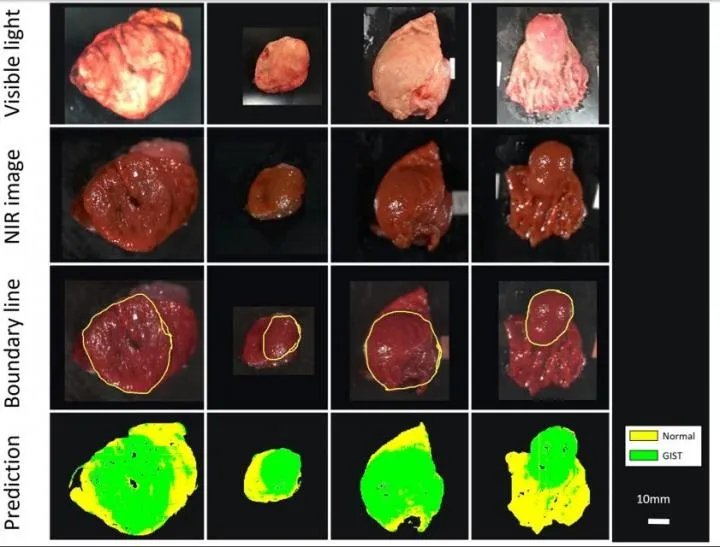
Tumors can be damaging to surrounding blood vessels and tissues even if they're benign. If they're malignant, they're aggressive and sneaky, and often irrevocably damaging. In the latter case, early detection is key to treatment and recovery. But such detection can sometimes require advanced imaging technology, beyond what is available commercially today.
For instance, some tumors occur deep inside organs and tissues, covered by a mucosal layer, which makes it difficult for scientists to directly observe them with standard methods like endoscopy (which inserts a small camera into a patient's body via a thin tube) or reach them during biopsies. In particular, gastrointestinal stromal tumors (GISTs)--typically found in the stomach and the small intestines--require demanding techniques that are very time-consuming and prolong the diagnosis. Now, to improve GIST diagnosis, Drs. Daiki Sato, Hiroaki Ikematsu, and Takeshi Kuwata from the National Cancer Center Hospital East in Japan, Dr. Hideo Yokota from the RIKEN Center for Advanced Photonics, Japan, and Drs. Toshihiro Takamatsu and Kohei Soga from Tokyo University of Science, Japan, led by Dr. Hiroshi Takemura, have developed a technology that uses near-infrared hyperspectral imaging (NIR-HSI) along with machine learning. Their findings are published in END
For instance, some tumors occur deep inside organs and tissues, covered by a mucosal layer, which makes it difficult for scientists to directly observe them with standard methods like endoscopy (which inserts a small camera into a patient's body via a thin tube) or reach them during biopsies. In particular, gastrointestinal stromal tumors (GISTs)--typically found in the stomach and the small intestines--require demanding techniques that are very time-consuming and prolong the diagnosis. Now, to improve GIST diagnosis, Drs. Daiki Sato, Hiroaki Ikematsu, and Takeshi Kuwata from the National Cancer Center Hospital East in Japan, Dr. Hideo Yokota from the RIKEN Center for Advanced Photonics, Japan, and Drs. Toshihiro Takamatsu and Kohei Soga from Tokyo University of Science, Japan, led by Dr. Hiroshi Takemura, have developed a technology that uses near-infrared hyperspectral imaging (NIR-HSI) along with machine learning. Their findings are published in END