Quasicrystal-clear: Material reveals unique shifting surface structure under microscope
Scientists reveal peculiar surface structure in materials resembling quasicrystals with interesting implications for its magnetic properties
Published 2021-02-04 · Original archive entry · Explore research explainers
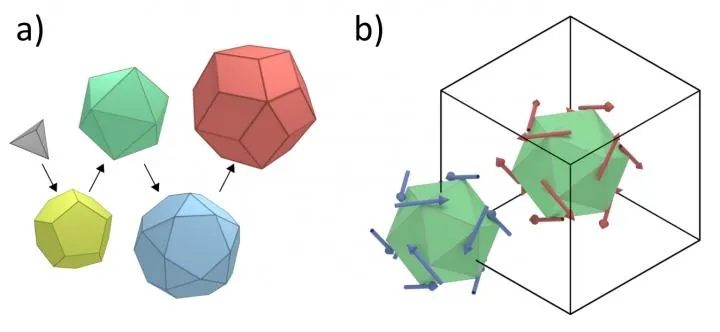
Between chemistry classes, gemstones, and electronics, the idea of crystals, substances with an ordered and periodic arrangement of atoms is quite common. But about 40 years ago, a strange particle was discovered by scientists that hasn't become commonplace in our world yet: quasicrystals. These are structures with curious atomic arrangements, which, while superficially similar to crystals, lack periodicity despite being ordered. Because of their structures, quasicrystals exhibit symmetries forbidden to crystals and are endowed with interesting properties that crystals cannot show, such as high resistance to heat flow, current flow, and corrosion.
Since their discovery, quasicrystals have been researched extensively by materials scientists around the world. Due to their rarity, scientists have often resorted to studying models mimicking them, called approximants. Recently, in a class of gold-based approximants, called "Tsai-type approximants", the presence of magnetic order was detected whose type can be controlled by the composition of the approximants--an exciting possibility for material scientists to explore.
In such approximants of increasing complexity, such as that composed of gold (Au), aluminum (Al), and terbium (Tb), the magnetic order was found to be antiferromagnetic, where each ion in the crystal acts as a small magnets with its poles opposite to those of its neighbors. In a new study published in END
Since their discovery, quasicrystals have been researched extensively by materials scientists around the world. Due to their rarity, scientists have often resorted to studying models mimicking them, called approximants. Recently, in a class of gold-based approximants, called "Tsai-type approximants", the presence of magnetic order was detected whose type can be controlled by the composition of the approximants--an exciting possibility for material scientists to explore.
In such approximants of increasing complexity, such as that composed of gold (Au), aluminum (Al), and terbium (Tb), the magnetic order was found to be antiferromagnetic, where each ion in the crystal acts as a small magnets with its poles opposite to those of its neighbors. In a new study published in END