Best of both worlds: A hybrid method for tracking laparoscopic ultrasound transducers
Combined hardware- and computer vision-based strategy will help improve laparoscopic ultrasound imaging
Published 2021-02-04 · Original archive entry · Explore research explainers
Laparoscopic surgery, a less invasive alternative to conventional open surgery, involves inserting thin tubes with a tiny camera and surgical instruments into the abdomen. To visualize specific surgical targets, ultrasound imaging is used in conjunction with the surgery. However, ultrasound images are viewed on a separate screen, requiring the surgeon to mentally combine the camera and ultrasound data.
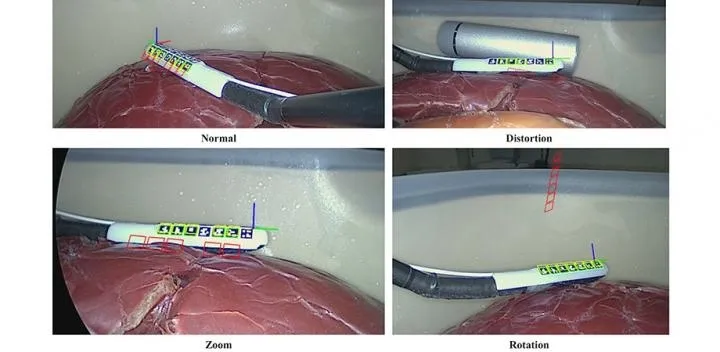
Modern augmented reality (AR)-based methods have overcome this issue by embedding ultrasound images into the video taken by the laparoscopic camera. These AR methods precisely map the ultrasound data coordinates to the coordinates of the images seen through the camera. Although the process is mathematically straightforward, it can only be done if the pose (position and orientation) of the ultrasound probe (transducer) is known by the camera coordinate system. This has proven to be challenging, despite many strategies for tracking the laparoscopic transducer. Hardware-based tracking by attaching electromagnetic (EM) sensors to the probe is a feasible approach, but it is prone to errors due to calibration and hardware limitations. Camera vision (CV) systems can also be used to process the images acquired by the camera and determine the probe's pose. However, because they rely entirely on camera data, such methods fail if the probe is defocused or if the camera's view is occluded. Thus, such CV systems are not yet ready for clinical settings.
To this end, in a END
Modern augmented reality (AR)-based methods have overcome this issue by embedding ultrasound images into the video taken by the laparoscopic camera. These AR methods precisely map the ultrasound data coordinates to the coordinates of the images seen through the camera. Although the process is mathematically straightforward, it can only be done if the pose (position and orientation) of the ultrasound probe (transducer) is known by the camera coordinate system. This has proven to be challenging, despite many strategies for tracking the laparoscopic transducer. Hardware-based tracking by attaching electromagnetic (EM) sensors to the probe is a feasible approach, but it is prone to errors due to calibration and hardware limitations. Camera vision (CV) systems can also be used to process the images acquired by the camera and determine the probe's pose. However, because they rely entirely on camera data, such methods fail if the probe is defocused or if the camera's view is occluded. Thus, such CV systems are not yet ready for clinical settings.
To this end, in a END