PRESS-NEWS.org - Press Release Distribution
PRESS RELEASES DISTRIBUTION

A new satellite-measured "Solar-induced Chlorophyll Fluorescence" (SIF) product aims to improve carbon neutrality research

A new satellite-measured
2021-03-17
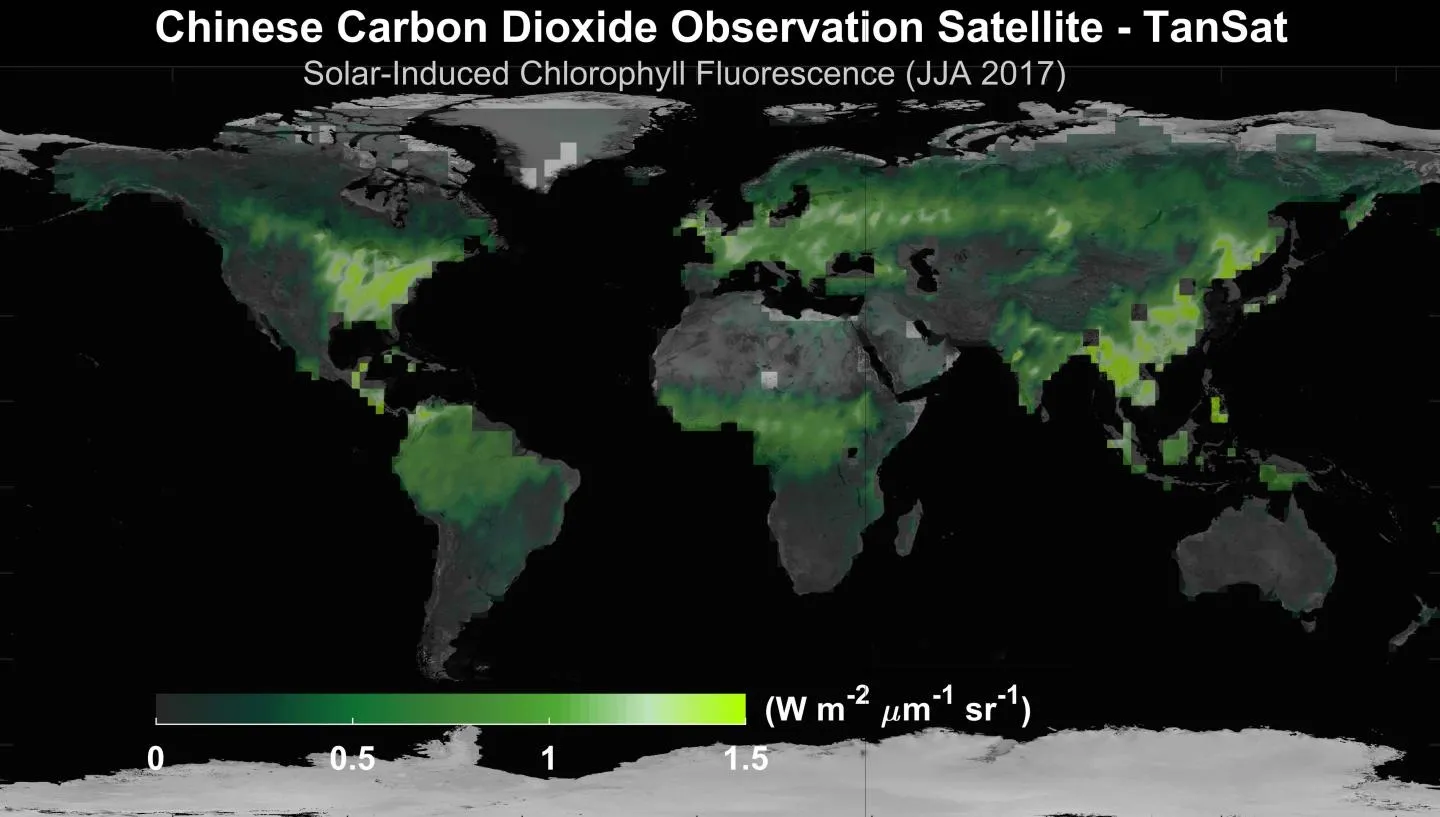
(Press-News.org) Solar-induced chlorophyll fluorescence (SIF) is emitted during plant photosynthesis. SIF results from vegetation chlorophyll giving off red and infrared light wavelengths when excited by solar radiation. Measuring SIF is important because it is closely related to the terrestrial gross primary productivity (GPP), which calculates the total amount of carbon dioxide fixed through photosynthesis in a given area. According to many laboratory and field experiments, studies show that SIF can effectively improve estimations of GPP, which is necessary for global carbon sink research and carbon mitigation strategies.

China has committed to carbon neutrality by 2060. Technological upgrades and energy structure adjustments through the next four decades will be vital to reducing carbon emissions. However, the goal is even more attainable considering the large natural carbon sink provided by plants. Expanding the capacity of the terrestrial ecosystem allows natural carbon fixation to provide a more direct and efficient path toward a carbon neutral future. Therefore, scientists must assess the natural carbon sink accurately to evaluate current and forthcoming carbon neutrality implementation plans.

Supported by the Ministry of Science and Technology of China, the Chinese Academy of Sciences, and the China Meteorological Administration, the Chinese Carbon Dioxide Monitoring Satellite Mission (TanSat) was launched in December 2016. TanSat monitors global atmospheric CO2 concentrations and is capable of measuring SIF.

The first TanSat global SIF map was constructed using a data-driven method based on the SVD (singular value decomposition) technique. TanSat now retrieves its SIF product from a new physical-based algorithm named IAPCAS/SIF. This algorithm is based on the Institute of Atmospheric Physics Carbon Dioxide Retrieval Algorithm for Satellite Remote Sensing Platform, which maps global atmospheric CO2 distribution. The IAPCAS/SIF algorithm provides SIF emission data from two micro-windows, 757nm and 771nm, within the O2 A-band.

Due to spatial scale differences, it is difficult to directly verify the accuracy and precision of satellite-measured SIF with SIF measured at the leaf or canopy scale. Much like satellite-based XCO2 products, SIF retrievals still need more comprehensive verification trials that assess precision for further carbon flux estimations.

"The intercomparison between SIF products by different algorithms can verify the reliability of the algorithms, and also provide ideas for subsequent algorithm optimization," said Dongxu Yang, the principal investigator of TanSat mission.

His team compared the TanSat SIF products provided by the new IAPCAS/SIF algorithm and the data-driven (SVD) method. Considering both scale and time, results indicate that the two SIF products agree well on a global extent thought the year. While the team noticed a slight regional bias in the SIF maps, the linear correlations between the two SIF products are strong, higher than 0.73, for all seasons. Their TanSat SIF algorithm comparison is published in Advances in Atmospheric Sciences.

Researchers will analyze and use the new SIF product to better understand the terrestrial ecosystem. This includes assimilating SIF data into GPP modeling and global carbon flux estimations. Optimization of the IAPCAS/SIF algorithm will help to develop SIF products from other satellite missions, and scientists hope that exploring the comprehensive usage of SIF products will promote the quantitive research of the global carbon sink and climate change.

INFORMATION:

TanSat SIF products are available from the CASA ( the Cooperation on the Analysis of carbon SAtellites data ), TanSat data and science service.


[Attachments] See images for this press release:
A new satellite-measured

ELSE PRESS RELEASES FROM THIS DATE:

South African Oxford AstraZeneca Covid-19 vaccine study a global game-changer

2021-03-17
This is a landmark study in so far as being the first to raise the alarm that, despite early successes with Covid-19 vaccines, further research is warranted on a next generation of Covid-19 vaccines. The results from this study, however, only indicate that the AstraZeneca vaccine does not have at least 60% efficacy against mild-moderate Covid-19 due to the B.1.351 (N501Y.V2) variant. Based on a broader body of evidence, the World Health Organization recommends that this vaccine still be deployed in countries where the B.1.351 variant circulates, as it likely still protects against severe ...

Trackable and guided 'nanomissiles' deliver cancer-fighting drug straight to the tumor

2021-03-17
Researchers from Skoltech and their colleagues from Hadassah Medical Center have developed hybrid nanostructured particles that can be magnetically guided to the tumor, tracked by their fluorescence and pushed to release the drug on demand by ultrasound. This technology can help make cancer chemotherapy more targeted. The paper was published in the journal Colloids and Surfaces B: Biointerfaces.Current treatments for cancer include chemotherapy, immunotherapy, radiation, and surgery, but these are often not selective enough to target just the tumor ...

Cu-based small-pore zeolites for deNOx

Cu-based small-pore zeolites for deNOx
2021-03-17
The diesel engine is the backbone of transportation due to its irreplaceability as the primary power source for the freight, navigation and marine engine industries and non-road engineering machinery for the foreseeable future. However, the control of contaminants from fuel combustion has become an urgent global concern. Nitrogen oxides are the primary pollutants from transportation and can contribute to the formation of haze, photochemical smog and acid rain. Selective catalytic reduction of NOx with ammonia (NH3-SCR) technology has been successfully and commercially applied for controlling pollution from diesel vehicle exhaust. The development of ...

https://discovery.kaust.edu.sa/en/article/1098/the-right-ring-count-to-harness-waste-heat

https://discovery.kaust.edu.sa/en/article/1098/the-right-ring-count-to-harness-waste-heat
2021-03-17
Electronic organic materials offer promise to support alternative and green energy sources to meet escalating global energy demands and strict environmental regulations. A KAUST-led team has now developed electron-transporting, so-called n-type, organic semiconductors that could help generate electricity from waste heat released by industrial processes and homes. Thermoelectric generators that can convert temperature changes or gradients into electricity are highly suited for harnessing waste heat. These readily scalable devices are environmentally friendly and do not have any moving parts, which makes them ...

CO2 electrotransformation into value-added chemicals in ionic liquid-based electrolytes

CO2 electrotransformation into value-added chemicals in ionic liquid-based electrolytes
2021-03-17
The use of fossil fuels as energy carriers and raw materials promotes the rapid development of the society. However, the excessive exploitation of fossil fuels gives rise to the energy crisis and undesirable environmental changes. In particular, a continuous increase of CO2 concentration in the atmosphere, which is > 400 ppm today and is estimated to triple by 2040, might result in a series of environmental issues, such as global warming, rising sea levels, and more extreme weather. Therefore, cutting CO2 emissions and developing abundant renewable energy are urgent needs and challenges for our society. CO2 is not only one of the main greenhouse gases but also an abundant, nontoxic, nonflammable, and renewable C1 resource. Electrochemical conversion of CO2 is an attractive way to recycle ...

PPE supplied to the NHS during COVID-19 pandemic poses challenge to the environment

2021-03-17
According to a new study published in the Journal of the Royal Society of Medicine, the carbon footprint of personal protective equipment (PPE) provided to health and social care staff in England during the first six months of the COVID-19 pandemic was equivalent to flying from London to New York 244 times every day. The good news is that adopting a range of strategies including increased UK manufacture, reusing and recycling could reduce the environmental impact of PPE dramatically while maintaining the safety of staff and patients. The study, by Brighton and Sussex Medical School and Brighton and Sussex University Hospitals NHS Trust, found that the 3 billion items of PPE used from ...

New aluminum and samarium hexaboride-based composite material with near-zero expansion

New aluminum and samarium hexaboride-based composite material with near-zero expansion
2021-03-17
Precision or invar alloys have been developed by scientists for many centuries. These iron and nickel-based alloys are capable of keeping their size unchanged within a given range of temperatures. Because of this, they are used in the manufacture of precision gages, standards of length, details for mechanical dial plates, and similar devices. However, invar alloys lack many other useful physical characteristics, and this limits their use in other areas, for example, those that require high thermal conductivity of materials. Therefore, scientists have long been trying to create a unique composite material based on other metals ...

Evolved to stop bacteria, designed for stability

2021-03-17
Connections are crucial. Bacteria may be most dangerous when they connect - banding together to build fortress-like structures known as biofilms that afford them resistance to antibiotics. But a biomolecular scientist in Israel and a microbiologist in California have forged their own connections that could lead to new protocols for laying siege to biofilm-protected colonies. Their research was published in the Proceedings of the National Academy of Sciences (PNAS), USA. This interdisciplinary collaboration began with a lecture given at the Weizmann Institute of Science in the Life Sciences Colloquium. Prof. Dianne Newman of the California Institute of Technology was the speaker, ...

Simple blood test could replace surgery for some brain tumour patients

Simple blood test could replace surgery for some brain tumour patients
2021-03-17
A research breakthrough shows that a simple blood test could reduce, or in some cases replace, the need for intrusive surgery when determining the best course of treatment for patients with a specific type of brain tumour. Researchers at the Brain Tumour Research Centre of Excellence at the University of Plymouth have discovered a biomarker which helps to distinguish whether meningioma - the most common form of adult primary brain tumour - is grade I or grade II. The grading is significant because lower grade tumours can sometimes remain dormant for long periods, not requiring high risk surgery or harsh treatments such as radiotherapy and chemotherapy. Tumours classified as grade II can progress to become cancerous and more aggressive treatment may be needed in order ...

Pressure sensors could ensure a proper helmet fit to help protect the brain

Pressure sensors could ensure a proper helmet fit to help protect the brain
2021-03-17
Many athletes, from football players to equestrians, rely on helmets to protect their heads from impacts or falls. However, a loose or improperly fitted helmet could leave them vulnerable to traumatic brain injuries (TBIs), a leading cause of death or disability in the U.S. Now, researchers reporting in ACS Sensors have developed a highly sensitive pressure sensor cap that, when worn under a helmet, could help reveal whether the headgear is a perfect fit. According to the U.S. Centers for Disease Control and Prevention, 1.6 to 3.8 million sports- and recreation-related TBIs occur each year in the U.S. Field data suggest that loose or improperly fitted helmets can contribute ...

LAST 30 PRESS RELEASES:

Fecal microbiome and bile acid profiles differ in preterm infants with parenteral nutrition-associated cholestasis

The Institute of Science and Technology Austria (ISTA) receives €5 million donation for AI research

Study finds link between colorblindness and death from bladder cancer

Tailored treatment approach shows promise for reducing suicide and self-harm risk in teens and young adults

Call for papers: AI in biochar research for sustainable land ecosystems

Methane eating microbes turn a powerful greenhouse gas into green plastics, feed, and fuel

Hidden nitrogen in China’s rice paddies could cut fertilizer use

Texas A&M researchers expose hidden risks of firefighter gear in an effort to improve safety and performance

Wood burning in homes drives dangerous air pollution in winter

The Journal of Nuclear Medicine Ahead-of-Print Tip Sheet: January 23, 2026

ISSCR statement in response to new NIH policy on research using human fetal tissue (Notice NOT-OD-26-028)

Biologists and engineers follow goopy clues to plant-wilting bacteria

What do rats remember? IU research pushes the boundaries on what animal models can tell us about human memory

Frontiers Science House: did you miss it? Fresh stories from Davos – end of week wrap

Watching forests grow from space

New grounded theory reveals why hybrid delivery systems work the way they do

CDI scientist joins NIH group to improve post-stem cell transplant patient evaluation

Uncovering cancer's hidden oncRNA signatures: From discovery to liquid biopsy

Multiple maternal chronic conditions and risk of severe neonatal morbidity and mortality

Interactive virtual assistant for health promotion among older adults with type 2 diabetes

Ion accumulation in liquid–liquid phase separation regulates biomolecule localization

Hemispheric asymmetry in the genetic overlap between schizophrenia and white matter microstructure

Research Article | Evaluation of ten satellite-based and reanalysis precipitation datasets on a daily basis for Czechia (2001–2021)

Nano-immunotherapy synergizing ferroptosis and STING activation in metastatic bladder cancer

Insilico Medicine receives IND approval from FDA for ISM8969, an AI-empowered potential best-in-class NLRP3 inhibitor

Combined aerobic-resistance exercise: Dual efficacy and efficiency for hepatic steatosis

Expert consensus outlines a standardized framework to evaluate clinical large language models

Bioengineered tissue as a revolutionary treatment for secondary lymphedema

Forty years of tracking trees reveals how global change is impacting Amazon and Andean Forest diversity

Breathing disruptions during sleep widespread in newborns with severe spina bifida

[Press-News.org] A new satellite-measured "Solar-induced Chlorophyll Fluorescence" (SIF) product aims to improve carbon neutrality research