PRESS-NEWS.org - Press Release Distribution
PRESS RELEASES DISTRIBUTION

Anyone can get super-hearing

New audio technique can track bats in flight and help localise sources of ultrasonic sound

Anyone can get super-hearing
2021-06-02
(Press-News.org) Humans can observe what and where something happens around them with their hearing, as long as sound frequencies lie between 20 Hz and 20 000 Hz. Researchers at Aalto University have now developed a new audio technique that enables people to also hear ultrasonic sources that generate sound at frequencies above 20,000 Hz with simultaneous perception of their direction. The results have been published in Scientific Reports on 2 June 2021.

'In our study, we used bats in their natural habitat as sources of ultrasonic sound. With our new technique, we can now hear the directions-of-arrival of bat sounds, which means we can track bats in flight and hear where they are - we're essentially giving ourselves super hearing,' says Professor Ville Pulkki from Aalto University.

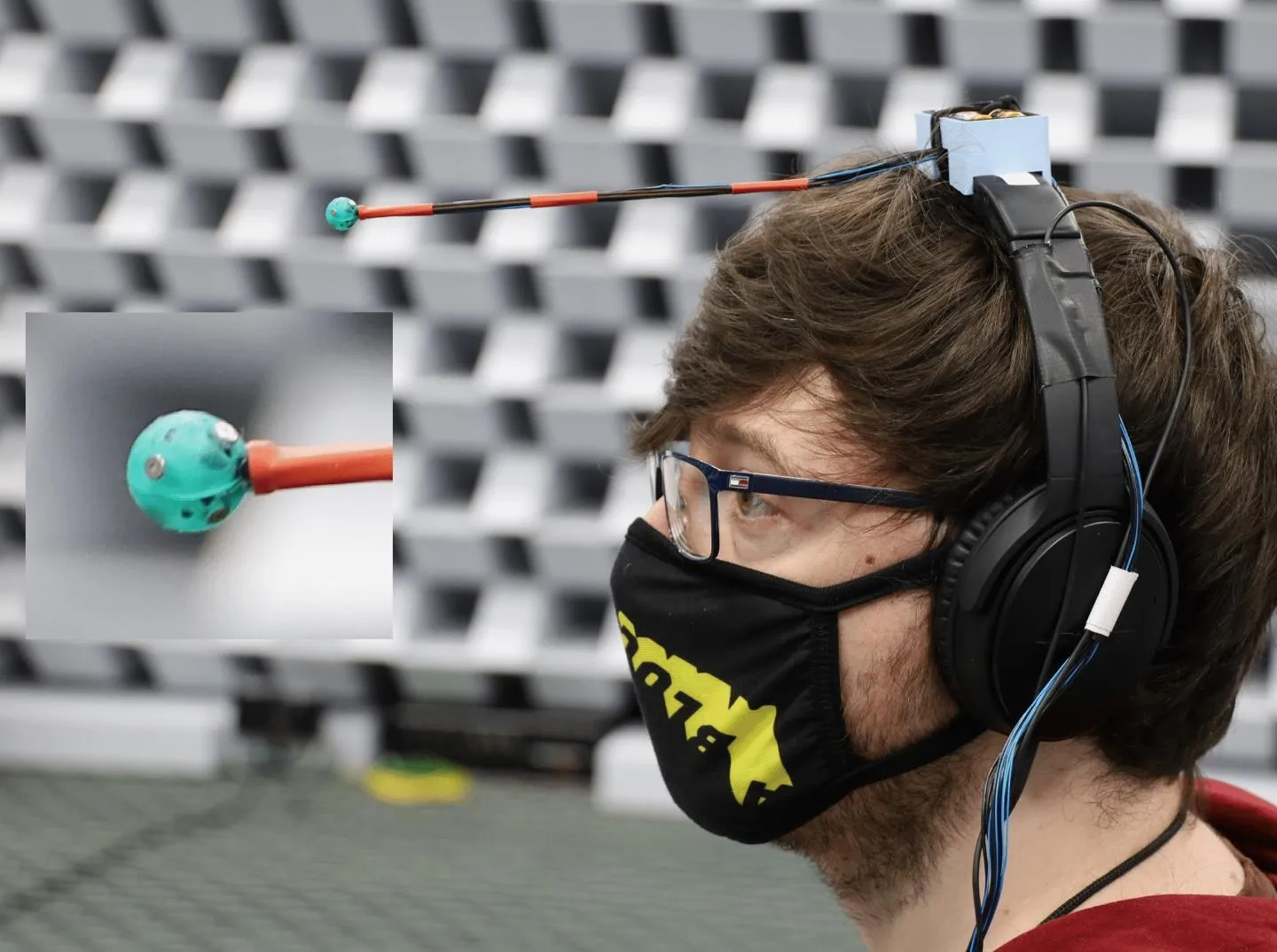
Small devices have been used before to listen to bats but previous versions haven't allowed listeners to locate the bats, just hear them. With their device the researchers record ultrasound using an array of microphones flush mounted and uniformly distributed on the surface of a small sphere. After the signal has been pitch-shifted to audible frequencies, the sound is played back on the headphones immediately. Currently, the pitch-shifting is performed on a computer, but, in the future, it could be done with electronics attached to the headphones.

'A sound-field analysis is performed on the microphone signals, and as a result we obtain the most prominent direction of the ultrasonic sound field and a parameter that suggests that the sound comes only from a single source. After this, a single microphone signal is brought to the audible frequency range of human hearing and its single-source signal is played back on the headphones so that the listener can perceive the source from the direction the sound was analysed to arrive,' Pulkki says.

On top of its popular appeal, the technique has tangible real-world applications.

'In science and art, people have always been interested in how they could improve their senses. Finding sources of ultrasonic sound is also useful in many practical situations, such as finding leaks in pressurised gas pipes. Minor pipe leaks often produce strong ultrasound emissions not detected by normal hearing. The device allows us to spot the sound source quickly,' Pulkki explains.

'Sometimes, damaged electrical equipment also emit ultrasound, and the device could be used for locating faulty equipment faster in places such as data centres,' he continues.

INFORMATION:

The Open Access article is available via the link http://www.nature.com/articles/s41598-021-90829-9

Listen to the sounds of bats and see the video to get acquainted with the study. The effect can be heard with headphones only. https://youtu.be/HMkZs7a1nQc


[Attachments] See images for this press release:
Anyone can get super-hearing

ELSE PRESS RELEASES FROM THIS DATE:

Astronomers discover a massive star cluster, of intermediate age, in the constellation Scutum

2021-06-02
An international team of astrophysicists led by the Stellar Astrophysics Group of the University of Alicante (UA), the Instituto de Astrofísica de Canarias (IAC), and the University of Valparaíso (Chile) has discovered a massive cluster of stars of intermediate age in the direction of the Scutum constellation. This object, which has been named Valparaíso 1, lies some seven thousand light years away from the Sun, and contains at least fifteen thousand stars. To detect it, observations have been combined from ESA's Gaia satellite, and various ground-based telescopes, ...

Converting scar tissue to heart muscle after a heart attack

Converting scar tissue to heart muscle after a heart attack
2021-06-02
Tsukuba, Japan - It is estimated that during a heart attack, one billion cells in the heart are lost. In the wake of the heart attack, the lost tissue is replaced by scar tissue, which can lead to heart failure, arrhythmia and death. In a new study, researchers from the University of Tsukuba have shown how cells in the scar tissue can be converted to heart muscle cells, effectively regenerating the injured heart. The injured heart of humans and rodents alike does not have the capacity to regenerate after injury. Therefore, the only way for the heart to heal the wound is to build a scar tissue in the injured area. A longstanding goal in the field has been to find a way to reprogram fibroblasts, ...

Magnesium ions injected directly into compromised bone accelerate bone regeneration

Magnesium ions injected directly into compromised bone accelerate bone regeneration
2021-06-02
Bone-regenerating treatments are in high demand due to the ageing population. Increasingly, the orthopaedic biomaterials used to support these treatments are designed to be "immunomodulatory", i.e., guide the body's inflammatory response. They do this by encouraging macrophages - a type of white blood cell that surrounds and kills microorganisms - to adopt new roles based on signals and stimuli in their microenvironment. This approach has proved effective for developing new bone and for encouraging existing bone to accept artificial implants. Magnesium is a mineral that not only helps to maintain normal nerve and ...

Central Oregon bat survey shows value and scale-up potential of citizen science

Central Oregon bat survey shows value and scale-up potential of citizen science
2021-06-02
BEND, Ore. - Bat researchers say a project in Central Oregon shows citizen science's strong potential for helping ecologists learn more about one of the least understood groups of mammals. Volunteers listened for the rare spotted bat, Euderma maculatum, within study grids in a 24,000-square-kilometer area in and around the Deschutes and Ochoco national forests. They completed a total of 61 surveys and heard the bat 25 times. Bat encounters help fill in holes in basic information regarding species abundance and distribution - gaps that impede conservation - and the ...

Low-wage earners spent less time at home during early pandemic lockdown

Low-wage earners spent less time at home during early pandemic lockdown
2021-06-02
FAYETTEVILLE, Ark. - Fine-grained location data gleaned from mobile phones shows that people living in less affluent neighborhoods spent less time at home during the early lockdown and first several months of the coronavirus pandemic. Researchers tracked data from millions of mobile phone users in the largest U.S. metropolitan areas. Their findings contribute to a growing body of research suggesting that low-wage earners -- a vulnerable group already at greater risk for contracting COVID-19 -- could not afford to comply with stay-at-home orders or worked in ...

A 'jolt' for ocean carbon sequestration

2021-06-02
Global oceans absorb about 25% of the carbon dioxide released into the atmosphere when fossil fuels are burned. Electricity-eating bacteria known as photoferrotrophs could provide a boost to this essential process, according to new research from Washington University in St. Louis. Scientists led by Arpita Bose, assistant professor of biology in Arts & Sciences, found that bacteria found in brackish sediments can "eat" electricity and, in the process, absorb and lock away climate-warming carbon dioxide. This unusual skill was previously thought to be almost exclusive to freshwater bacteria, but may be common ...

People who eat a healthy diet including whole fruits may be less likely to develop diabetes

2021-06-02
WASHINGTON--A new study finds people who consume two servings of fruit per day have 36 percent lower odds of developing type 2 diabetes than those who consume less than half a serving. The research was published in the Endocrine Society's Journal of Clinical Endocrinology & Metabolism. Diabetes is a disease where people have too much sugar in their bloodstream, and it is a huge public health burden. Approximately 463 million adults worldwide were living with diabetes in 2019, and by 2045 this number is expected to rise to 700 million. An estimated 374 million people are at increased risk of developing type 2 diabetes, the most common form of the disease. A healthy diet and lifestyle can play a major role in lowering a person's diabetes risk. "We ...

Target protein identified for improving heart attack treatment

Target protein identified for improving heart attack treatment
2021-06-02
A new study led by researchers at Washington State University has identified a protein that could be the key to improving treatment outcomes after a heart attack. Published in the Journal of Biological Chemistry, the research suggests that protein kinase A (PKA) plays a role in heart muscle cell necrosis, a major type of cell death that commonly occurs after reperfusion therapy, the treatment used to unblock arteries and restore blood flow after a heart attack. "Our study has found that turning off a gene that controls this protein activity increased necrotic cell death and led to more heart injury and worse heart function following heart attack in a rodent model," said study author Zhaokang Cheng, an assistant professor in the WSU College ...

Future Pandemic? Consider Radically Altering Animal Agriculture Practices

Future Pandemic? Consider Radically Altering Animal Agriculture Practices
2021-06-02
As early as the Neolithic period (circa 3900 BC), the domestication of animals likely led to the development of diseases including measles and smallpox. Since then, zoonotic disease has led to other major transnational outbreaks including HIV, Ebola, SARS, MERS, and H1N1 swine flu, among others. Currently, more than half of all existing human pathogens, and almost three-quarters of emerging infectious diseases, are zoonotic in nature. COVID-19 is the latest and most impactful zoonotic event of the modern era, but it will certainly not be the last. Given the breadth of these impacts and the fact that other zoonotic pandemics are highly likely - a matter of when and not if - the key public health ethics question that emerges is about whether it is ethically appropriate for governments ...

Antibiotics no help for mysterious lung-scarring disease, large trial finds

Antibiotics no help for mysterious lung-scarring disease, large trial finds
2021-06-02
Doctors have hoped that antibiotics could benefit patients with chronic lung diseases, but a new study has found no benefit for patients with life-threatening idiopathic pulmonary fibrosis in preventing hospitalization or death. While there were no statistical benefits for patients with the lung-scarring disease, the new research will prevent unnecessary antibiotic use that could contribute to the growing problem of antibiotic resistance. The nationwide clinical trial - believed to be the largest idiopathic pulmonary fibrosis trial ever conducted - also collected biological samples that will advance the understanding and treatment of the mysterious and ultimately fatal illness. "We were certainly disappointed in the results. But we remain hopeful that in further downstream ...

LAST 30 PRESS RELEASES:

Evidence behind intermittent fasting for weight loss fails to match hype

How AI tools like DeepSeek are transforming emotional and mental health care of Chinese youth

Study finds link between sugary drinks and anxiety in young people

Scientists show how to predict world’s deadly scorpion hotspots

ASU researchers to lead AAAS panel on water insecurity in the United States

ASU professor Anne Stone to present at AAAS Conference in Phoenix on ancient origins of modern disease

Proposals for exploring viruses and skin as the next experimental quantum frontiers share US$30,000 science award

ASU researchers showcase scalable tech solutions for older adults living alone with cognitive decline at AAAS 2026

Scientists identify smooth regional trends in fruit fly survival strategies

Antipathy toward snakes? Your parents likely talked you into that at an early age

Sylvester Cancer Tip Sheet for Feb. 2026

Online exposure to medical misinformation concentrated among older adults

Telehealth improves access to genetic services for adult survivors of childhood cancers

Outdated mortality benchmarks risk missing early signs of famine and delay recognizing mass starvation

Newly discovered bacterium converts carbon dioxide into chemicals using electricity

Flipping and reversing mini-proteins could improve disease treatment

Scientists reveal major hidden source of atmospheric nitrogen pollution in fragile lake basin

Biochar emerges as a powerful tool for soil carbon neutrality and climate mitigation

Tiny cell messengers show big promise for safer protein and gene delivery

AMS releases statement regarding the decision to rescind EPA’s 2009 Endangerment Finding

Parents’ alcohol and drug use influences their children’s consumption, research shows

Modular assembly of chiral nitrogen-bridged rings achieved by palladium-catalyzed diastereoselective and enantioselective cascade cyclization reactions

Promoting civic engagement

AMS Science Preview: Hurricane slowdown, school snow days

Deforestation in the Amazon raises the surface temperature by 3 °C during the dry season

Model more accurately maps the impact of frost on corn crops

How did humans develop sharp vision? Lab-grown retinas show likely answer

Sour grapes? Taste, experience of sour foods depends on individual consumer

At AAAS, professor Krystal Tsosie argues the future of science must be Indigenous-led

From the lab to the living room: Decoding Parkinson’s patients movements in the real world

[Press-News.org] Anyone can get super-hearing
New audio technique can track bats in flight and help localise sources of ultrasonic sound