Optical superoscillation without side waves
A sharp-edged aperture is a promising solution for eliminating side lobes from superoscillatory waves
Published 2021-06-24 · Original archive entry · Explore research explainers
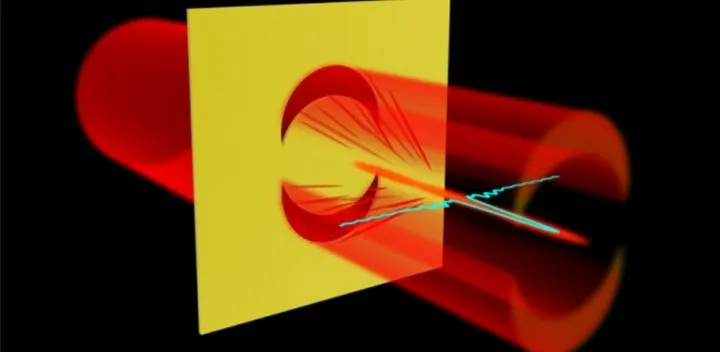
Optical superoscillation refers to a wave packet that can oscillate locally in a frequency exceeding its highest Fourier component. This intriguing phenomenon enables production of extremely localized waves that can break the optical diffraction barrier. Indeed, superoscillation has proven to be an effective technique for overcoming the diffraction barrier in optical superresolution imaging. The trouble is that strong side lobes accompany the main lobes of superoscillatory waves, which limits the field of view and hinders application.
There also are tradeoffs between the main lobes and the side lobes of superoscillatory wave packets: reducing the superoscillatory feature size of the main lobe comes at the cost of enlarging the side lobes. This happens mainly because superoscillation is a local phenomenon, yet the overall width of the wave packet is wider than the optical diffraction limit.
Precise engineering of the interference of diffracted light fields emitted from complex nanostructures can produce structural masks that enable significant optical superoscillation. But structural masks require optimization and complex fabrication, and the resulting light field is still limited by high-intensity side lobes. Producing superoscillatory waves with appreciable feature size while maintaining a larger field of view has remained challenging until now.
There also are tradeoffs between the main lobes and the side lobes of superoscillatory wave packets: reducing the superoscillatory feature size of the main lobe comes at the cost of enlarging the side lobes. This happens mainly because superoscillation is a local phenomenon, yet the overall width of the wave packet is wider than the optical diffraction limit.
Precise engineering of the interference of diffracted light fields emitted from complex nanostructures can produce structural masks that enable significant optical superoscillation. But structural masks require optimization and complex fabrication, and the resulting light field is still limited by high-intensity side lobes. Producing superoscillatory waves with appreciable feature size while maintaining a larger field of view has remained challenging until now.