Getting a good night’s sleep could boost your response to vaccination
Published 2023-03-13 · Original archive entry · Explore research explainers
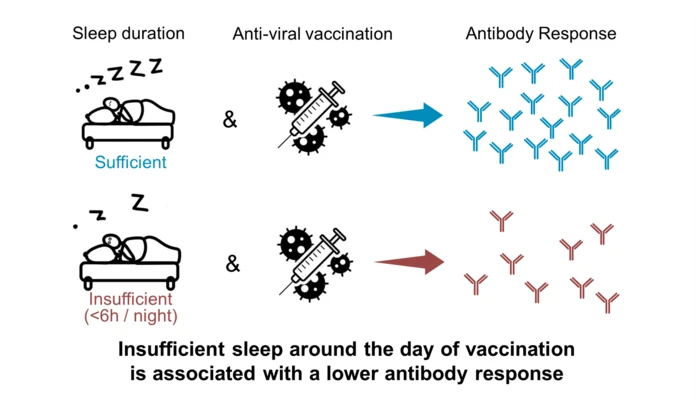
We all know how important sleep is for mental health, but a meta-analysis publishing in the journal Current Biology on March 13 found that getting good shut-eye also helps our immune systems respond to vaccination. The authors found that people who slept less than six hours per night produced significantly fewer antibodies than people who slept seven hours or more, and the deficit was equivalent to two months of antibody waning.
“Good sleep not only amplifies but may also extend the duration of protection of the vaccine,” says senior author Eve Van Cauter, professor emeritus at the University of Chicago who, along with lead author Karine Spiegel at the French National Institute of Health and Medicine, published a landmark study on the effects of sleep on vaccination in 2002.
When the COVID-19 pandemic hit, and mass-vaccination became an international priority, Spiegel and Van Cauter set out to summarize our current knowledge about the effect of sleep duration on vaccine response.
To do this, they combed the literature and then combined and re-analyzed the results of seven studies that vaccinated for viral infections (influenza and hepatitis A and B). In their analysis, the team compared the antibody response for individuals who slept a “normal” amount (7–9 hours, as per the National Sleep Foundation’s recommendation for healthy adults) with “short sleepers” who slept less than 6 hours per night. They compared the effect for men versus women and adults over the age of 65 years versus younger adults.
Overall, they found strong evidence that sleeping less than 6 hours per night reduces the immune response to vaccination. When they analyzed men and women separately, though, the result was only significant in men, and the effect of sleep duration on antibody production was much more variable in women. This difference is probably due to fluctuating sex hormone levels in women, the authors say.
“We know from immunology studies that sex hormones influence the immune system,” says Spiegel. “In women, immunity is influenced by the state of the menstrual cycle, the use of contraceptives, and by menopause and post-menopausal status, but unfortunately, none of the studies that we summarized had any data about sex hormone levels.”
The negative effect of insufficient sleep on antibody levels was also greater for adults aged 18–60 compared with people over the age of 65. This was not surprising because older adults tend to sleep less in general; going from seven hours of sleep per night to less than six hours is not as big of a change as going from eight hours to less than six per night.
Some of the studies measured sleep duration directly, either via motion-detecting wristwatches or in a sleep lab, while others relied on self-reported sleep duration. In both cases, short sleep duration was associated with lower levels of antibodies, but the effect was stronger for the studies that used objective measures of sleep, likely because people are notoriously bad at estimating the amount of sleep they have had.
Knowing that sleep duration impacts vaccination might give people some degree of control over their immunity, the authors say. “When you see the variability in protection provided by the COVID-19 vaccines—people who have pre-existing conditions are less protected, men are less protected than women, and obese people are less protected than people who don't have obesity. Those are all factors that an individual person has no control over, but you can modify your sleep,” says Van Cauter.
However, there’s a lot more to be known about sleep and vaccination, the authors say. “We need to understand the sex differences, which days around the time of vaccination are most important, and exactly how much sleep is needed so that we can give guidance to people,” says Spiegel. “We are going to be vaccinating millions and millions of people in the next few years, and this is an aspect that can help maximize protection.”
“Good sleep not only amplifies but may also extend the duration of protection of the vaccine,” says senior author Eve Van Cauter, professor emeritus at the University of Chicago who, along with lead author Karine Spiegel at the French National Institute of Health and Medicine, published a landmark study on the effects of sleep on vaccination in 2002.
When the COVID-19 pandemic hit, and mass-vaccination became an international priority, Spiegel and Van Cauter set out to summarize our current knowledge about the effect of sleep duration on vaccine response.
To do this, they combed the literature and then combined and re-analyzed the results of seven studies that vaccinated for viral infections (influenza and hepatitis A and B). In their analysis, the team compared the antibody response for individuals who slept a “normal” amount (7–9 hours, as per the National Sleep Foundation’s recommendation for healthy adults) with “short sleepers” who slept less than 6 hours per night. They compared the effect for men versus women and adults over the age of 65 years versus younger adults.
Overall, they found strong evidence that sleeping less than 6 hours per night reduces the immune response to vaccination. When they analyzed men and women separately, though, the result was only significant in men, and the effect of sleep duration on antibody production was much more variable in women. This difference is probably due to fluctuating sex hormone levels in women, the authors say.
“We know from immunology studies that sex hormones influence the immune system,” says Spiegel. “In women, immunity is influenced by the state of the menstrual cycle, the use of contraceptives, and by menopause and post-menopausal status, but unfortunately, none of the studies that we summarized had any data about sex hormone levels.”
The negative effect of insufficient sleep on antibody levels was also greater for adults aged 18–60 compared with people over the age of 65. This was not surprising because older adults tend to sleep less in general; going from seven hours of sleep per night to less than six hours is not as big of a change as going from eight hours to less than six per night.
Some of the studies measured sleep duration directly, either via motion-detecting wristwatches or in a sleep lab, while others relied on self-reported sleep duration. In both cases, short sleep duration was associated with lower levels of antibodies, but the effect was stronger for the studies that used objective measures of sleep, likely because people are notoriously bad at estimating the amount of sleep they have had.
Knowing that sleep duration impacts vaccination might give people some degree of control over their immunity, the authors say. “When you see the variability in protection provided by the COVID-19 vaccines—people who have pre-existing conditions are less protected, men are less protected than women, and obese people are less protected than people who don't have obesity. Those are all factors that an individual person has no control over, but you can modify your sleep,” says Van Cauter.
However, there’s a lot more to be known about sleep and vaccination, the authors say. “We need to understand the sex differences, which days around the time of vaccination are most important, and exactly how much sleep is needed so that we can give guidance to people,” says Spiegel. “We are going to be vaccinating millions and millions of people in the next few years, and this is an aspect that can help maximize protection.”
###
Current Biology, Spiegel et al. ‘Impact of sleep duration on the antibody response to vaccination: A meta-analysis’, https://www.cell.com/current-biology/fulltext/S0960-9822(23)00156-2
Current Biology (@CurrentBiology), published by Cell Press, is a bimonthly journal that features papers across all areas of biology. Current Biology strives to foster communication across fields of biology, both by publishing important findings of general interest and through highly accessible front matter for non-specialists. Visit: http://www.cell.com/current-biology. To receive Cell Press media alerts, contact press@cell.com.
END
Attachments