WVU researcher searching for ‘holy grail’ of sustainable bioenergy
Published 2023-05-18 · Original archive entry · Explore research explainers
Searches for sustainable bioenergy and climate change solutions may be one in the same, according to a West Virginia University researcher.
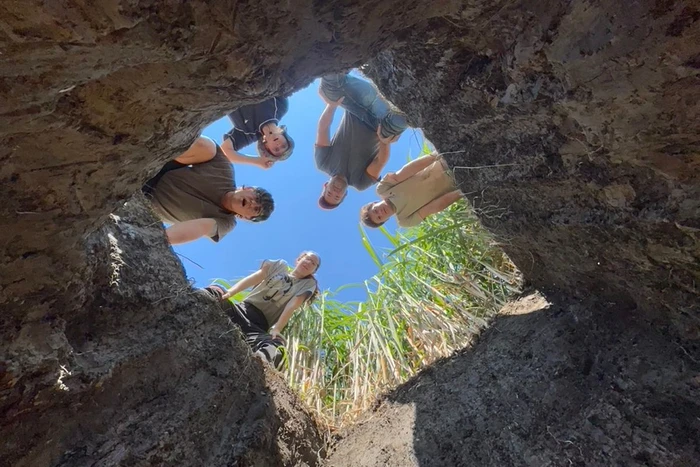
Edward Brzostek, associate professor of biology, and his students at the WVU Eberly College of Arts and Sciences are creating mathematical models to predict how bioenergy crops will enhance and store soil carbon through a renewed five-year grant from the U.S. Department of Energy.
Brzostek said he believes the models could present a “win-win” that not only improves soil carbon but spurs renewable bioenergy from biological sources. This includes biofuels like corn ethanol and perennial grasses.
Soil microbes in Brzostek’s model determine how plants might store or lose carbon in the future. That’s something current models haven’t taken into consideration.
“Our model can predict whether a bioenergy crop is going to be a net carbon benefit or actually result in carbon losses,” he said. Variables include whether living roots increase or decrease carbon in the soil and how the processes vary with depth and differences in feedstocks.
Natural climate solutions like regenerative agriculture can help mitigate the effects of climate change. Brzostek’s goal is to determine the most efficient way to facilitate the growth of biofuel sources while cleaning up the environment.
“We don't need any new technology to do this,” he said. “It’s one of the few ways that you can get carbon dioxide out of the atmosphere. The holy grail of bioenergy crops is to make products or fuel while also storing more carbon in the ecosystem. If you can grow a biofuel that enhances soil carbon, that’s a win-win.”
Capturing and storing carbon comes naturally to plants, which take it in through photosynthesis. When the plant dies, the leaf litter and dead root material stay in the soil. From there, different entities go to work on the decaying matter, the vast majority of which is decomposed by bacteria and fungi. When they die, their byproducts — including carbon — remain in the soil.
“It’s like a microbial funnel,” Brzostek said. “And a lot of the questions that we’re asking about soil carbon storage, agricultural management and predicting soil carbon into the future are germane to any ecosystem. They’re fundamental questions in ecology that are important to understanding whether our ecosystems can keep the carbon they have and potentially take up more.”
The research team is also looking at how plants help themselves.
“There’s this growing idea that plants can engineer their soil environment by doing things with their roots,” he said. “They can leak carbon out of their roots that feed the microbes. That makes the microbes happy. They break down soil carbon and then they give the plant nitrogen in return, which it needs to grow.”
Thus far, research has revealed that miscanthus roots can mine the nitrogen from leaf litter without leading to carbon being lost.
The microbes perform an essential role in the process. Fortunately, they’re ubiquitous.
“When you walk out in the forest in West Virginia, the microbes are eating everything,” Brzostek said. “If they weren’t, you’d be drowning in leaf litter.”
His research is carried out under the Center of Advanced Biofuels and Bioproducts Innovation, established in 2017 by the U.S. Department of Energy. CABBI, headquartered at the University of Illinois, brings together 20 partner institutions, universities and national laboratories to research sustainable bioproducts from bioenergy crops.
Decarbonizing the economy is complicated. Wind, solar and nuclear power are renewable, but some industries — like aviation — cannot be decarbonized.
“Bioenergy can play a part in the new bioeconomy,” Brzostek said. “We talk about bioenergy refineries and plants that could produce energy from some bioenergy crop. They’d capture the carbon dioxide and pump it underground. It could lead to a new green industry across much of the rain-fed United States, where you can grow these things.”
WVU students and postdoctoral researchers assisting Brzostek on the research include Joanna Ridgeway, Zoe Pagliaro, Dominick Cifelli, Jessica Burke, Noah Wauls and Stephanie Juice.
END
Edward Brzostek, associate professor of biology, and his students at the WVU Eberly College of Arts and Sciences are creating mathematical models to predict how bioenergy crops will enhance and store soil carbon through a renewed five-year grant from the U.S. Department of Energy.
Brzostek said he believes the models could present a “win-win” that not only improves soil carbon but spurs renewable bioenergy from biological sources. This includes biofuels like corn ethanol and perennial grasses.
Soil microbes in Brzostek’s model determine how plants might store or lose carbon in the future. That’s something current models haven’t taken into consideration.
“Our model can predict whether a bioenergy crop is going to be a net carbon benefit or actually result in carbon losses,” he said. Variables include whether living roots increase or decrease carbon in the soil and how the processes vary with depth and differences in feedstocks.
Natural climate solutions like regenerative agriculture can help mitigate the effects of climate change. Brzostek’s goal is to determine the most efficient way to facilitate the growth of biofuel sources while cleaning up the environment.
“We don't need any new technology to do this,” he said. “It’s one of the few ways that you can get carbon dioxide out of the atmosphere. The holy grail of bioenergy crops is to make products or fuel while also storing more carbon in the ecosystem. If you can grow a biofuel that enhances soil carbon, that’s a win-win.”
Capturing and storing carbon comes naturally to plants, which take it in through photosynthesis. When the plant dies, the leaf litter and dead root material stay in the soil. From there, different entities go to work on the decaying matter, the vast majority of which is decomposed by bacteria and fungi. When they die, their byproducts — including carbon — remain in the soil.
“It’s like a microbial funnel,” Brzostek said. “And a lot of the questions that we’re asking about soil carbon storage, agricultural management and predicting soil carbon into the future are germane to any ecosystem. They’re fundamental questions in ecology that are important to understanding whether our ecosystems can keep the carbon they have and potentially take up more.”
The research team is also looking at how plants help themselves.
“There’s this growing idea that plants can engineer their soil environment by doing things with their roots,” he said. “They can leak carbon out of their roots that feed the microbes. That makes the microbes happy. They break down soil carbon and then they give the plant nitrogen in return, which it needs to grow.”
Thus far, research has revealed that miscanthus roots can mine the nitrogen from leaf litter without leading to carbon being lost.
The microbes perform an essential role in the process. Fortunately, they’re ubiquitous.
“When you walk out in the forest in West Virginia, the microbes are eating everything,” Brzostek said. “If they weren’t, you’d be drowning in leaf litter.”
His research is carried out under the Center of Advanced Biofuels and Bioproducts Innovation, established in 2017 by the U.S. Department of Energy. CABBI, headquartered at the University of Illinois, brings together 20 partner institutions, universities and national laboratories to research sustainable bioproducts from bioenergy crops.
Decarbonizing the economy is complicated. Wind, solar and nuclear power are renewable, but some industries — like aviation — cannot be decarbonized.
“Bioenergy can play a part in the new bioeconomy,” Brzostek said. “We talk about bioenergy refineries and plants that could produce energy from some bioenergy crop. They’d capture the carbon dioxide and pump it underground. It could lead to a new green industry across much of the rain-fed United States, where you can grow these things.”
WVU students and postdoctoral researchers assisting Brzostek on the research include Joanna Ridgeway, Zoe Pagliaro, Dominick Cifelli, Jessica Burke, Noah Wauls and Stephanie Juice.
END
Attachments