First Contact: Global team simulates message from extraterrestrial intelligence to Earth
A Sign in Space imagines how Earth might respond to a signal from aliens and invites the public to help decode an ET message.
Published 2023-05-22 · Original archive entry · Explore research explainers
First Contact: Global team simulates message from extraterrestrial intelligence to Earth
A Sign in Space imagines how Earth might respond to a signal from aliens and invites the public to help decode an ET message.
May 22, 2023, Mountain View, CA – What would happen if we received a message from an extraterrestrial civilization? Daniela de Paulis, an established interdisciplinary artist and licensed radio operator who currently serves as Artist in Residence at the SETI Institute and the Green Bank Observatory, has brought together a team of international experts, including SETI researchers, space scientists, and artists, to stage her latest project, A Sign in Space. This revolutionary presentation of global theater aims to explore the process of decoding and interpreting an extraterrestrial message by engaging the worldwide SETI community, professionals from different fields and the broader public. This process requires global cooperation, bridging a conversation around SETI, space research and society across multiple cultures and areas of expertise.
As part of the project, on May 24, 2023, the European Space Agency’s ExoMars Trace Gas Orbiter (TGO) in orbit around Mars will transmit an encoded message to Earth to simulate receiving a signal from an extraterrestrial intelligence.
“Throughout history, humanity has searched for meaning in powerful and transformative phenomena,” said Daniela de Paulis, the visionary artist behind the A Sign in Space project. “Receiving a message from an extraterrestrial civilization would be a profoundly transformational experience for all humankind. A Sign in Space offers the unprecedented opportunity to tangibly rehearse and prepare for this scenario through global collaboration, fostering an open-ended search for meaning across all cultures and disciplines.”
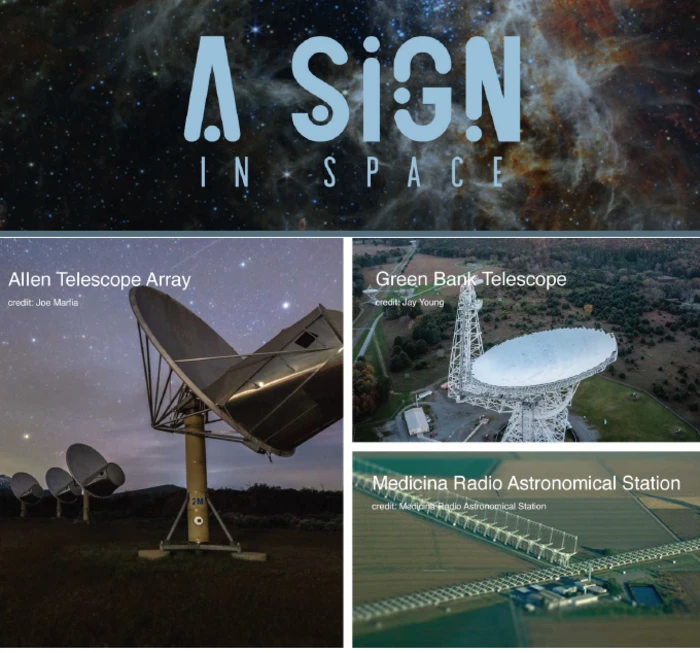
Three world-class radio astronomy observatories located across the globe will detect the encoded message. These include the SETI Institute’s Allen Telescope Array (ATA), the Robert C. Byrd Green Bank Telescope (GBT) at the Green Bank Observatory (GBO), and the Medicina Radio Astronomical Station observatory managed by Italian National Institute for Astrophysics (INAF). The specific content of the encoded message, developed by de Paulis and her team, is currently undisclosed, allowing the public to contribute to decoding and interpreting the content.
The ESA ExoMars Orbiter will transmit the encoded message on May 24 at 19:00 UTC / 12:00 pm PDT, with receipt on Earth 16 minutes later. To engage the public, the SETI Institute will host a social media live stream event featuring interviews with key team members, including scientists, engineers, artists and more, joining the live stream from around the world, including control rooms from the ATA, the GBT, and Medicina. Hosted by the SETI Institute’s Dr. Franck Marchis and GBO’s Victoria Catlett, the live stream event will begin at 11:15 am PDT here.
“This experiment is an opportunity for the world to learn how the SETI community, in all its diversity, will work together to receive, process, analyze, and understand the meaning of a potential extraterrestrial signal,” said ATA Project Scientist Dr. Wael Farah. “More than astronomy, communicating with ET will require a breadth of knowledge. With “A Sign in Space,” we hope to make the initial steps towards bringing a community together to meet this challenge.”
Following the transmission, ATA, GBT, and Medicina teams will process the signal and then make it available to the public for decoding.
The SETI Institute will securely store the processed data in collaboration with Breakthrough Listen Open Data Archive and Filecoin, the world’s largest decentralized storage network. This collaborative effort ensures the preservation and accessibility of the processed data, safeguarding its availability for further analysis and decoding endeavors.
“We’re thrilled to partner with SETI on this groundbreaking project,” said Stefaan Verveat, Head of Network Growth at Protocol Labs, the company behind Filecoin. “Our decentralized data storage solutions are ideally suited for the secure and reliable storage of the vast amounts of data generated by this project.”
Anyone working to decode and interpret the message can discuss the process in the A Sign in Space Discord server. Submissions of findings, thoughts, and artistic and scientific inputs may be made through the dedicated submission form on the project’s website: https://asignin.space/decode-the-message/
Following the transmission, the A Sign in Space team will host a series of Zoom-based discussions open to the public around topics that consider the societal implications of detecting a signal from an extraterrestrial civilization. The discussions will take place over 6-8 weeks after the transmission. A list of events with registration links is here.
More information about the project can be found at “A Sign in Space” website: https://asignin.space/.
About the SETI Institute
Founded in 1984, the SETI Institute is a non-profit, multi-disciplinary research and education organization whose mission is to lead humanity’s quest to understand the origins and prevalence of life and intelligence in the Universe and to share that knowledge with the world. Its research encompasses the physical and biological sciences and leverages expertise in data analytics, machine learning and advanced signal detection technologies. The SETI Institute is a distinguished research partner for industry, academia and government agencies, including NASA and NSF
About the Green Bank Observatory
The Green Bank Telescope is operated by the Green Bank Observatory, a major facility of the National Science Foundation operated under cooperative agreement by Associated Universities, Inc.
About INAF and the Medicina Radio Astronomical Station
The Italian National Institute for Astrophysics, INAF, is the main Italian public research institute dedicated to the study of the Universe. It is present throughout Italy with 16 research facilities and the headquarters in Rome, as well as the Galileo National Telescope in the Canary Islands. Besides optical observatories, INAF manages three radio telescopes in Italy. The Medicina Radio Astronomical Station, located 30 km from Bologna, hosts two radio telescopes: the first Italian radio telescope, the Northern Cross (owned by the University of Bologna) and a 32-m parabolic dish. A second 32-m parabolic antenna, very similar to the Medicina one, is located in Noto (Siracusa, Sicily). More recently, the Sardinia Radio Telescope (SRT) was inaugurated in San Basilio (Cagliari, Sardinia) with a 64-m dish antenna.
About the European Space Agency
The European Space Agency (ESA) is Europe’s gateway to space.
ESA is an international organization, created in 1975, with the mission to shape the development of Europe’s space capability and ensure that investment in space delivers benefits to the citizens of Europe and the world. Today, it launches satellites for Earth observation, navigation, telecommunications and astronomy, sends probes to the far reaches of the Solar System, and cooperates in the human exploration of space. ESA develops the launchers, spacecraft, and ground facilities needed to keep Europe at the forefront of global space activities.
About Filecoin
Filecoin, the world’s largest decentralized storage network, enables users to store, request, and transfer data via a verifiable marketplace. Filecoin’s advanced technology provides a robust foundation to store the world’s most valuable datasets. An alternative to costly cloud storage, the Filecoin network offers efficiently priced and geographically decentralized storage, minimizing financial barriers and allowing users to take advantage of its unmatched network capabilities. Filecoin is completely open source, enabling people from all over the world to participate. For more information about Filecoin, please visit https://filecoin.io/
END
A Sign in Space imagines how Earth might respond to a signal from aliens and invites the public to help decode an ET message.
May 22, 2023, Mountain View, CA – What would happen if we received a message from an extraterrestrial civilization? Daniela de Paulis, an established interdisciplinary artist and licensed radio operator who currently serves as Artist in Residence at the SETI Institute and the Green Bank Observatory, has brought together a team of international experts, including SETI researchers, space scientists, and artists, to stage her latest project, A Sign in Space. This revolutionary presentation of global theater aims to explore the process of decoding and interpreting an extraterrestrial message by engaging the worldwide SETI community, professionals from different fields and the broader public. This process requires global cooperation, bridging a conversation around SETI, space research and society across multiple cultures and areas of expertise.
As part of the project, on May 24, 2023, the European Space Agency’s ExoMars Trace Gas Orbiter (TGO) in orbit around Mars will transmit an encoded message to Earth to simulate receiving a signal from an extraterrestrial intelligence.
“Throughout history, humanity has searched for meaning in powerful and transformative phenomena,” said Daniela de Paulis, the visionary artist behind the A Sign in Space project. “Receiving a message from an extraterrestrial civilization would be a profoundly transformational experience for all humankind. A Sign in Space offers the unprecedented opportunity to tangibly rehearse and prepare for this scenario through global collaboration, fostering an open-ended search for meaning across all cultures and disciplines.”
Three world-class radio astronomy observatories located across the globe will detect the encoded message. These include the SETI Institute’s Allen Telescope Array (ATA), the Robert C. Byrd Green Bank Telescope (GBT) at the Green Bank Observatory (GBO), and the Medicina Radio Astronomical Station observatory managed by Italian National Institute for Astrophysics (INAF). The specific content of the encoded message, developed by de Paulis and her team, is currently undisclosed, allowing the public to contribute to decoding and interpreting the content.
The ESA ExoMars Orbiter will transmit the encoded message on May 24 at 19:00 UTC / 12:00 pm PDT, with receipt on Earth 16 minutes later. To engage the public, the SETI Institute will host a social media live stream event featuring interviews with key team members, including scientists, engineers, artists and more, joining the live stream from around the world, including control rooms from the ATA, the GBT, and Medicina. Hosted by the SETI Institute’s Dr. Franck Marchis and GBO’s Victoria Catlett, the live stream event will begin at 11:15 am PDT here.
“This experiment is an opportunity for the world to learn how the SETI community, in all its diversity, will work together to receive, process, analyze, and understand the meaning of a potential extraterrestrial signal,” said ATA Project Scientist Dr. Wael Farah. “More than astronomy, communicating with ET will require a breadth of knowledge. With “A Sign in Space,” we hope to make the initial steps towards bringing a community together to meet this challenge.”
Following the transmission, ATA, GBT, and Medicina teams will process the signal and then make it available to the public for decoding.
The SETI Institute will securely store the processed data in collaboration with Breakthrough Listen Open Data Archive and Filecoin, the world’s largest decentralized storage network. This collaborative effort ensures the preservation and accessibility of the processed data, safeguarding its availability for further analysis and decoding endeavors.
“We’re thrilled to partner with SETI on this groundbreaking project,” said Stefaan Verveat, Head of Network Growth at Protocol Labs, the company behind Filecoin. “Our decentralized data storage solutions are ideally suited for the secure and reliable storage of the vast amounts of data generated by this project.”
Anyone working to decode and interpret the message can discuss the process in the A Sign in Space Discord server. Submissions of findings, thoughts, and artistic and scientific inputs may be made through the dedicated submission form on the project’s website: https://asignin.space/decode-the-message/
Following the transmission, the A Sign in Space team will host a series of Zoom-based discussions open to the public around topics that consider the societal implications of detecting a signal from an extraterrestrial civilization. The discussions will take place over 6-8 weeks after the transmission. A list of events with registration links is here.
More information about the project can be found at “A Sign in Space” website: https://asignin.space/.
About the SETI Institute
Founded in 1984, the SETI Institute is a non-profit, multi-disciplinary research and education organization whose mission is to lead humanity’s quest to understand the origins and prevalence of life and intelligence in the Universe and to share that knowledge with the world. Its research encompasses the physical and biological sciences and leverages expertise in data analytics, machine learning and advanced signal detection technologies. The SETI Institute is a distinguished research partner for industry, academia and government agencies, including NASA and NSF
About the Green Bank Observatory
The Green Bank Telescope is operated by the Green Bank Observatory, a major facility of the National Science Foundation operated under cooperative agreement by Associated Universities, Inc.
About INAF and the Medicina Radio Astronomical Station
The Italian National Institute for Astrophysics, INAF, is the main Italian public research institute dedicated to the study of the Universe. It is present throughout Italy with 16 research facilities and the headquarters in Rome, as well as the Galileo National Telescope in the Canary Islands. Besides optical observatories, INAF manages three radio telescopes in Italy. The Medicina Radio Astronomical Station, located 30 km from Bologna, hosts two radio telescopes: the first Italian radio telescope, the Northern Cross (owned by the University of Bologna) and a 32-m parabolic dish. A second 32-m parabolic antenna, very similar to the Medicina one, is located in Noto (Siracusa, Sicily). More recently, the Sardinia Radio Telescope (SRT) was inaugurated in San Basilio (Cagliari, Sardinia) with a 64-m dish antenna.
About the European Space Agency
The European Space Agency (ESA) is Europe’s gateway to space.
ESA is an international organization, created in 1975, with the mission to shape the development of Europe’s space capability and ensure that investment in space delivers benefits to the citizens of Europe and the world. Today, it launches satellites for Earth observation, navigation, telecommunications and astronomy, sends probes to the far reaches of the Solar System, and cooperates in the human exploration of space. ESA develops the launchers, spacecraft, and ground facilities needed to keep Europe at the forefront of global space activities.
About Filecoin
Filecoin, the world’s largest decentralized storage network, enables users to store, request, and transfer data via a verifiable marketplace. Filecoin’s advanced technology provides a robust foundation to store the world’s most valuable datasets. An alternative to costly cloud storage, the Filecoin network offers efficiently priced and geographically decentralized storage, minimizing financial barriers and allowing users to take advantage of its unmatched network capabilities. Filecoin is completely open source, enabling people from all over the world to participate. For more information about Filecoin, please visit https://filecoin.io/
END
Attachments