PRESS-NEWS.org - Press Release Distribution
PRESS RELEASES DISTRIBUTION

Multicyclic molecular wheels with polymer potential

Multicyclic molecular wheels with polymer potential
2023-08-02
(Press-News.org) Molecules that act as connected wheels can hold long molecular chains together to modify the properties of soft polymers.

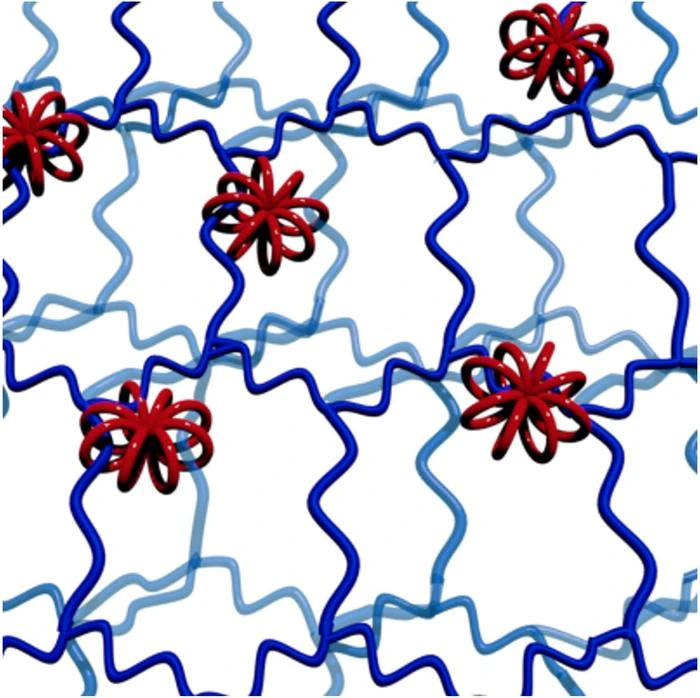
Rotaxanes are interlocked molecular structures with a linear ‘axle’ molecule penetrating one or more cyclic ‘wheel’ molecules. Bulky groups at the end of the axle prevent the wheels from coming off. Now, researchers at Hokkaido University have taken the previous achievements of this technology a step further, making macro-rotaxanes that have multicyclic wheels interlocked with several high-molecular-weight axles. They report their innovation in the journal Angewandte Chemie International Edition.

Rotaxanes, initially regarded as intriguing chemical curiosities, are now being explored for a wide range of potential applications, ranging from next-generation polymers to ambitious possibilities in molecular computing, sensor technologies and drug delivery.

The Hokkaido University researchers, with collaborators elsewhere in Japan, are focusing their attention on making new network polymers, in which ring structures more complex than simple circles hold together different strands of long polymer chains. 

“We think the multicyclic structures in these macro-rotaxanes could be useful as non-leaching additives, permanently retained in a polymer network by the way they hold onto several neighboring polymer chains,” says polymer chemist Professor Toshifumi Satoh of the Hokkaido team.

The 3D wheels act as a unique and highly flexible form of molecular crosslinks, allowing the wheels and the interlocked polymer strands much more freedom of movement than in conventionally cross-linked networks. Structural variations should allow fine control over the properties of soft materials to make them suitable for a variety of industrial and medical applications.

Other research groups have achieved some similar success with smaller molecular arrangements, but the advances at Hokkaido University move the field into the realm of larger molecules.

The researchers explored some of the possibilities of this significant new development in polymer chemistry using chemicals called polydimethylsiloxanes (PDMSs) to make the multicyclic rings. They were able to build different numbers of cyclic units with rings of different sizes. When combined with silicone polymer chains with short crosslinking agents, the multicyclic units became efficiently incorporated into a newly-forming extended, mixed and interlocked network. 

“We explored some of the potential for making modified soft materials by measuring the damping performance of the networks, which is essentially the ability of a material to absorb and reduce vibrations,” says Satoh. “This revealed that our macro-rotaxanes achieved significant improvements in damping efficiency relative to conventional polymer networks.”

Satoh and his colleagues now plan to explore further possibilities that can be built on the proof-of-concept foundations laid by their current progress.

END

[Attachments] See images for this press release:
Multicyclic molecular wheels with polymer potential Multicyclic molecular wheels with polymer potential 2

ELSE PRESS RELEASES FROM THIS DATE:

AI-supported mammography screening is found to be safe

2023-08-02
Mammography screening supported by artificial intelligence (AI) is a safe alternative to today’s conventional double reading by radiologists and can reduce heavy workloads for doctors. This has now been shown in an interim analysis of a prospective, randomised controlled trial, which addressed the clinical safety of using AI in mammography screening. The trial, led by researchers from Lund University in Sweden, has been published in The Lancet Oncology.  Each year around one million women in Sweden are called to mammography screening. Each screening examination is reviewed by two breast radiologists to ensure a high sensitivity, so called double reading. ...

Decades of research have left knowledge gaps about cells that regulate the immune system: Purdue and NIH

Decades of research have left knowledge gaps about cells that regulate the immune system: Purdue and NIH
2023-08-02
Decades of research have left knowledge gaps about cells that regulate the immune system: Purdue and NIH Four decades of research have produced a vast pool of knowledge about regulatory T cells, a subset of our immune cells. Even so, scientists at Purdue University and the National Institutes of Health have identified 14 understudied T-reg proteins that merit increased attention for the molecular roles they play in disease onset. “Our lab studies the exact molecular mechanism underlying autoimmunity, infection and cancer,” said Majid Kazemian, associate professor of biochemistry in the College of Agriculture ...

Reducing the risks of nuclear war—the role of health professionals

2023-08-02
About The Editorial: In this editorial, JAMA and JAMA Network journals join journals worldwide to call on health professionals to warn the public about the major danger to health and essential life support systems posed by the threat of nuclear war and urge action to prevent use of nuclear weapons. Authors: Chris Zielinski, of the University of Winchester, U.K., and World Association of Medical Editors, is the corresponding author. To access the embargoed study: Visit our For The Media website at this ...

Early-stage cancer diagnoses decreased sharply in the U.S. during first year of COVID-19 pandemic; underserved greatly affected

Early-stage cancer diagnoses decreased sharply in the U.S. during first year of COVID-19 pandemic; underserved greatly affected
2023-08-02
ATLANTA, August 1, 2023 – A new study from researchers at the American Cancer Society (ACS) found monthly adult cancer diagnoses decreased by half in April 2020 during the COVID-19 pandemic in the United States. The largest decrease was for stage I cancers, resulting in a higher proportion of late-stage diagnoses. The study is the most comprehensive research to date about the effects of the first year of the pandemic on cancer diagnoses and stage in the nation. The paper was published today in the ...

Results of large pragmatic trial will help guide treatment of malignant bowel obstruction in patients with advanced cancer

2023-08-02
Findings from the first-ever prospective trial including a randomized pathway comparing surgery to non-surgical treatment of malignant bowel obstruction (MBO) provide important evidence to help inform clinical decision-making in managing this frequent complication in patients with advanced cancer. Results include data on clinical outcomes and patient quality of life and are being reported in The Lancet Gastroenterology & Hepatology. The S1316 study, a hybrid design trial that included a randomized component, was led by the SWOG Cancer Research Network, a clinical trials group funded by the National Cancer Institute ...

THE LANCET ONCOLOGY: First randomised trial finds AI-supported mammography screening is safe and almost halved radiologist workload

2023-08-02
Peer-reviewed / Randomised trial / People Planned interim safety analysis of the first randomised trial investigating the use of AI in a national breast cancer screening programme underscores the potential of AI to make mammography screening more accurate and efficient. Interim findings from a cohort of over 80,000 women in Sweden reveal AI-supported screening detected 20% more cancers compared with the routine double reading of mammograms by two breast radiologists. The use of AI did not increase false positives (when a mammogram ...

Royal Ontario Museum researchers identify oldest known species of swimming jellyfish

Royal Ontario Museum researchers identify oldest known species of swimming jellyfish
2023-08-02
Royal Ontario Museum (ROM) announces the oldest swimming jellyfish in the fossil record with the newly named Burgessomedusa phasmiformis. These findings are announced in the journal Proceedings of the Royal Society B.   Jellyfish belong to medusozoans, or animals producing medusae, and include today’s box jellies, hydroids, stalked jellyfish and true jellyfish. Medusozoans are part of one of the oldest groups of animals to have existed, called Cnidaria, a group which also includes ...

Earth’s most ancient impact craters are disappearing

Earth’s most ancient impact craters are disappearing
2023-08-01
This press release is available online at: https://news.agu.org/press-release/earths-most-ancient-impact-craters-are-disappearing/ AGU press contact: Rebecca Dzombak, news@agu.org (UTC-4 hours) Contact information for the researchers: Matthew S. Huber, University of the Western Cape, mhuber@uwc.ac.za (UTC+2 hours) WASHINGTON — Earth’s oldest craters could give scientists critical information about the structure of the early Earth and the composition of bodies in the solar system as well as help to interpret crater records on other ...

Sea level rise shifts habitat for endangered Florida Keys species

2023-08-01
The silver rice rat, an endangered species endemic to the Florida Keys, makes its home as close to the shoreline as possible for easy access to its low-tide marine species diet. It is this proximity to the water that prompted a team of scientists at the University of Florida to examine the rats’ movement in correlation with historical tidal data over 17 years. The sea level rose 0.142 meters between 2004 and 2021, and the researchers also found that the rats moved to higher ground. In fact, the rats ...

Pecans give obesity and diabetes a slim chance

2023-08-01
By Adam Russell   A new research study shows pecans may help prevent obesity and reduce inflammation. (Texas A&M AgriLife photo by Laura McKenzie) “Obesity and diabetes numbers are increasing in modern society worldwide, and the trend in high fat diet consumption is one of the main reasons besides lifestyle and genetic predisposition,” said Luis Cisneros-Zevallos, Ph.D., professor of horticulture and food science in the Department of Horticultural Sciences in the Texas A&M College of Agriculture and ...

LAST 30 PRESS RELEASES:

Making lighter work of calculating fluid and heat flow

Normalizing blood sugar can halve heart attack risk

Lowering blood sugar cuts heart attack risk in people with prediabetes

Study links genetic variants to risk of blinding eye disease in premature infants

Non-opioid ‘pain sponge’ therapy halts cartilage degeneration and relieves chronic pain

AI can pick up cultural values by mimicking how kids learn

China’s ecological redlines offer fast track to 30 x 30 global conservation goal

Invisible indoor threats: emerging household contaminants and their growing risks to human health

Adding antibody treatment to chemo boosts outcomes for children with rare cancer

Germline pathogenic variants among women without a history of breast cancer

Tanning beds triple melanoma risk, potentially causing broad DNA damage

Unique bond identified as key to viral infection speed

Indoor tanning makes youthful skin much older on a genetic level

Mouse model sheds new light on the causes and potential solutions to human GI problems linked to muscular dystrophy

The Journal of Nuclear Medicine ahead-of-print tip sheet: December 12, 2025

Smarter tools for peering into the microscopic world

Applications open for funding to conduct research in the Kinsey Institute archives

Global measure underestimates the severity of food insecurity

Child survivors of critical illness are missing out on timely follow up care

Risk-based vs annual breast cancer screening / the WISDOM randomized clinical trial

University of Toronto launches Electric Vehicle Innovation Ontario to accelerate advanced EV technologies and build Canada’s innovation advantage

Early relapse predicts poor outcomes in aggressive blood cancer

American College of Lifestyle Medicine applauds two CMS models aligned with lifestyle medicine practice and reimbursement

Clinical trial finds cannabis use not a barrier to quitting nicotine vaping

Supplemental nutrition assistance program policies and food insecurity

Switching immune cells to “night mode” could limit damage after a heart attack, study suggests

URI-based Global RIghts Project report spotlights continued troubling trends in worldwide inhumane treatment

Neutrophils are less aggressive at night, explaining why nighttime heart attacks cause less damage than daytime events

Menopausal hormone therapy may not pose breast cancer risk for women with BRCA mutations

Mobile health tool may improve quality of life for adolescent and young adult breast cancer survivors

[Press-News.org] Multicyclic molecular wheels with polymer potential