Growing triple-decker hybrid crystals for lasers
Collaboration between Duke and Purdue explores the fabrication and optoelectronic characterization of multilayered perovskites
Published 2023-08-31 · Original archive entry · Explore research explainers
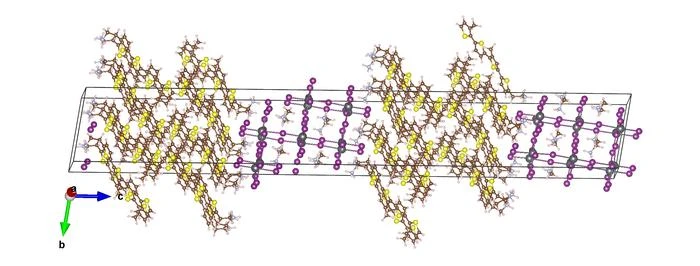
By controlling the arrangement of multiple inorganic and organic layers within crystals using a novel technique, researchers at Duke University and Purdue University have shown they can control the energy levels of electrons and holes (positive charge carriers) within a class of materials called perovskites. This tuning influences the materials’ optoelectronic properties and their ability to emit light of specific energies, demonstrated by their ability to function as a source of lasers.
Appearing online August 31 in the journal Nature Chemistry, the research is the result of a close collaboration between several experimental and theoretical teams. The experimental teams synthesize the materials and characterize their properties, while the theoretical team performs computational simulations to predict the electronic structure and properties of the materials.
One important foundation of the computational work is a long-standing investment into the creation of computational simulation codes for materials properties. “We’ve invested almost 20 years into being able to make these kinds of calculations in larger systems,” said Volker Blum, associate professor of mechanical engineering and materials science at Duke. “This study involved simulating structures including up to around 900 atoms with an advanced methodology, which requires powerful supercomputers that can handle some of the largest calculations on the planet.”
Perovskite materials are a class of compounds that have gained significant attention in the field of materials science due to their unique properties, particularly in the area of semiconductors. These materials, which are defined by their specific crystalline structure, can be used in applications like light-emitting diodes (LEDs), solar cells and lasers.
The paper focuses on refining the structural control of layered perovskite materials with organic semiconductor incorporation. While these types of perovskites have been made before with single layers of organic and inorganic components (including in pioneering research by David B. Mitzi, who is now a Duke professor), the ability to precisely control the thickness of the inorganic component and, thus, adjust the properties of the material, has remained elusive for these more complex “organic semiconductor incorporated perovskites”.
According to their findings, the organic components added to the inorganic layers affect the semiconductor properties, such as energy levels and light emission. By carefully controlling the arrangement of atoms and the number of layers in these structures, the researchers can tune the optical and electronic properties of the resulting material.
Their research also addresses challenges in synthesizing these materials, including the need to mix different components that may not readily dissolve in the same solvent, like trying to mix oil and salt into water. Achieving precise layering and alignment in larger structures becomes more complex.
“It’s like taking salt and olive oil and trying to mix it into water,” Blum explained. “One dissolves and the other does not. And if you try to use gasoline instead of water, you end up with the same problem. Our collaborators were able to find a way to get both into solution and dry into ordered crystals, and we were able to model those crystals to help explain how they function.”
While Blum led the effort to computationally simulate and characterize these materials, Letian Dou, the Charles Davidson Associate Professor of Chemical Engineering at Purdue University, led the overall effort to synthesize and characterize these layered perovskite structures.
This work was supported by the National Science Foundation (2110706-DMR, DMR-1729297, CHE 1625543), the Department of Energy (DE-SC0022082, DE-AC02-05CH11231, DE-AC02-05CH11231), and the New Cornerstone Science Foundation.
“Thickness control of organic semiconductor-incorporated perovskites.” Jee Yung Park, Ruyi Song, Jie Liang, Linrui Jin, Kang Wang, Shunran Li, Enzheng Shi, Yao Gao, Matthias Zeller, Simon J. Teat, Peijun Guo, Libai Huang, Yong Sheng Zhao, Volker Blum & Letian Dou. Nature Chemistry, August 31, 2023. DOI: 10.1038/s41557-023-01311-0
END
Appearing online August 31 in the journal Nature Chemistry, the research is the result of a close collaboration between several experimental and theoretical teams. The experimental teams synthesize the materials and characterize their properties, while the theoretical team performs computational simulations to predict the electronic structure and properties of the materials.
One important foundation of the computational work is a long-standing investment into the creation of computational simulation codes for materials properties. “We’ve invested almost 20 years into being able to make these kinds of calculations in larger systems,” said Volker Blum, associate professor of mechanical engineering and materials science at Duke. “This study involved simulating structures including up to around 900 atoms with an advanced methodology, which requires powerful supercomputers that can handle some of the largest calculations on the planet.”
Perovskite materials are a class of compounds that have gained significant attention in the field of materials science due to their unique properties, particularly in the area of semiconductors. These materials, which are defined by their specific crystalline structure, can be used in applications like light-emitting diodes (LEDs), solar cells and lasers.
The paper focuses on refining the structural control of layered perovskite materials with organic semiconductor incorporation. While these types of perovskites have been made before with single layers of organic and inorganic components (including in pioneering research by David B. Mitzi, who is now a Duke professor), the ability to precisely control the thickness of the inorganic component and, thus, adjust the properties of the material, has remained elusive for these more complex “organic semiconductor incorporated perovskites”.
According to their findings, the organic components added to the inorganic layers affect the semiconductor properties, such as energy levels and light emission. By carefully controlling the arrangement of atoms and the number of layers in these structures, the researchers can tune the optical and electronic properties of the resulting material.
Their research also addresses challenges in synthesizing these materials, including the need to mix different components that may not readily dissolve in the same solvent, like trying to mix oil and salt into water. Achieving precise layering and alignment in larger structures becomes more complex.
“It’s like taking salt and olive oil and trying to mix it into water,” Blum explained. “One dissolves and the other does not. And if you try to use gasoline instead of water, you end up with the same problem. Our collaborators were able to find a way to get both into solution and dry into ordered crystals, and we were able to model those crystals to help explain how they function.”
While Blum led the effort to computationally simulate and characterize these materials, Letian Dou, the Charles Davidson Associate Professor of Chemical Engineering at Purdue University, led the overall effort to synthesize and characterize these layered perovskite structures.
This work was supported by the National Science Foundation (2110706-DMR, DMR-1729297, CHE 1625543), the Department of Energy (DE-SC0022082, DE-AC02-05CH11231, DE-AC02-05CH11231), and the New Cornerstone Science Foundation.
“Thickness control of organic semiconductor-incorporated perovskites.” Jee Yung Park, Ruyi Song, Jie Liang, Linrui Jin, Kang Wang, Shunran Li, Enzheng Shi, Yao Gao, Matthias Zeller, Simon J. Teat, Peijun Guo, Libai Huang, Yong Sheng Zhao, Volker Blum & Letian Dou. Nature Chemistry, August 31, 2023. DOI: 10.1038/s41557-023-01311-0
END