Benefit breakdown, 3D printed vs. wood molds
Published 2023-09-21 · Original archive entry · Explore research explainers
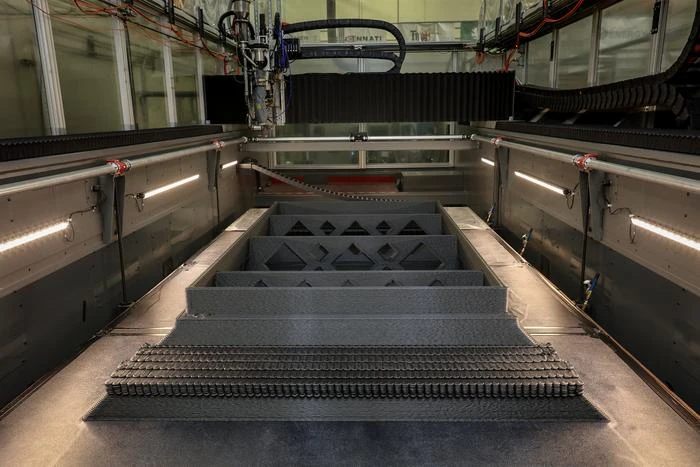
Oak Ridge National Laboratory researchers have conducted a comprehensive life cycle, cost and carbon emissions analysis on 3D-printed molds for precast concrete and determined the method is economically beneficial compared to conventional wood molds.
Precast concrete is used in building construction and produced by pouring the material into a reusable mold. For decades, these molds have been made from wood — a technique that requires a highly specialized skillset. As an alternative, molds made from fiber-reinforced polymer composites can be 3D printed.
“We developed a techno-economic model that compared costs associated with each method, evaluating materials, equipment, energy and labor,” ORNL’s Kristina Armstrong said. “3D printing can make complex molds faster, and the composites can be recycled, leading to more economical molds when used many times for precast concrete parts.”
Optimizing mold designs also reduces energy demand and carbon emissions. Future studies will further evaluate the recycling impact.
END
Attachments