Discovering a new mechanism of vestibular neuritis
Autoimmunity as a mechanism of vestibular neuritis
Published 2024-01-09 · Original archive entry · Explore research explainers

Prof. Sun-Uk Lee of the Department of Neurology and Prof. Euyhyun Park of the Department of Otorhinolaryngology from Korea University’s Anam Hospital discovered a new mechanism of vestibular neuritis.
Vestibular neuritis is one of the common diseases causing acute dizziness. It is known to be caused by an inflammation in the vestibular nerve and inner ear, which is responsible for balance and body motion sensation.
Various mechanisms had been suggesting as the cause of vestibular neuritis, such as reactivation of latent herpes virus or peripheral blood circulation disorder in the inner ear, but the exact cause largely remained to be elucidated.
with Prof. Lee and Park, working elaborately as a team (The Neurotology and Neuro-ophthalmology Laboratory of Korea University’s Anam Hospital) recently introduced the association between the anti-GQ1b antibodies and vestibular neuritis.
The ganglioside antigen is distributed throughout the central nervous system, including the human vestibular nerve and various cranial nerves, and anti-ganglioside antibody is known to cause various neurological symptoms by attacking ganglioside cells present between nerve cell membranes. Among those, GQ1b is found mostly in cranial nerve responsible for ocular motility. Thus, when an autoimmunity arises targeting those antigens, patients usually present with double vision as a constellating symptom of ‘anti-GQ1b antibody syndrome’. Based on prior literature, Prof. Lee found that GQ1b antigen are also widely expressed in the vestibular nerve and cell body, which provided insights for the current research.
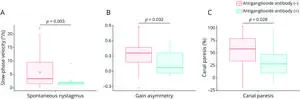
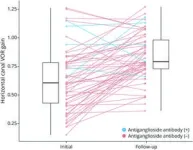
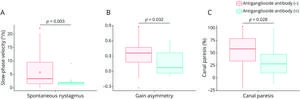
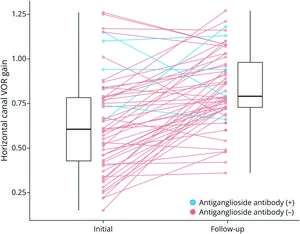
The research team analyzed 105 patients with vestibular neuritis who had acute dizziness and visited Korea University’s Anam Hospital from 2019 to 2023. 11% of these patients were confirmed antiganglioside antibody positive. Compared those not having these antibodis, bilateral vestibular damage was observed in 33% of the patients with those antibodies. The antibody converted negativealong with improvement of the functional deficits of vestibular nerve.
The research team explained, “The fact that autoimmunity plays a role for the development of acute dizziness,may help understand the mechanisms of other various vestibular disorders, too. We anticipate that this research may be a future springboard for immunotherapy in patients presenting with acute vestibular syndrome.”
Prof. Sun-Uk Lee, the leading author of this research said, “Acute dizziness causes great discomfort to patients and is also difficult to properly be diagnosed, depleting many resources for both patients and society. We hope our research may help patients suffering from dizziness. As the association being confirmed clinically, follow-up research will be conducted how to incorporate these results into treatment.”
This research was published in Neurology, the most prestigious American academic journal in the field of clinical neurology, and attracting attention from academia under the title of “Clinical features and neurotological findings in patients with acute unilateral peripheral vestibulopathy associated with antiganglioside antibody.”
END
Vestibular neuritis is one of the common diseases causing acute dizziness. It is known to be caused by an inflammation in the vestibular nerve and inner ear, which is responsible for balance and body motion sensation.
Various mechanisms had been suggesting as the cause of vestibular neuritis, such as reactivation of latent herpes virus or peripheral blood circulation disorder in the inner ear, but the exact cause largely remained to be elucidated.
with Prof. Lee and Park, working elaborately as a team (The Neurotology and Neuro-ophthalmology Laboratory of Korea University’s Anam Hospital) recently introduced the association between the anti-GQ1b antibodies and vestibular neuritis.
The ganglioside antigen is distributed throughout the central nervous system, including the human vestibular nerve and various cranial nerves, and anti-ganglioside antibody is known to cause various neurological symptoms by attacking ganglioside cells present between nerve cell membranes. Among those, GQ1b is found mostly in cranial nerve responsible for ocular motility. Thus, when an autoimmunity arises targeting those antigens, patients usually present with double vision as a constellating symptom of ‘anti-GQ1b antibody syndrome’. Based on prior literature, Prof. Lee found that GQ1b antigen are also widely expressed in the vestibular nerve and cell body, which provided insights for the current research.
The research team analyzed 105 patients with vestibular neuritis who had acute dizziness and visited Korea University’s Anam Hospital from 2019 to 2023. 11% of these patients were confirmed antiganglioside antibody positive. Compared those not having these antibodis, bilateral vestibular damage was observed in 33% of the patients with those antibodies. The antibody converted negativealong with improvement of the functional deficits of vestibular nerve.
The research team explained, “The fact that autoimmunity plays a role for the development of acute dizziness,may help understand the mechanisms of other various vestibular disorders, too. We anticipate that this research may be a future springboard for immunotherapy in patients presenting with acute vestibular syndrome.”
Prof. Sun-Uk Lee, the leading author of this research said, “Acute dizziness causes great discomfort to patients and is also difficult to properly be diagnosed, depleting many resources for both patients and society. We hope our research may help patients suffering from dizziness. As the association being confirmed clinically, follow-up research will be conducted how to incorporate these results into treatment.”
This research was published in Neurology, the most prestigious American academic journal in the field of clinical neurology, and attracting attention from academia under the title of “Clinical features and neurotological findings in patients with acute unilateral peripheral vestibulopathy associated with antiganglioside antibody.”
END
Attachments