Rice’s Santiago Segarra wins NSF CAREER Award
Research aims to leverage properties of real-world data to boost AI utility
Published 2024-02-07 · Original archive entry · Explore research explainers
HOUSTON – (Feb. 7, 2024) – Artificial intelligence is good at many tasks involving data in the form of text, audio and images, including face recognition and text summarization.
“AI is an amazing tool and has been extended over less conventional domains, such as climate data defined on spheres (representing the Earth) and traffic data defined on road networks,” said Santiago Segarra, assistant professor of electrical and computer engineering and statistics.
With his five-year, $599,138 CAREER Award from the National Science Foundation, Segarra intends to study the use of graphs to represent these less conventional domains, since AI tools designed to be implemented in any graph necessarily disregard the structure of specific graphs of interest.
The highly competitive five-year NSF grants are given to early career faculty members who demonstrate the potential to serve as academic models and leaders in research and education. The NSF gives about 500 such awards across all disciplines each year.
Traffic data that changes over time, Segarra said, can be represented on a structured graph that combines the underlying road network with the linear evolution of time. His research will focus on classes of graphs with structural properties that are both practically relevant ⎯ representing real-world data domains ⎯ and methodologically advantageous in that they can be exploited to better learn from the data.
“Our aim is to boost the utility of AI by leveraging structural properties often found in real-world data,” Segarra said. “One of the many applications for this sort of research is climate prediction.”
The project will draw upon graph theory, machine learning, algebraic topology, signal processing, deep learning and integral linear operators to achieve an understanding of learning in structured domains.
Segarra earned his Ph.D. in electrical and systems engineering at the University of Pennsylvania in 2016. After two years as a postdoctoral research associate at the Institute for Data, Systems and Society at MIT, he joined the Rice faculty in 2018.
-30-
This release was authored by Patrick Kurp and can be found online at news.rice.edu.
Follow Rice News and Media Relations via Twitter @RiceUNews.
Award information:
https://www.nsf.gov/awardsearch/showAward?AWD_ID=2340481&HistoricalAwards=false
Image downloads:
https://news-network.rice.edu/news/files/2024/02/240119_Santiago-_Fitlow_007-a345047acd26e0e0.jpg
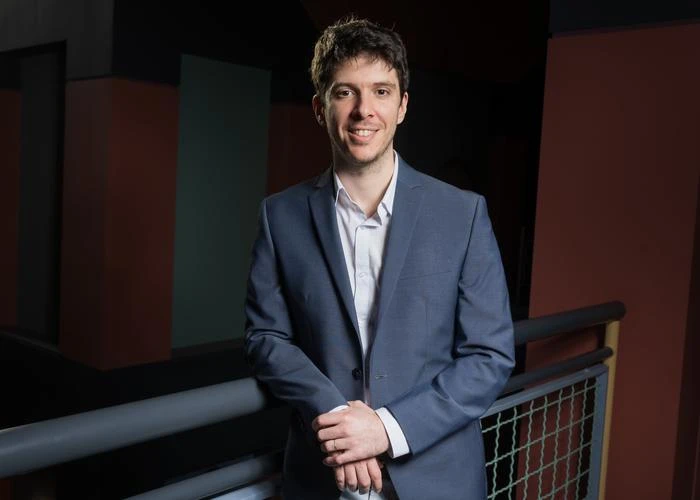
CAPTION: Santiago Segarra is an assistant professor of electrical and computer engineering and statistics at Rice University. (Photo by Jeff Fitlow/Rice University)
Links:
Department of Electrical and Computer Engineering: https://eceweb.rice.edu/
Santiago Segarra Website: https://segarra.rice.edu/
Rice Wireless: https://wireless.rice.edu/
George R. Brown School of Engineering: https://engineering.rice.edu/
About Rice:
Located on a 300-acre forested campus in Houston, Rice University is consistently ranked among the nation’s top 20 universities by U.S. News & World Report. Rice has highly respected schools of architecture, business, continuing studies, engineering, humanities, music, natural sciences and social sciences and is home to the Baker Institute for Public Policy. With 4,574 undergraduates and 3,982 graduate students, Rice’s undergraduate student-to-faculty ratio is just under 6-to-1. Its residential college system builds close-knit communities and lifelong friendships, just one reason why Rice is ranked No. 1 for lots of race/class interaction, No. 2 for best-run colleges and No. 12 for quality of life by the Princeton Review. Rice is also rated as a best value among private universities by Kiplinger’s Personal Finance.
END
“AI is an amazing tool and has been extended over less conventional domains, such as climate data defined on spheres (representing the Earth) and traffic data defined on road networks,” said Santiago Segarra, assistant professor of electrical and computer engineering and statistics.
With his five-year, $599,138 CAREER Award from the National Science Foundation, Segarra intends to study the use of graphs to represent these less conventional domains, since AI tools designed to be implemented in any graph necessarily disregard the structure of specific graphs of interest.
The highly competitive five-year NSF grants are given to early career faculty members who demonstrate the potential to serve as academic models and leaders in research and education. The NSF gives about 500 such awards across all disciplines each year.
Traffic data that changes over time, Segarra said, can be represented on a structured graph that combines the underlying road network with the linear evolution of time. His research will focus on classes of graphs with structural properties that are both practically relevant ⎯ representing real-world data domains ⎯ and methodologically advantageous in that they can be exploited to better learn from the data.
“Our aim is to boost the utility of AI by leveraging structural properties often found in real-world data,” Segarra said. “One of the many applications for this sort of research is climate prediction.”
The project will draw upon graph theory, machine learning, algebraic topology, signal processing, deep learning and integral linear operators to achieve an understanding of learning in structured domains.
Segarra earned his Ph.D. in electrical and systems engineering at the University of Pennsylvania in 2016. After two years as a postdoctoral research associate at the Institute for Data, Systems and Society at MIT, he joined the Rice faculty in 2018.
-30-
This release was authored by Patrick Kurp and can be found online at news.rice.edu.
Follow Rice News and Media Relations via Twitter @RiceUNews.
Award information:
https://www.nsf.gov/awardsearch/showAward?AWD_ID=2340481&HistoricalAwards=false
Image downloads:
https://news-network.rice.edu/news/files/2024/02/240119_Santiago-_Fitlow_007-a345047acd26e0e0.jpg
CAPTION: Santiago Segarra is an assistant professor of electrical and computer engineering and statistics at Rice University. (Photo by Jeff Fitlow/Rice University)
Links:
Department of Electrical and Computer Engineering: https://eceweb.rice.edu/
Santiago Segarra Website: https://segarra.rice.edu/
Rice Wireless: https://wireless.rice.edu/
George R. Brown School of Engineering: https://engineering.rice.edu/
About Rice:
Located on a 300-acre forested campus in Houston, Rice University is consistently ranked among the nation’s top 20 universities by U.S. News & World Report. Rice has highly respected schools of architecture, business, continuing studies, engineering, humanities, music, natural sciences and social sciences and is home to the Baker Institute for Public Policy. With 4,574 undergraduates and 3,982 graduate students, Rice’s undergraduate student-to-faculty ratio is just under 6-to-1. Its residential college system builds close-knit communities and lifelong friendships, just one reason why Rice is ranked No. 1 for lots of race/class interaction, No. 2 for best-run colleges and No. 12 for quality of life by the Princeton Review. Rice is also rated as a best value among private universities by Kiplinger’s Personal Finance.
END
Attachments