PRESS-NEWS.org - Press Release Distribution
PRESS RELEASES DISTRIBUTION

Water activation induced strong interfacial hydrogen bonding interactions for efficient oxygen reduction reaction
Water activation induced strong interfacial hydrogen bonding interactions for efficient oxygen reduction reaction
2024-08-23
(Press-News.org)

Exploring new energy storage and conversion technologies is crucial for sustainable human development. Proton exchange membrane fuel cells (PEMFCs) and metal-air batteries are particularly promising due to their high energy efficiency and environmental friendliness. A key component in these technologies is the oxygen reduction reaction (ORR) catalyst. Traditionally, ORR catalysts rely on expensive platinum group metals (PGM), which are cost-prohibitive for widespread use. This has spurred interest in developing non-precious metal alternatives, such as transition metal/nitrogen-doped carbon-based materials (M–N–C). Among these, Fe–N–C catalysts, where iron is coordinated with nitrogen in the Fe–N4 configuration, are notable for their Pt-like behavior in catalyzing ORR, particularly in terms of O2 adsorption and O=O bond breaking. However, these catalysts often suffer from limited activity and rapid degradation, especially in acidic conditions, due to suboptimal adsorption energy for oxygen intermediates.

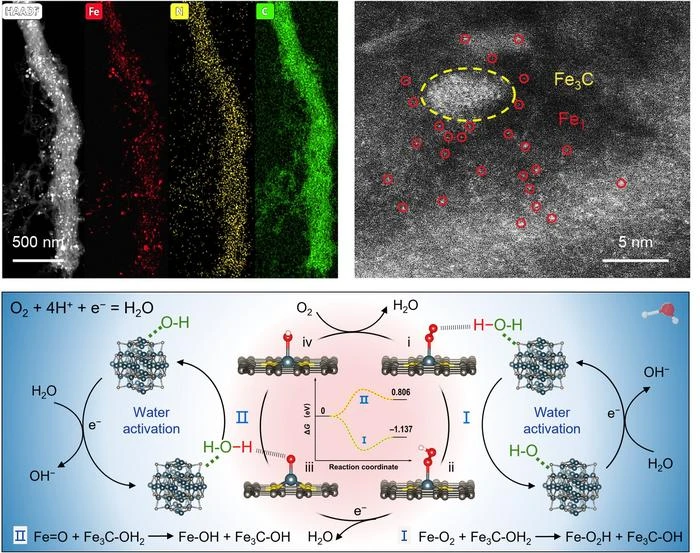
To enhance the intrinsic activity and stability of Fe-based catalysts, various strategies have been employed, including doping with heteroatoms (e.g., S, P), introducing neighboring transition metal sites (e.g., Co, Ni, Mn), and adding axial coordination groups (e.g., O, OH, Cl) at the metal center. Transition metal compounds, particularly those modifying atomically dispersed Fe–N4 sites, have shown potential in improving ORR performance in acidic media. Nonetheless, the role of water activation in the ORR process, often underappreciated, is critical. In acidic conditions, a strong electric field polarizes interfacial water molecules into an O-down configuration, disrupting hydrogen bonding with oxygenated intermediates and slowing down the proton-coupled electron transfer (PCET) step. Enhancing hydrogen bonding between these intermediates and interfacial water through effective water activation sites can significantly speed up PCET and ORR kinetics. The platinum-like electronic configuration of Fe3C makes it an effective catalytic site for water activation, improving proton generation from water and boosting ORR activity when paired with traditional Fe-N4 sites.

Imagine a catalyst that can provide performance comparable to traditional platinum metals but at a lower cost. Professor Peng's research team has made significant progress in this direction. Their developed Fe3C-Fe1/CNT catalyst not only exhibits an excellent half-wave potential of 0.83 V in acidic media but also achieves 0.91 V in alkaline media. This means it performs exceptionally well in actual H2-O2 fuel cells and aluminum-air batteries. Through a meticulous process of treating the electrospun precursor, followed by thermal decomposition and etching, the research team created a nanomaterial with a three-dimensional network structure and excellent electron transfer capabilities. This structure not only increases the exposure of active sites but also facilitates the rapid conversion of reactants to products.

In traditional proton exchange membrane fuel cells and metal-air batteries, the oxygen reduction reaction often relies on expensive platinum-group metals. Professor Peng's research offers a more economical and efficient alternative. This catalyst, composed of coordinated Fe and N, demonstrates excellent stability and high efficiency in both acidic and alkaline environments, which is crucial for advancing sustainable energy technologies. The article's diagrams and data further substantiate these findings, displaying the structure and performance test results of the catalyst in detail. Through in situ Fourier-transform infrared spectroscopy and density functional theory analysis, the research team revealed the key role of Fe3C in activating water molecules and enhancing reaction rates.

Professor Peng's team plans to further explore the application of this catalyst in other electrocatalytic reactions, hoping to bring more breakthroughs to future energy conversion technologies through continuous innovation and optimization.

###

See the article:

Fe-N co-doped carbon nanofibers with Fe3C decoration for water activation induced oxygen reduction reaction

https://doi.org/10.1093/nsr/nwae193

END

[Attachments] See images for this press release:
Water activation induced strong interfacial hydrogen bonding interactions for efficient oxygen reduction reaction Water activation induced strong interfacial hydrogen bonding interactions for efficient oxygen reduction reaction 2

ELSE PRESS RELEASES FROM THIS DATE:

Temperature regulates negative supercoils to modulate meiotic crossovers and chromosome organization

2024-08-23
This study is led by Prof. Shunxin Wang (State Key Laboratory of Reproductive Medicine and Offspring Health, Center for Reproductive Medicine, Institute of Women, Children and Reproductive Health, Shandong University) and Prof. Liangran Zhang (Advanced Medical Research Institute, Shandong University). In their study of meiosis in budding yeast, the research team found that yeast senses temperature changes by increasing the level of DNA negative supercoils to increase crossovers and modulate chromosome organization ...

Single nucleosomes tracked in live cells during cell division using super-resolution microscopy

Single nucleosomes tracked in live cells during cell division using super-resolution microscopy
2024-08-23
Individual cells divide through a process called mitosis, during which the cell’s copied DNA is separated between two resulting daughter cells. Despite recent advances in cell biology, the mechanism by which DNA condenses during mitosis is still poorly understood. Researchers recently tracked small stretches of DNA wound around histone proteins, called nucleosomes, to better characterize nucleosome behavior during cell division. DNA is organized as chromatin, which are dynamic structures comprised of DNA, RNA, and proteins that regulate the accessibility of genes for expression and the overall configuration of genetic material in the cell. Histone proteins, for example, are positively ...

Slow down in China’s methane emission growth

Slow down in China’s methane emission growth
2024-08-23
Methane is a potent greenhouse gas. Since the Industrial Revolution, atmospheric methane concentrations have nearly doubled, with its radiative forcing accounting for one-third of all greenhouse gases. As one of the world's largest methane emitters, China made a clear commitment as early as 2007 to "strive to control the growth rate of methane emissions." The country's 12th, 13th, and 14th Five-Year Plans all proposed measures to control methane emissions. In 2023, China released the "Methane Emission Control Action ...

Socioeconomics shape children’s connection to nature more than where they live

2024-08-23
The income and education levels of a child’s environment determine their relationship to nature, not whether they live in a city or the countryside. This is the finding of a new study conducted by researchers at Lund University, Sweden. The results run counter to the assumption that growing up in the countryside automatically increases our connection to nature, and yet the study also shows that nature close to home increases children’s well-being. There is a general concern that, with urbanisation, people have lost contact with nature. According to research, less contact ...

The higher the environmental stress, the lower the resistance to global change

The higher the environmental stress, the lower the resistance to global change
2024-08-23
An international study led by Institute of Natural Resources and Agrobiology of Seville (IRNAS-CSIC), of the Spanish National Research Council (CISC), has shown that as the number of global change factors increases, terrestrial ecosystems become more sensitive to the impacts of global change. The results, published in the prestigious journal Nature Geoscience, show that the resistance of our ecosystems to global change decreases significantly as the number of environmental stressors increases, especially when this stress is sustained over time. This is the conclusion reached by the Biodiversity and Ecosystem Functioning ...

Intestinal parasite could hold key to scar-free wound healing, study suggests

Intestinal parasite could hold key to scar-free wound healing, study suggests
2024-08-23
Researchers at Rutgers University in New Jersey have discovered that a protein produced by parasitic worms in the gut enhances wound healing in mice. The study, to be published August 23 in the journal Life Science Alliance (LSA), reveals that applying the protein to skin wounds speeds up wound closure, improves skin regeneration, and inhibits the formation of scar tissue. Whether the protein can be harnessed to enhance wound healing in human patients remains to be seen. Skin wounds must be rapidly closed in order to prevent infection, but rapid wound closure can favor the development of scar tissue instead of properly regenerated skin. The balance between scarring ...

Breakthroughs in prostate cancer: New insights into biomarkers and probes

Breakthroughs in prostate cancer: New insights into biomarkers and probes
2024-08-23
In a recent comprehensive review published in Cyborg Bionic Systems, researchers led by Keyi Li from the General Hospital of Northern Theater Command in Shenyang, along with international collaborators, detail significant advances in the identification and application of biomarkers for prostate cancer (PCa). This critical insight is pivotal as prostate cancer remains one of the most common malignancies among men globally, emphasizing the urgent need for effective diagnostic and therapeutic strategies. Prostate cancer is characterized by a multitude of molecular aberrations that complicate its early ...

New approach for profiling complex dynamics at the single-molecule level

New approach for profiling complex dynamics at the single-molecule level
2024-08-23
A team of researchers led by Professor Sebastian Deindl at Uppsala University has developed a pioneering method that vastly improves the ability to observe and analyse complex biological processes at the single-molecule level. Their work is set to be published in the upcoming issue of the journal Science. “With our new technique, we can now extend single-molecule biophysics to the genome scale. This advance is expected to significantly deepen our understanding of how nucleic-acid interacting proteins function in ...

Single 5-nm quantum dot detection via microtoroid resonator photothermal microscopy

Single 5-nm quantum dot detection via microtoroid resonator photothermal microscopy
2024-08-23
The detection of individual particles and molecules has opened new horizons in analytical chemistry, cellular imaging, nanomaterials, and biomedical diagnostics. Traditional single-molecule detection methods rely heavily on fluorescence techniques, which require labeling of the target molecules. In contrast, photothermal microscopy has emerged as a promising label-free, non-invasive imaging technique. This method measures localized variations in the refractive index of a sample's surroundings, resulting from light absorption by sample components, which induces temperature changes in the surrounding region. Whispering ...

Alzheimer’s drug may slow down cognitive decline in dementia with Lewy bodies

2024-08-23
Dementia with Lewy bodies is a type of dementia that is similar to both Alzheimer’s disease and Parkinson’s disease but studies on long-term treatments are lacking. A new study from Karolinska Institutet in Sweden, published in Alzheimer’s & Dementia: The Journal of the Alzheimer's Association, highlights the potential cognitive benefits of cholinesterase inhibitor treatment. Lewy body disease, which includes dementia with Lewy bodies (DLB) and Parkinson’s disease with and without dementia, is the second most common neurodegenerative disorder, following Alzheimer’s disease. DLB accounts for approximately ...

LAST 30 PRESS RELEASES:

Making lighter work of calculating fluid and heat flow

Normalizing blood sugar can halve heart attack risk

Lowering blood sugar cuts heart attack risk in people with prediabetes

Study links genetic variants to risk of blinding eye disease in premature infants

Non-opioid ‘pain sponge’ therapy halts cartilage degeneration and relieves chronic pain

AI can pick up cultural values by mimicking how kids learn

China’s ecological redlines offer fast track to 30 x 30 global conservation goal

Invisible indoor threats: emerging household contaminants and their growing risks to human health

Adding antibody treatment to chemo boosts outcomes for children with rare cancer

Germline pathogenic variants among women without a history of breast cancer

Tanning beds triple melanoma risk, potentially causing broad DNA damage

Unique bond identified as key to viral infection speed

Indoor tanning makes youthful skin much older on a genetic level

Mouse model sheds new light on the causes and potential solutions to human GI problems linked to muscular dystrophy

The Journal of Nuclear Medicine ahead-of-print tip sheet: December 12, 2025

Smarter tools for peering into the microscopic world

Applications open for funding to conduct research in the Kinsey Institute archives

Global measure underestimates the severity of food insecurity

Child survivors of critical illness are missing out on timely follow up care

Risk-based vs annual breast cancer screening / the WISDOM randomized clinical trial

University of Toronto launches Electric Vehicle Innovation Ontario to accelerate advanced EV technologies and build Canada’s innovation advantage

Early relapse predicts poor outcomes in aggressive blood cancer

American College of Lifestyle Medicine applauds two CMS models aligned with lifestyle medicine practice and reimbursement

Clinical trial finds cannabis use not a barrier to quitting nicotine vaping

Supplemental nutrition assistance program policies and food insecurity

Switching immune cells to “night mode” could limit damage after a heart attack, study suggests

URI-based Global RIghts Project report spotlights continued troubling trends in worldwide inhumane treatment

Neutrophils are less aggressive at night, explaining why nighttime heart attacks cause less damage than daytime events

Menopausal hormone therapy may not pose breast cancer risk for women with BRCA mutations

Mobile health tool may improve quality of life for adolescent and young adult breast cancer survivors

[Press-News.org] Water activation induced strong interfacial hydrogen bonding interactions for efficient oxygen reduction reaction