Soft cells: Rounded tile shapes echo those found in nature
Published 2024-09-10 · Original archive entry · Explore research explainers
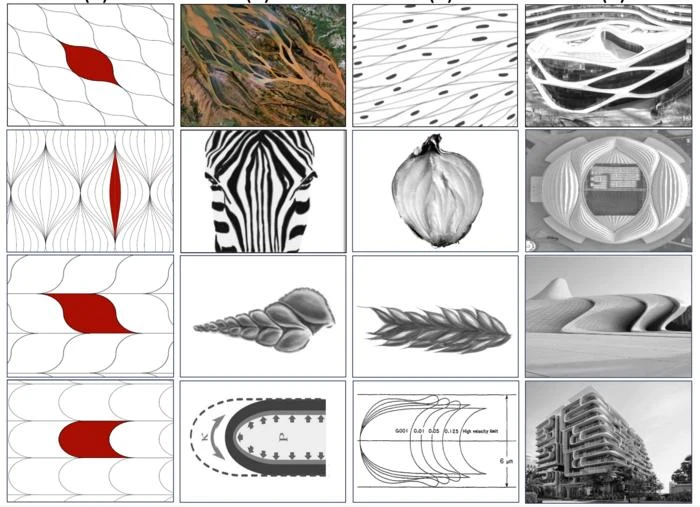
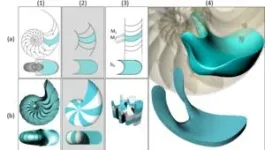
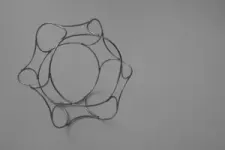
Tiles that fill two- and three-dimensional spaces with no gaps—including triangles, squares, hexagons, cubes, and other polyhedra—are typically designed with sharp corners and flat faces (straight edges). Gábor Domokos and colleagues explore soft and curved two- and three-dimensional tiles that completely fill space with a minimal number of sharp corners, which they term “soft cells.” The authors demonstrate how to soften polyhedral tiles by systematically deforming edges. The resulting shapes echo those found in nature, including river estuaries, zebra stripes, muscle tissue, and the chambers of seashells, including the Nautilus. Biological structures that evolved to fill space are likely to display these forms. The authors prove a theorem demonstrating that soft tilings are combinatorically abundant. Soft cells are also found in art and architecture, especially in situations where architects wish to avoid corners. According to the authors, some types of three-dimensional soft cells have not yet been found in nature—although they are not convinced they do not exist.
END
END
Attachments