Seven new frog species discovered in Madagascar: sounds like something from Star Trek
An international team of researchers have discovered seven new species of tree frogs that make otherworldly calls in the rainforests of Madagascar. Their strange, high-pitched whistling calls sound more like sound effects from the sci-fi series Star Trek.
Published 2024-10-15 · Original archive entry · Explore research explainers

Seven New Frog Species Discovered in Madagascar: Sounds Like Something from Star Trek
An international team of researchers have discovered seven new species of tree frogs that make otherworldly calls in the rainforests of Madagascar. Their strange, high-pitched whistling calls sound more like sound effects from the sci-fi series Star Trek. As a result, the researchers have named the new species after seven of the series' most iconic
If you think all frogs croak, you’d be wrong. Seven newly discovered species from the tree frog genus Boophis, found across the rainforests of Madagascar, emit special bird-like whistling sounds in their communication with other frogs.
These whistling sounds reminded the research team, led by Professor Miguel Vences of the Technische Universität Braunschweig, Germany, of Star Trek, where similar whistle-like sound effects are frequently used.
“That’s why we named the frogs after Kirk, Picard, Sisko, Janeway, Archer, Burnham, and Pike—seven of the most iconic captains from the sci-fi series,” says Professor Vences.
“Not only do these frogs sound like sound-effects from Star Trek, but it seems also fitting that to find them, you often have to do quite a bit of trekking! A few species are found in places accessible to tourists, but to find several of these species, we had to undertake major expeditions to remote forest fragments and mountain peaks. There’s a real sense of scientific discovery and exploration here, which we think is in the spirit of Star Trek,” explains Assistant Professor Mark D. Scherz from the Natural History Museum of Denmark at the University of Copenhagen, who was senior author on the study.
To Drown Out the Sound of Water
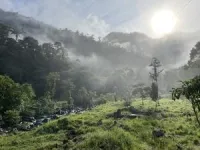
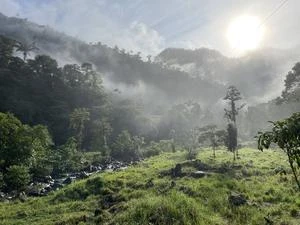
The otherworldly calls of these frogs are known as "advertisement calls"—a type of self-promotion that, according to the researchers, may convey information about the male frog’s suitability as a mate to females. This particular group live along fast-flowing streams in the most mountainous regions of Madagascar—a loud background that may explain why the frogs call at such high pitches.
For fans of Star Trek, some of the frog calls might remind them of sounds from the so-called ‘boatswain whistle’ and a device called the ‘tricorder.’ To others, they might sound like a bird or an insect.
“If the frogs just croaked like our familiar European frogs, they might not be audible over the sound of rushing water from the rivers they live near. Their high-pitched trills and whistles stand out against all that noise,” explains Dr Jörn Köhler, Senior Curator of Vertebrate Zoology at the Hessisches Landesmuseum Darmstadt, Germany, who played a key role in analyzing the calls of the frogs.
“The appearance of the frogs has led to them being confused with similar species until now, but each species makes a distinctive series of these high-pitched whistles, that has allowed us to tell them apart from each other, and from other frogs,” he says.
The calls also lined up with the genetic analysis the team performed.
Vulnerable to Climate Change
Madagascar is renowned for its immense biodiversity, and research in its rainforests continues to uncover hidden species, making it a true paradise for frogs. Madagascar, an island roughly the size of France, is home to about 9% of all the world’s frog species.
“We’ve only scratched the surface of what Madagascar’s rainforests have to offer. Every time we go into the forest, we find new species, and just in terms of frogs, there are still several hundred species we haven’t yet described,” says Professor Andolalao Rakotoarison of the Université d’Itasy in Madagascar. Just in the last ten years, she and the rest of this team have described around 100 new species from the island.
The researchers behind the discovery hope that this new knowledge will strengthen conservation efforts in Madagascar’s rainforests. The species often live in close geographic proximity but at different altitudes and in different microhabitats. This division makes them particularly vulnerable to changes in climate or the environment.
Thus, the research team urges greater awareness around the conservation of Madagascar’s biodiversity to ensure that these unique species and their habitats are preserved for the future. But they also hope to continue exploring, to seek out new species in forests where no scientist has gone before.
END
If you think all frogs croak, you’d be wrong. Seven newly discovered species from the tree frog genus Boophis, found across the rainforests of Madagascar, emit special bird-like whistling sounds in their communication with other frogs.
These whistling sounds reminded the research team, led by Professor Miguel Vences of the Technische Universität Braunschweig, Germany, of Star Trek, where similar whistle-like sound effects are frequently used.
“That’s why we named the frogs after Kirk, Picard, Sisko, Janeway, Archer, Burnham, and Pike—seven of the most iconic captains from the sci-fi series,” says Professor Vences.
“Not only do these frogs sound like sound-effects from Star Trek, but it seems also fitting that to find them, you often have to do quite a bit of trekking! A few species are found in places accessible to tourists, but to find several of these species, we had to undertake major expeditions to remote forest fragments and mountain peaks. There’s a real sense of scientific discovery and exploration here, which we think is in the spirit of Star Trek,” explains Assistant Professor Mark D. Scherz from the Natural History Museum of Denmark at the University of Copenhagen, who was senior author on the study.
To Drown Out the Sound of Water
The otherworldly calls of these frogs are known as "advertisement calls"—a type of self-promotion that, according to the researchers, may convey information about the male frog’s suitability as a mate to females. This particular group live along fast-flowing streams in the most mountainous regions of Madagascar—a loud background that may explain why the frogs call at such high pitches.
For fans of Star Trek, some of the frog calls might remind them of sounds from the so-called ‘boatswain whistle’ and a device called the ‘tricorder.’ To others, they might sound like a bird or an insect.
“If the frogs just croaked like our familiar European frogs, they might not be audible over the sound of rushing water from the rivers they live near. Their high-pitched trills and whistles stand out against all that noise,” explains Dr Jörn Köhler, Senior Curator of Vertebrate Zoology at the Hessisches Landesmuseum Darmstadt, Germany, who played a key role in analyzing the calls of the frogs.
“The appearance of the frogs has led to them being confused with similar species until now, but each species makes a distinctive series of these high-pitched whistles, that has allowed us to tell them apart from each other, and from other frogs,” he says.
The calls also lined up with the genetic analysis the team performed.
Vulnerable to Climate Change
Madagascar is renowned for its immense biodiversity, and research in its rainforests continues to uncover hidden species, making it a true paradise for frogs. Madagascar, an island roughly the size of France, is home to about 9% of all the world’s frog species.
“We’ve only scratched the surface of what Madagascar’s rainforests have to offer. Every time we go into the forest, we find new species, and just in terms of frogs, there are still several hundred species we haven’t yet described,” says Professor Andolalao Rakotoarison of the Université d’Itasy in Madagascar. Just in the last ten years, she and the rest of this team have described around 100 new species from the island.
The researchers behind the discovery hope that this new knowledge will strengthen conservation efforts in Madagascar’s rainforests. The species often live in close geographic proximity but at different altitudes and in different microhabitats. This division makes them particularly vulnerable to changes in climate or the environment.
Thus, the research team urges greater awareness around the conservation of Madagascar’s biodiversity to ensure that these unique species and their habitats are preserved for the future. But they also hope to continue exploring, to seek out new species in forests where no scientist has gone before.
END
Attachments