A successful catalyst design for advanced zinc-iodine batteries
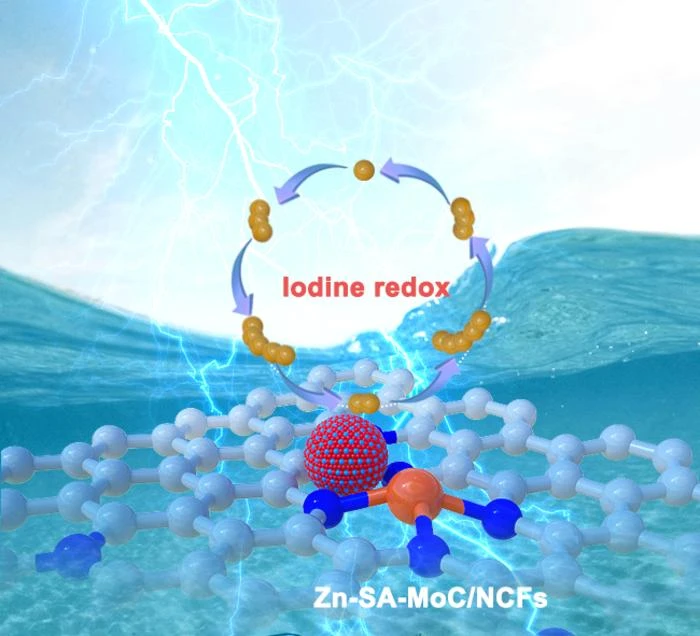
Aqueous zinc-ion batteries (ZIBs) have attracted extensive attention due to their high safety, abundant reserves, and environmental friendliness. Iodine with high abundance in seawater (55 μg L−1) is highly promising to fabricate zinc-iodine batteries due to high theoretical capacity (211 mAh g−1) and appropriate redox potential (0.54 V). However, the low electrical conductivity of iodine hinders the redox conversion for the efficient energy storage process with zinc. Additionally, the formed soluble polyiodides are prone to migirate to Zn anode, leading to capacity degration and Zn corrosion.
To address the existed issues in Zn-I2 batteries, the research team presents the coprecipitation method to encapsulate molybdate ions into zeolitic imidazolate framework-8 (ZIF-8), followed by electrospinning and calcination to create free-standing porous carbon fibers with Zn single atom sites and molybdenum carbide clusters (Zn-SA-MoC/NCFs). With the hierarchical porous carbon framework for favorable mass transfer, the integration of molybdenum carbides with single-atom catalysts are expected to amplify the adsorption capability to iodine species and modulate the catalytic activity with an optimal charge redistribution. Thus, the assembled Zn-I2 batteries demonstrate a large specific capacity of 230.6 mAh g−1 at a current density of 0.5 C (1 C= 0.211 mA cm−2) and the good capacity retention of 90% after 20,000 cycles. With the fundamental understanding of enhanced electrocatalysis by incorporating of Zn-SA with MoC clusters, the concept study on electronic structure modulation between hosts and iodine species demonstrate the basic principles for high-performing Zn-I2 batteries and beyond.
This study is the first to demonstrate the manipulation of the electrocatalytic activity of MoC clusters via the incorporation of Zn-N4 sites for iodine redox reaction. The electronic structure regulation strategy provides robust guidance for constructing advanced iodine catalysts and optimizing their battery performance.
END