We can make fertilizer more efficiently under the surface of the Earth
Published 2025-01-21 · Original archive entry · Explore research explainers
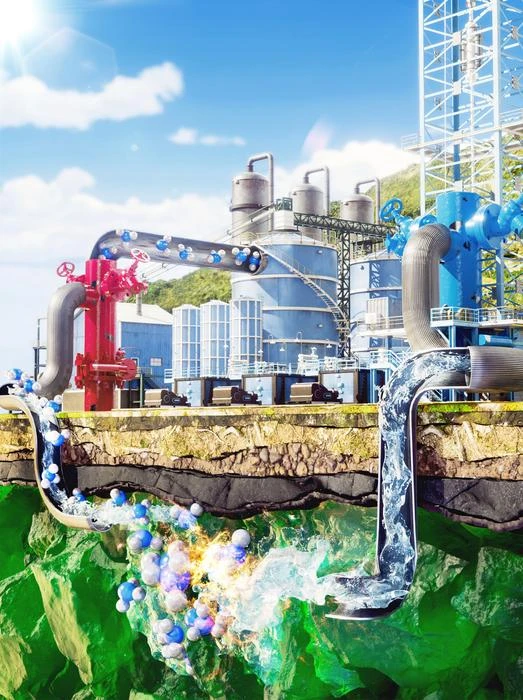
Instead of relying on energy-hungry reactors to generate high temperatures and pressure, researchers are looking underground at Earth’s natural heat and forces to cook up ammonia for fertilizer. In a proof-of-concept study, published January 21 in the Cell Press journal Joule, researchers generated ammonia by mixing nitrogen-laced water with iron-rich rocks—without any energy input or CO2 emission. This new recipe may lead to a more sustainable alternative to current methods, theoretically churning out enough ammonia for 2.42 million years.
The idea stems from an unusual geological phenomenon observed in the 1980s in Mali, West Africa. Locals discovered a well streaming with hydrogen gas, which scientists later traced to a water-rock chemical reaction beneath the Earth’s surface.
“It was an ‘aha’ moment,” says senior author Iwnetim Abate of the Massachusetts Institute of Technology (MIT). “We may be able to use Earth as a factory, harnessing its heat and pressure to produce valuable chemicals like ammonia in a cleaner manner.”
Ammonia is as a key ingredient in fertilizers and could one day power the future as clean fuel, but today’s industrial ammonia production is energy intensive. It consumes about 2% of global energy and releases around 2.4 tons (5,291 lb) of CO2 for every ton (2,204 lb) of ammonia produced, making it the chemical industry’s top CO₂ emitter.
To test their “Earth factory” idea, Abate and his team built a rock-water reaction system that mimics Earth’s subsurface environment. They exposed synthetic iron-rich minerals to nitrogen-laced water, triggering a chemical reaction that oxidized the rock and yielded ammonia, which the team dubbed “geological ammonia.” The process required no energy input, emitted no CO2, and even worked under ambient conditions.
The team then swapped the synthetic mineral with olivine, a natural iron-laden rock, to better mimic real-world scenarios. They further optimized the process by adding a copper catalyst and cranking the heat to 300°C (572°F). Within 21 hours, they produced about 1.8 kg (4 lb) of ammonia per ton (2,204.6 lb) of olivine, demonstrating the method’s feasibility and sustainability.
“These rocks are all over the world, so the method could be adapted very widely across the globe,” says Abate. But still, “there’s a whole other level of complexity that we’ll need to work through.” Implementation will involve drilling into iron-rich rocks deep within Earth, injecting nitrogen-laced water, and grappling with the intricacies of how rocks crack, expand, and interact with gases and liquids. Abate is pursing the scale-up efforts, including a pilot scale test by 2026, through Addis Energy, a company he co-founded.
The idea’s economic outlook is encouraging. Producing geological ammonia costs about $0.55 per kilogram (2.2 lb), on par with conventional methods priced at $0.40–$0.80. The research may also open new ways to address wastewater pollution.
“Nitrogen sources are considered as pollution in wastewater, and removing them costs money and energy,” says first author Yifan Gao of MIT. “But we may be able use the wastewater to produce ammonia. It’s a win-win strategy.” Integrating wastewater treatment with ammonia production could yield an additional profit of $3.82 per kilogram of ammonia.
“Ammonia is pretty important for life,” says senior author Ju Li of MIT. Apart from microbes, the only other natural way to produce ammonia on Earth is through lightning striking nitrogen gas. “That’s why the geological production of ammonia is quite interesting when you think about where life came from.”
###
This work was supported by the National Science Foundation.
Joule, Abate et al.: “Geological Ammonia: Stimulated NH3 production from rocks.” https://www.cell.com/joule/fulltext/S2542-4351(24)00541-5
Joule (@Joule_CP), published monthly by Cell Press, is a new home for outstanding and insightful research, analysis, and ideas addressing the need for more sustainable energy. A sister journal to Cell, Joule spans all scales of energy research, from fundamental laboratory research into energy conversion and storage to impactful analysis at the global level. Visit http://www.cell.com/joule. To receive Cell Press media alerts, contact press@cell.com.
END
The idea stems from an unusual geological phenomenon observed in the 1980s in Mali, West Africa. Locals discovered a well streaming with hydrogen gas, which scientists later traced to a water-rock chemical reaction beneath the Earth’s surface.
“It was an ‘aha’ moment,” says senior author Iwnetim Abate of the Massachusetts Institute of Technology (MIT). “We may be able to use Earth as a factory, harnessing its heat and pressure to produce valuable chemicals like ammonia in a cleaner manner.”
Ammonia is as a key ingredient in fertilizers and could one day power the future as clean fuel, but today’s industrial ammonia production is energy intensive. It consumes about 2% of global energy and releases around 2.4 tons (5,291 lb) of CO2 for every ton (2,204 lb) of ammonia produced, making it the chemical industry’s top CO₂ emitter.
To test their “Earth factory” idea, Abate and his team built a rock-water reaction system that mimics Earth’s subsurface environment. They exposed synthetic iron-rich minerals to nitrogen-laced water, triggering a chemical reaction that oxidized the rock and yielded ammonia, which the team dubbed “geological ammonia.” The process required no energy input, emitted no CO2, and even worked under ambient conditions.
The team then swapped the synthetic mineral with olivine, a natural iron-laden rock, to better mimic real-world scenarios. They further optimized the process by adding a copper catalyst and cranking the heat to 300°C (572°F). Within 21 hours, they produced about 1.8 kg (4 lb) of ammonia per ton (2,204.6 lb) of olivine, demonstrating the method’s feasibility and sustainability.
“These rocks are all over the world, so the method could be adapted very widely across the globe,” says Abate. But still, “there’s a whole other level of complexity that we’ll need to work through.” Implementation will involve drilling into iron-rich rocks deep within Earth, injecting nitrogen-laced water, and grappling with the intricacies of how rocks crack, expand, and interact with gases and liquids. Abate is pursing the scale-up efforts, including a pilot scale test by 2026, through Addis Energy, a company he co-founded.
The idea’s economic outlook is encouraging. Producing geological ammonia costs about $0.55 per kilogram (2.2 lb), on par with conventional methods priced at $0.40–$0.80. The research may also open new ways to address wastewater pollution.
“Nitrogen sources are considered as pollution in wastewater, and removing them costs money and energy,” says first author Yifan Gao of MIT. “But we may be able use the wastewater to produce ammonia. It’s a win-win strategy.” Integrating wastewater treatment with ammonia production could yield an additional profit of $3.82 per kilogram of ammonia.
“Ammonia is pretty important for life,” says senior author Ju Li of MIT. Apart from microbes, the only other natural way to produce ammonia on Earth is through lightning striking nitrogen gas. “That’s why the geological production of ammonia is quite interesting when you think about where life came from.”
###
This work was supported by the National Science Foundation.
Joule, Abate et al.: “Geological Ammonia: Stimulated NH3 production from rocks.” https://www.cell.com/joule/fulltext/S2542-4351(24)00541-5
Joule (@Joule_CP), published monthly by Cell Press, is a new home for outstanding and insightful research, analysis, and ideas addressing the need for more sustainable energy. A sister journal to Cell, Joule spans all scales of energy research, from fundamental laboratory research into energy conversion and storage to impactful analysis at the global level. Visit http://www.cell.com/joule. To receive Cell Press media alerts, contact press@cell.com.
END