PRESS-NEWS.org - Press Release Distribution
PRESS RELEASES DISTRIBUTION

Mysterious interstellar icy objects
A new site for organic molecule formation?

Mysterious interstellar icy objects
2025-03-03
(Press-News.org)

Niigata, Japan - Organic molecules that serve as the building blocks of life are believed to form in space, but their exact formation sites and delivery mechanisms to planets remain a major mystery in astronomy and planetary science. One of the key elements in solving this mystery is the presence of ice in interstellar environments. In cold, dense, and shielded regions of the galaxy, atoms and molecules adhere to the surfaces of submicron-sized solid particles (dust), leading to the formation of interstellar ices. This process is similar to how snow forms in Earth’s clouds.

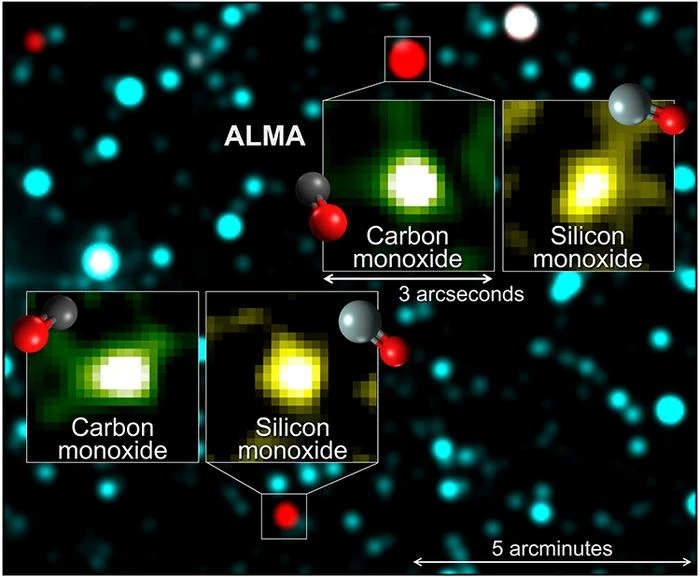
Astronomers from Niigata University and The University of Tokyo (Japan) conducted molecular gas observations of two enigmatic interstellar objects using the Atacama Large Millimeter/submillimeter Array (ALMA) in Chile. These objects were previously discovered by the Japanese infrared satellite AKARI in 2021 and are known to be rich in interstellar ices containing water and organic molecules, though their properties remained unclear. Typically, interstellar ices are detected in dense regions of star-forming clouds, but these two objects do not belong to any known star-forming regions.

The research team used the ALMA telescope to observe them at a wavelength of approximately 0.9 mm. While infrared observations are effective for studying solid materials, radio observations are more useful for analyzing the motion and composition of associated gases. If these two interstellar objects were forming stars, ALMA’s high spatial resolution and sensitivity would detect various molecular emissions. Additionally, if a previously undetected molecular cloud were present in the direction of these objects, it would appear as spatially extended gas emissions in carbon monoxide.

However, the observations revealed something different from either of these expectations. At the positions of the two icy objects, only molecular emission lines of carbon monoxide and silicon monoxide were detected, exhibiting a very compact distribution of less than one arcsecond. Using the ALMA data, the team analyzed the distance, motion, size, and chemical composition of the molecular gas associated with these objects.

For example, based on the analysis of their line-of-sight velocities, it was suggested that the two objects are located approximately 30,000 to 40,000 light-years away from Earth. Additionally, the significant difference in their velocities indicates that these objects are kinematically independent and situated at different distances, despite being separated by only about 3 arcminutes on the celestial sphere and exhibiting similar colors, brightness, and interstellar ice features.

Interstellar objects with ices are usually embedded in large amounts of dust, causing them to shine brightly in the far-infrared to submillimeter wavelengths. However, the ALMA observations in this study did not detect submillimeter radiation from the two icy objects, revealing an unusual energy distribution that does not match the characteristics of previously known interstellar icy objects.

Furthermore, the ALMA observations revealed that the ratio of silicon monoxide to carbon monoxide in the two objects is significantly higher than what is typically observed in normal molecular clouds. Such abundant silicon monoxide is usually found only in regions where interstellar dust is being destroyed by intense shock waves, suggesting that the two objects are associated with an energy source that is strongly disturbing the gas.

The unique properties of the mysterious icy objects revealed by ALMA cannot be explained by the characteristics of any known objects associated with interstellar ices, such as newly formed stars, young stars with protoplanetary disks, evolved stars that exhibit intense mass loss, or bright stars located behind the dense molecular clouds.

"They may represent a new class of interstellar objects that provide an environment conducive to the formation of ices and organic molecules," says Takashi Shimonishi, an astronomer at Niigata University, Japan, and the lead author of the paper. "Future high-resolution observations of the associated gas using the ALMA telescope, along with more detailed studies of ices and dust with the James Webb Space Telescope, would shed light on the nature of these mysterious icy objects," hopes Takashi Shimonishi.

The findings were published in The Astrophysical Journal on February 25, 2025.

END


[Attachments] See images for this press release:
Mysterious interstellar icy objects

ELSE PRESS RELEASES FROM THIS DATE:

Chronic diseases misdiagnosed as psychosomatic can lead to long term damage to physical and mental wellbeing, study finds

2025-03-03
A ‘chasm of misunderstanding and miscommunication’ is often experienced between clinicians and patients, leading to autoimmune diseases such as lupus and vasculitis being wrongly diagnosed as psychiatric or psychosomatic conditions, with a profound and lasting impact on patients, researchers have found. A study involving over 3,000 participants – both patients and clinicians – found that these misdiagnoses (sometimes termed “in your head” by patients) were often associated with long term impacts on patients’ physical health and wellbeing and damaged trust in healthcare services. The researchers are calling for greater awareness ...

Omalizumab treats multi-food allergy better than oral immunotherapy

Omalizumab treats multi-food allergy better than oral immunotherapy
2025-03-02
A clinical trial has found that the medication omalizumab, marketed as Xolair, treated multi-food allergy more effectively than oral immunotherapy (OIT) in people with allergic reactions to very small amounts of common food allergens. OIT, the most common approach to treating food allergy in the United States, involves eating gradually increasing doses of a food allergen to reduce the allergic response to it. Thirty-six percent of study participants who received an extended course of omalizumab could tolerate 2 grams or more of peanut protein, or about eight peanuts, and two other ...

Sleep apnea linked to increased risk of Parkinson’s, but CPAP may reduce risk

2025-03-02
EMBARGOED FOR RELEASE UNTIL 4 P.M. ET, SUNDAY, MARCH 2, 2025 Media Contacts: Renee Tessman, rtessman@aan.com, (612) 928-6137 Natalie Conrad, nconrad@aan.com, (612) 928-6164 Sleep apnea linked to increased risk of Parkinson’s, but CPAP may reduce risk Risk reduced if treatment started within two years of diagnosis MINNEAPOLIS – People with obstructive sleep apnea have an increased risk of Parkinson’s disease, but if started early enough, continuous positive airway pressure ...

New insights into drug addiction: The role of astrocytic G protein-coupled receptors

New insights into drug addiction: The role of astrocytic G protein-coupled receptors
2025-03-02
A recent study published in Engineering delves into the complex mechanisms of drug addiction, highlighting the crucial role of astrocytic G protein-coupled receptors (GPCRs). This research offers fresh perspectives on understanding and potentially treating substance-use disorders (SUDs). For a long time, neuroscience research on drug addiction mainly focused on neuronal mechanisms. However, emerging evidence shows that astrocytes, the most abundant glial cells in the central nervous system, also play a significant part. Astrocytes ...

Digital twin technology: Transforming road engineering and its lifecycle applications

Digital twin technology: Transforming road engineering and its lifecycle applications
2025-03-02
A recent study published in the journal Engineering delves into the potential of digital twin (DT) technology in revolutionizing road engineering and its lifecycle applications. As road infrastructure worldwide faces the challenge of digitalization, DT has emerged as a promising solution. The research, conducted by a team of scholars from Tongji University and Harbin Institute of Technology (Shenzhen), systematically reviews DT-enabling technologies, including model creation, condition sensing, data processing, and interaction. The development of DT in road engineering has been ...

Next-generation AI and big data: Transforming crop breeding

Next-generation AI and big data: Transforming crop breeding
2025-03-01
A new study published in Engineering explores how next-generation artificial intelligence (AI) and big data are revolutionizing crop breeding, with potential far-reaching implications for global food security. Crop breeding has come a long way, evolving through distinct stages from domestication breeding to the current era of big data intelligent design breeding. The latest stage, “Breeding 4.0,” integrates biotechnology, big data, and AI. This convergence aims to achieve efficient, personalized breeding of new crop varieties, marking a significant shift from traditional “scientific” ...

Biomimetic synthesis of natural products: Progress, challenges and prospects

Biomimetic synthesis of natural products: Progress, challenges and prospects
2025-03-01
In a recent publication in Engineering, researchers from Jinan University in China and the University of Illinois Chicago in the US presented an in-depth perspective on the biomimetic synthesis of natural products. This research area, which bridges chemistry, biology, and pharmacy, has seen significant progress in recent years. Natural products are crucial in drug discovery, providing essential scaffolds for developing new medications. However, obtaining sufficient quantities of these compounds for research and production is challenging due to resource limitations. Traditional chemical synthesis and biosynthesis methods also face their own set of ...

New limits found for dark matter properties from latest search

New limits found for dark matter properties from latest search
2025-03-01
Tokyo, Japan – A team led by a member of Tokyo Metropolitan University have made advances in the search for dark matter, observing galaxies using new spectrographic technology and the Magellan Clay Telescope. With a mere 4 hours of observations, precise measurements in the infrared range have set new limits on the lifetime of dark matter. Their findings highlight the crucial utility of their technology and extend the search to less explored parts of the spectrum.   Over the past century, cosmologists have grappled with an apparent inconsistency in what they saw in the universe. Observations of the rotation of galaxies, for example, imply that there is a lot of mass out ...

SCAI expresses disappointment over ABMS decision to deny independent cardiovascular medicine boar

2025-02-28
WASHINGTON– The Society for Cardiovascular Angiography & Interventions (SCAI) today expressed profound disappointment in the American Board of Medical Specialties (ABMS) decision to deny the creation of the American Board of Cardiovascular Medicine (ABCVM). The ABCVM was proposed by SCAI, the American College of Cardiology (ACC), the American Heart Association (AHA), the Heart Failure Society of America (HFSA), and the Heart Rhythm Society (HRS) as a necessary step to establish cardiology as its own distinct medical specialty, separate from internal ...

Rice researchers develop efficient lithium extraction method, setting stage for sustainable EV battery supply chains

Rice researchers develop efficient lithium extraction method, setting stage for sustainable EV battery supply chains
2025-02-28
In the race to meet the growing global demand for lithium — a critical component in batteries for electric vehicles — a team of researchers from Rice University’s Elimelech lab has developed a breakthrough lithium extraction method that could reshape the industry. In their study published in Science Advances, the researchers demonstrated near-perfect lithium selectivity by repurposing solid-state electrolytes (SSEs) as membrane materials for aqueous lithium extraction. While originally designed for the rapid conduction of lithium ions in solid-state batteries — where there are no other ions or liquid solvents — the highly ordered and confined structure ...

LAST 30 PRESS RELEASES:

Making lighter work of calculating fluid and heat flow

Normalizing blood sugar can halve heart attack risk

Lowering blood sugar cuts heart attack risk in people with prediabetes

Study links genetic variants to risk of blinding eye disease in premature infants

Non-opioid ‘pain sponge’ therapy halts cartilage degeneration and relieves chronic pain

AI can pick up cultural values by mimicking how kids learn

China’s ecological redlines offer fast track to 30 x 30 global conservation goal

Invisible indoor threats: emerging household contaminants and their growing risks to human health

Adding antibody treatment to chemo boosts outcomes for children with rare cancer

Germline pathogenic variants among women without a history of breast cancer

Tanning beds triple melanoma risk, potentially causing broad DNA damage

Unique bond identified as key to viral infection speed

Indoor tanning makes youthful skin much older on a genetic level

Mouse model sheds new light on the causes and potential solutions to human GI problems linked to muscular dystrophy

The Journal of Nuclear Medicine ahead-of-print tip sheet: December 12, 2025

Smarter tools for peering into the microscopic world

Applications open for funding to conduct research in the Kinsey Institute archives

Global measure underestimates the severity of food insecurity

Child survivors of critical illness are missing out on timely follow up care

Risk-based vs annual breast cancer screening / the WISDOM randomized clinical trial

University of Toronto launches Electric Vehicle Innovation Ontario to accelerate advanced EV technologies and build Canada’s innovation advantage

Early relapse predicts poor outcomes in aggressive blood cancer

American College of Lifestyle Medicine applauds two CMS models aligned with lifestyle medicine practice and reimbursement

Clinical trial finds cannabis use not a barrier to quitting nicotine vaping

Supplemental nutrition assistance program policies and food insecurity

Switching immune cells to “night mode” could limit damage after a heart attack, study suggests

URI-based Global RIghts Project report spotlights continued troubling trends in worldwide inhumane treatment

Neutrophils are less aggressive at night, explaining why nighttime heart attacks cause less damage than daytime events

Menopausal hormone therapy may not pose breast cancer risk for women with BRCA mutations

Mobile health tool may improve quality of life for adolescent and young adult breast cancer survivors

[Press-News.org] Mysterious interstellar icy objects
A new site for organic molecule formation?