Rare frog rediscovered after 130 years
Published 2025-03-11 · Original archive entry · Explore research explainers
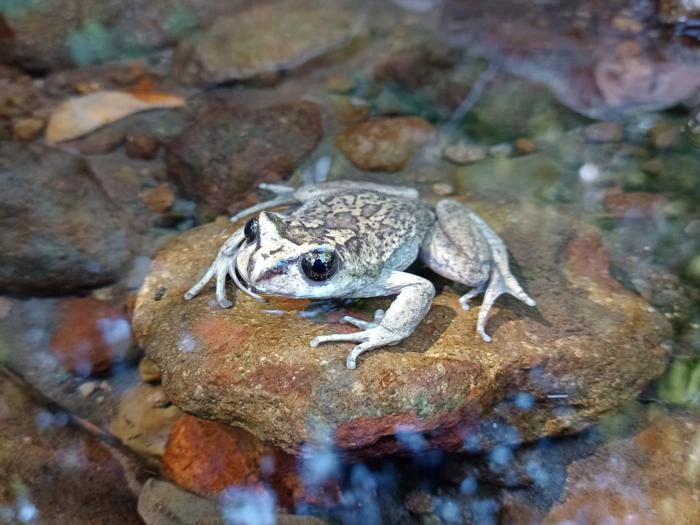
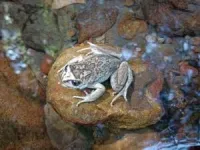
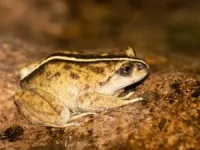
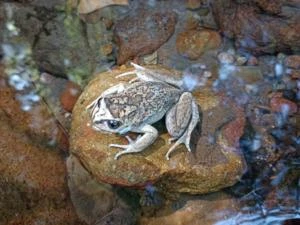
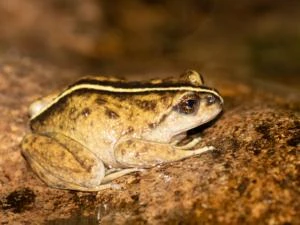
A team of researchers has rediscovered a frog species which has not been seen in more than 130 years. First described in 1902, Alsodes vittatus had evaded detection since then, despite multiple search efforts. The researchers discovered two populations of the frog at the southeastern end of the ancient Hacienda San Ignacio de Pemehue in La Araucanía Region, Chile. The rediscovery is an important milestone for South American herpetology and the conservation of biodiversity in the southern cone.
The frog Alsodes vittatus is an elusive creature – described in 1902, it managed to go undetected for more than a century. Now, after a decade of investigation, a research team has rediscovered it, in its first sighting after 130 years.
Researchers from the Laboratory of Systematics and Conservation of Herpetozoa (SyCoH) of the University of Concepción, Chile - Dr. Claudio Correa, engineer in renewable natural resources Edvin Riveros Riffo, and biologist Juan Pablo Donoso, have published their extraordinary discovery in the journal ZooKeys.
Alsodes vittatus was scientifically described in 1902 by Rodulfo Amando Philippi, a German naturalist living in Chile. French entomologist Philibert Germain had discovered the species in 1893 at the former Hacienda San Ignacio de Pemehue in La Araucanía Region, Chile, and brought three specimens to Philippi for description. Since then, no one has seen the species again, despite multiple search efforts.
Between 1995 and 2002, several researchers unsuccessfully tried to find it in the Pemehue area, at the northwestern end of the former estate. In 2015 and 2016, new expeditions led by Claudio Correa and Juan Pablo Donoso managed to locate two populations of Alsodes in the same area, but the individuals they saw lacked A. vittatus’ distinctive white or yellow stripe on the back, suggesting they likely belonged to a different species.
“The main challenge in locating it was the lack of precision in the description of its type locality,” say the researchers. “In Germain's time, the Hacienda San Ignacio de Pemehue was an estate of enormous size, and the naturalist did not specify the exact place where he collected the specimens.”
To locate the species, Correa and his team had to reconstruct the route that Germain could have followed within the estate by studying his publications and other historical documents. In 2023 and 2024, Claudio Correa and Edvin Riveros followed the reconstructed route, entering the former estate from the southeastern end. There, they found two populations of A. vittatus in the Lolco and Portales river basins in La Araucanía region, confirming the existence of this enigmatic species after more than a century without records.
This is an important milestone for South American herpetology and the conservation of biodiversity in the southern cone. Most of the other species in the genus Alsodes are either threatened with extinction or we don’t know enough about them to assess their status, and shedding light on where and how they live is the first step in protecting them.
“The rediscovery of A. vittatus allowed us to obtain, more than a century after its description, the first biological and ecological data on the species. Field observations also indicate that this amphibian faces several significant threats and that it could be considered endangered,” the researchers warn. “In a broader context, this rediscovery demonstrates the limited biological, evolutionary and biogeographic knowledge of the amphibians that inhabit the southern cone of South America, emphasizing the urgency of their study and conservation.”
Original source:
Correa C, Riveros-Riffo E, Donoso JP (2025) Lost for more than a century: the rediscovery of Alsodes vittatus (Philippi, 1902) (Anura, Alsodidae), one of the rarest and most elusive amphibians from Chile. ZooKeys 1230: 195-212. https://doi.org/10.3897/zookeys.1230.135523
END
The frog Alsodes vittatus is an elusive creature – described in 1902, it managed to go undetected for more than a century. Now, after a decade of investigation, a research team has rediscovered it, in its first sighting after 130 years.
Researchers from the Laboratory of Systematics and Conservation of Herpetozoa (SyCoH) of the University of Concepción, Chile - Dr. Claudio Correa, engineer in renewable natural resources Edvin Riveros Riffo, and biologist Juan Pablo Donoso, have published their extraordinary discovery in the journal ZooKeys.
Alsodes vittatus was scientifically described in 1902 by Rodulfo Amando Philippi, a German naturalist living in Chile. French entomologist Philibert Germain had discovered the species in 1893 at the former Hacienda San Ignacio de Pemehue in La Araucanía Region, Chile, and brought three specimens to Philippi for description. Since then, no one has seen the species again, despite multiple search efforts.
Between 1995 and 2002, several researchers unsuccessfully tried to find it in the Pemehue area, at the northwestern end of the former estate. In 2015 and 2016, new expeditions led by Claudio Correa and Juan Pablo Donoso managed to locate two populations of Alsodes in the same area, but the individuals they saw lacked A. vittatus’ distinctive white or yellow stripe on the back, suggesting they likely belonged to a different species.
“The main challenge in locating it was the lack of precision in the description of its type locality,” say the researchers. “In Germain's time, the Hacienda San Ignacio de Pemehue was an estate of enormous size, and the naturalist did not specify the exact place where he collected the specimens.”
To locate the species, Correa and his team had to reconstruct the route that Germain could have followed within the estate by studying his publications and other historical documents. In 2023 and 2024, Claudio Correa and Edvin Riveros followed the reconstructed route, entering the former estate from the southeastern end. There, they found two populations of A. vittatus in the Lolco and Portales river basins in La Araucanía region, confirming the existence of this enigmatic species after more than a century without records.
This is an important milestone for South American herpetology and the conservation of biodiversity in the southern cone. Most of the other species in the genus Alsodes are either threatened with extinction or we don’t know enough about them to assess their status, and shedding light on where and how they live is the first step in protecting them.
“The rediscovery of A. vittatus allowed us to obtain, more than a century after its description, the first biological and ecological data on the species. Field observations also indicate that this amphibian faces several significant threats and that it could be considered endangered,” the researchers warn. “In a broader context, this rediscovery demonstrates the limited biological, evolutionary and biogeographic knowledge of the amphibians that inhabit the southern cone of South America, emphasizing the urgency of their study and conservation.”
Original source:
Correa C, Riveros-Riffo E, Donoso JP (2025) Lost for more than a century: the rediscovery of Alsodes vittatus (Philippi, 1902) (Anura, Alsodidae), one of the rarest and most elusive amphibians from Chile. ZooKeys 1230: 195-212. https://doi.org/10.3897/zookeys.1230.135523
END
Attachments