UAlbany researchers unlock new capabilities in DNA nanostructure self-assembly
RNA Institute scientists are pioneering new methods for designing and assembling DNA nanostructures, enhancing their potential for applications in medicine, materials science and data storage
Published 2025-03-12 · Original archive entry · Explore research explainers
ALBANY, N.Y. (March 12, 2025) — University at Albany researchers at the RNA Institute are pioneering new methods for designing and assembling DNA nanostructures, enhancing their potential for real-world applications in medicine, materials science and data storage.
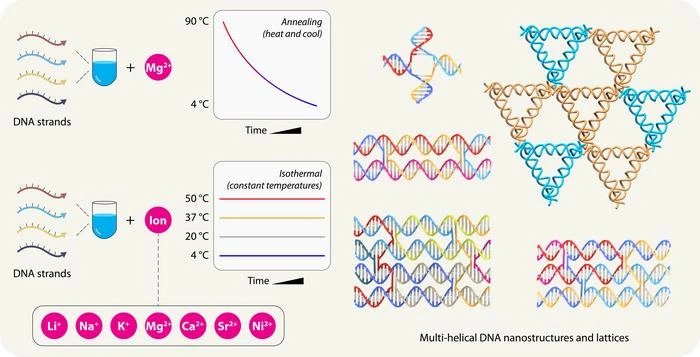
Their latest findings demonstrate a novel ability to assemble these structures without the need for extreme heat and controlled cooling. They also demonstrate successful assembly in unconventional “buffer” substances including nickel. These developments, published today in the journal Science Advances, unlock new possibilities in DNA nanotechnology.
DNA is most commonly recognized for its role in storing genetic information. Comprised of base pairs that can easily be manipulated, DNA is also an excellent material for constructing nanoscale objects. By “programming” the base pairs that make up DNA molecules, scientists can create precise structures as small as a few nanometers that can be engineered into shapes with intricate architectures. With their tiny scale and custom design, these structures can be used for highly accurate placement of things like biomolecules, cells and nanoparticles, with applications in biomedicine (e.g., drug delivery, therapeutics and diagnostic tools) and material design.
Creating these structures often requires DNA strands to be heated then cooled in special buffer solutions that typically contain magnesium ions. However, the need for precise temperature control limits possibilities for practical applications, and DNA nanostructures assembled in magnesium can pose challenges, including structural instability in biological environments.
To address these issues, the UAlbany team is exploring ways to assemble DNA nanostructures at moderate temperatures, and in a variety of metal ion solutions that lead to more stable nanostructures.
“We typically assemble DNA nanostructures by mixing the component DNA strands in a buffer solution, heating the solution to high temperatures (194 to 203 degrees Fahrenheit), then cooling it down to lower temperatures,” said senior author Arun Richard Chandrasekaran, senior research scientist at the RNA Institute. “In this new study, we show that DNA nanostructures can be assembled isothermally, that is, at constant moderate temperatures around 68 degrees Fahrenheit (room temperature) or 98.6 degrees Fahrenheit (body temperature). By eliminating the use of thermal cyclers or other fancy heating equipment, this greatly simplifies the process of nanostructure synthesis and opens up the possibility of assembling these structures at constant temperatures for applications in biological and materials science.”
Many DNA nanostructure applications involve attaching temperature-sensitive proteins (e.g., enzymes and antibodies) to the nanostructures. Assembling DNA nanostructures at moderate temperatures makes is easier to construct DNA nanodevices for drug delivery and diagnostics using these delicate biological components.
“Importantly, this work brings us closer to imagining how these nanostructures could actually be made and used in the human body for things like targeted drug delivery or precision diagnostics,” Chandrasekaran said. “While we still have a long way to go before this is possible, demonstrating DNA nanostructure assembly at body temperature is a promising step.”
In previous work, the UAlbany team successfully used calcium, barium, sodium, potassium and lithium for DNA nanostructure assembly using the high-temperature approach. In this study, they added nickel and strontium to the list, with the important difference that they were able to use these substances to construct DNA nanostructures at room and body temperature.
Assembling DNA nanostructures without the use of magnesium and at moderate temperatures enhances the structures’ potential utility in various applications. They also showed that DNA nanostructures made using this method have no negative effects on cell viability or immune response, indicating their potential use in biological applications.
“Our ongoing research aims to optimize nanostructure assembly in various metal ions and to test the biostability of these structures for a variety of potential future applications,” Chandrasekaran said. “Through innovative approaches to DNA nanostructure design and stabilization, we hope these advances in nanotechnology can help pave the way for new solutions to complex challenges in medicine and beyond.”
This work was a collaborative effort of the Chandrasekaran Lab. Contributors included: postdoctoral associate Bharath Raj Madhanagopal, research associates Arlin Rodriguez and Akul Patel, PhD student Hannah Talbot, and collaborators Andrew Berglund, Sweta Vangaveti and Ken Halvorsen.
The collaborators on this work are supported by the National Institutes of Health, including the National Institute of General Medical Sciences, the National Institute on Aging, and the National Institute of Neurological Disorders and Stroke; the University at Albany Faculty Research Awards Programs; a U.S. Army Medical Research Acquisition Activity Award; and the Muscular Dystrophy Association.
END
Their latest findings demonstrate a novel ability to assemble these structures without the need for extreme heat and controlled cooling. They also demonstrate successful assembly in unconventional “buffer” substances including nickel. These developments, published today in the journal Science Advances, unlock new possibilities in DNA nanotechnology.
DNA is most commonly recognized for its role in storing genetic information. Comprised of base pairs that can easily be manipulated, DNA is also an excellent material for constructing nanoscale objects. By “programming” the base pairs that make up DNA molecules, scientists can create precise structures as small as a few nanometers that can be engineered into shapes with intricate architectures. With their tiny scale and custom design, these structures can be used for highly accurate placement of things like biomolecules, cells and nanoparticles, with applications in biomedicine (e.g., drug delivery, therapeutics and diagnostic tools) and material design.
Creating these structures often requires DNA strands to be heated then cooled in special buffer solutions that typically contain magnesium ions. However, the need for precise temperature control limits possibilities for practical applications, and DNA nanostructures assembled in magnesium can pose challenges, including structural instability in biological environments.
To address these issues, the UAlbany team is exploring ways to assemble DNA nanostructures at moderate temperatures, and in a variety of metal ion solutions that lead to more stable nanostructures.
“We typically assemble DNA nanostructures by mixing the component DNA strands in a buffer solution, heating the solution to high temperatures (194 to 203 degrees Fahrenheit), then cooling it down to lower temperatures,” said senior author Arun Richard Chandrasekaran, senior research scientist at the RNA Institute. “In this new study, we show that DNA nanostructures can be assembled isothermally, that is, at constant moderate temperatures around 68 degrees Fahrenheit (room temperature) or 98.6 degrees Fahrenheit (body temperature). By eliminating the use of thermal cyclers or other fancy heating equipment, this greatly simplifies the process of nanostructure synthesis and opens up the possibility of assembling these structures at constant temperatures for applications in biological and materials science.”
Many DNA nanostructure applications involve attaching temperature-sensitive proteins (e.g., enzymes and antibodies) to the nanostructures. Assembling DNA nanostructures at moderate temperatures makes is easier to construct DNA nanodevices for drug delivery and diagnostics using these delicate biological components.
“Importantly, this work brings us closer to imagining how these nanostructures could actually be made and used in the human body for things like targeted drug delivery or precision diagnostics,” Chandrasekaran said. “While we still have a long way to go before this is possible, demonstrating DNA nanostructure assembly at body temperature is a promising step.”
In previous work, the UAlbany team successfully used calcium, barium, sodium, potassium and lithium for DNA nanostructure assembly using the high-temperature approach. In this study, they added nickel and strontium to the list, with the important difference that they were able to use these substances to construct DNA nanostructures at room and body temperature.
Assembling DNA nanostructures without the use of magnesium and at moderate temperatures enhances the structures’ potential utility in various applications. They also showed that DNA nanostructures made using this method have no negative effects on cell viability or immune response, indicating their potential use in biological applications.
“Our ongoing research aims to optimize nanostructure assembly in various metal ions and to test the biostability of these structures for a variety of potential future applications,” Chandrasekaran said. “Through innovative approaches to DNA nanostructure design and stabilization, we hope these advances in nanotechnology can help pave the way for new solutions to complex challenges in medicine and beyond.”
This work was a collaborative effort of the Chandrasekaran Lab. Contributors included: postdoctoral associate Bharath Raj Madhanagopal, research associates Arlin Rodriguez and Akul Patel, PhD student Hannah Talbot, and collaborators Andrew Berglund, Sweta Vangaveti and Ken Halvorsen.
The collaborators on this work are supported by the National Institutes of Health, including the National Institute of General Medical Sciences, the National Institute on Aging, and the National Institute of Neurological Disorders and Stroke; the University at Albany Faculty Research Awards Programs; a U.S. Army Medical Research Acquisition Activity Award; and the Muscular Dystrophy Association.
END