Biologists discover ancient neurohormone that controls appetite
Published 2025-03-24 · Original archive entry · Explore research explainers
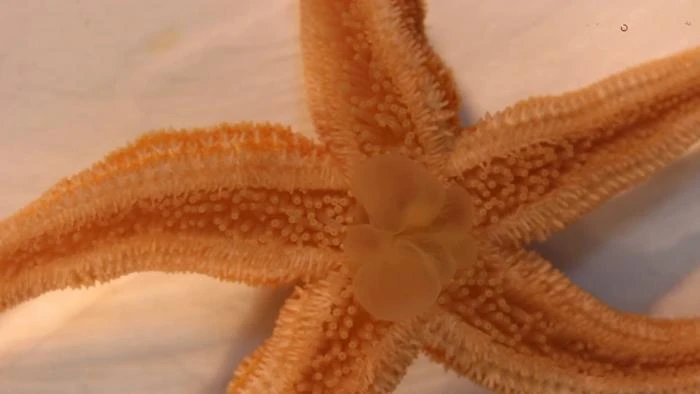
A team of biologists at Queen Mary University of London has discovered that a neurohormone controlling appetite in humans has an ancient evolutionary origin, dating back over half a billion years. The findings, published in Proceedings of the National Academy of Sciences USA, reveal that this satiety-inducing molecule, known as bombesin, is not only present in humans and other vertebrates but also in starfish and their marine relatives.
Bombesin, a small peptide, plays a key role in regulating hunger by signalling when we’ve had enough to eat. But its story doesn’t start with humans or even mammals. New research shows that bombesin-like neurohormones have been controlling appetite in animals since long before the first vertebrates evolved on Earth.
You may be wondering why bombesin has such a strange name? It has nothing to do with exploding devices! The name comes from the fire-bellied toad (Bombina bombina), from whose skin the peptide was first isolated in 1971. When injected into mammals, bombesin was found to reduce meal size and increase the time between meals. This led scientists to believe that bombesin-like neurohormones, produced in the brain and gut, are part of the body’s natural system for controlling food intake. Furthermore, alongside weight-loss inducing drugs such as Ozempic, compounds that mimic the action of bombesin are in development for treatment of obesity.
Professor Maurice Elphick and his team at Queen Mary University of London, in collaboration with Dr Olivier Mirabeau at the Institut Pasteur in Paris, set out to explore the evolutionary history of bombesin. By analysing the genomes of invertebrate animals, they discovered genes encoding bombesin-like neurohormones in the common starfish (Asterias rubens) and other echinoderms, such as sea urchins and sea cucumbers.
“It was a bit like looking for a needle in a haystack,” said Professor Elphick, “but eventually we discovered genes encoding a bombesin-like neurohormone in the genomes of starfish and their relatives.”
The team then turned their attention to the function of this starfish bombesin, named ArBN. Using mass spectrometry, collaborators at the University of Warwick determined the molecular structure of ArBN, allowing it to be chemically synthesised and tested.
Dr Weiling Huang, a former PhD student in the Elphick lab and lead author of the study, investigated how ArBN affects starfish feeding behaviour. Starfish have a unique way of eating: they evert their stomach out of their mouth to digest prey like mussels and oysters.
“When I tested ArBN, I saw that it caused contraction of the starfish stomach,” explained Dr Huang. “This suggested that ArBN might be involved in stimulating stomach retraction when starfish stop feeding. And this is exactly what I found. When I injected ArBN into starfish with their stomachs everted, it triggered the stomach to retract back into the mouth. What’s more, ArBN also delayed the initiation of feeding, as starfish injected with ArBN took longer to enclose a mussel compared to those injected with water.”
The discovery of bombesin’s ancient role in appetite regulation sheds light on the evolutionary origins of feeding behaviour in animals. “We can infer that this function extends back half-a-billion years to the common ancestor of starfish, humans, and other vertebrates,” said Professor Elphick.
In addition to development of novel weight-loss promoting drugs, the findings of this study could have other practical applications. “One of the consequences of climate change is that some starfish species are invading cooler waters where shellfish are cultivated for human consumption,” Professor Elphick added. “Discovering molecules that inhibit feeding in starfish could be useful in managing these invasions.”
This research not only deepens our understanding of the evolutionary history of neurohormones but also highlights the unexpected connections between humans and the strange, stomach-everting world of starfish.
The study was funded by BBSRC, China Scholarship Council and Leverhulme Trust.
END
Bombesin, a small peptide, plays a key role in regulating hunger by signalling when we’ve had enough to eat. But its story doesn’t start with humans or even mammals. New research shows that bombesin-like neurohormones have been controlling appetite in animals since long before the first vertebrates evolved on Earth.
You may be wondering why bombesin has such a strange name? It has nothing to do with exploding devices! The name comes from the fire-bellied toad (Bombina bombina), from whose skin the peptide was first isolated in 1971. When injected into mammals, bombesin was found to reduce meal size and increase the time between meals. This led scientists to believe that bombesin-like neurohormones, produced in the brain and gut, are part of the body’s natural system for controlling food intake. Furthermore, alongside weight-loss inducing drugs such as Ozempic, compounds that mimic the action of bombesin are in development for treatment of obesity.
Professor Maurice Elphick and his team at Queen Mary University of London, in collaboration with Dr Olivier Mirabeau at the Institut Pasteur in Paris, set out to explore the evolutionary history of bombesin. By analysing the genomes of invertebrate animals, they discovered genes encoding bombesin-like neurohormones in the common starfish (Asterias rubens) and other echinoderms, such as sea urchins and sea cucumbers.
“It was a bit like looking for a needle in a haystack,” said Professor Elphick, “but eventually we discovered genes encoding a bombesin-like neurohormone in the genomes of starfish and their relatives.”
The team then turned their attention to the function of this starfish bombesin, named ArBN. Using mass spectrometry, collaborators at the University of Warwick determined the molecular structure of ArBN, allowing it to be chemically synthesised and tested.
Dr Weiling Huang, a former PhD student in the Elphick lab and lead author of the study, investigated how ArBN affects starfish feeding behaviour. Starfish have a unique way of eating: they evert their stomach out of their mouth to digest prey like mussels and oysters.
“When I tested ArBN, I saw that it caused contraction of the starfish stomach,” explained Dr Huang. “This suggested that ArBN might be involved in stimulating stomach retraction when starfish stop feeding. And this is exactly what I found. When I injected ArBN into starfish with their stomachs everted, it triggered the stomach to retract back into the mouth. What’s more, ArBN also delayed the initiation of feeding, as starfish injected with ArBN took longer to enclose a mussel compared to those injected with water.”
The discovery of bombesin’s ancient role in appetite regulation sheds light on the evolutionary origins of feeding behaviour in animals. “We can infer that this function extends back half-a-billion years to the common ancestor of starfish, humans, and other vertebrates,” said Professor Elphick.
In addition to development of novel weight-loss promoting drugs, the findings of this study could have other practical applications. “One of the consequences of climate change is that some starfish species are invading cooler waters where shellfish are cultivated for human consumption,” Professor Elphick added. “Discovering molecules that inhibit feeding in starfish could be useful in managing these invasions.”
This research not only deepens our understanding of the evolutionary history of neurohormones but also highlights the unexpected connections between humans and the strange, stomach-everting world of starfish.
The study was funded by BBSRC, China Scholarship Council and Leverhulme Trust.
END