A kimchi bacterium binds nanoplastics in the gut — and doubles their excretion in mice
World Institute of Kimchi (WiKim), Republic of Korea / Bioresource Technology
You are already eating nanoplastics. They ride in on drinking water, seafood, table salt, tea bags, and the invisible dust that settles on your dinner plate. Particles smaller than one micrometer—a thousand times thinner than a millimeter—slip through food packaging and municipal filtration alike. Once swallowed, the smallest fragments can breach the intestinal lining and lodge in the kidneys, liver, and brain. What no one has had is a plausible biological strategy for intercepting those particles before they cross the gut wall.
A team at the World Institute of Kimchi (WiKim), a government-funded research body under South Korea's Ministry of Science and ICT, now reports one. A lactic acid bacterium plucked from fermented kimchi, Leuconostoc mesenteroides CBA3656, adsorbs polystyrene nanoplastics on its cell surface and rides them out of the body in feces. In germ-free mice, animals given the strain excreted more than twice the nanoplastics found in control animals that received no probiotic.
Why the gut is the bottleneck
The global conversation about microplastic contamination has shifted rapidly from oceans and rivers to human tissue. Studies over the past few years have detected plastic fragments in blood, placental tissue, and arterial plaques. The sheer volume of exposure is staggering: some estimates suggest the average person ingests roughly five grams of plastic per week—about the weight of a credit card—though the true figure remains debated. What is less debated is that the gastrointestinal tract is where most of that exposure begins. Nanoplastics ingested with food linger in the intestine, and a fraction small enough to evade the mucosal barrier enters systemic circulation, potentially triggering inflammatory responses in tissues never designed to handle synthetic polymers.
The research community has poured effort into detecting and quantifying these particles. Filtration technologies, water treatment upgrades, and packaging redesigns all aim to reduce exposure at the source. But once nanoplastics are already inside the body, the options narrow dramatically. Pharmaceutical approaches—chelation agents, binders—have not been developed for plastic particles the way they have for heavy metals. Biological strategies to reduce nanoplastic accumulation in the gastrointestinal tract remain at the very earliest stages of investigation.
That gap motivated Drs. Se Hee Lee and Tae Woong Whon at WiKim to ask a simple question: could bacteria that already thrive in the human gut physically grab nanoplastics and carry them out?
87% in a test tube, 57% in a fake gut
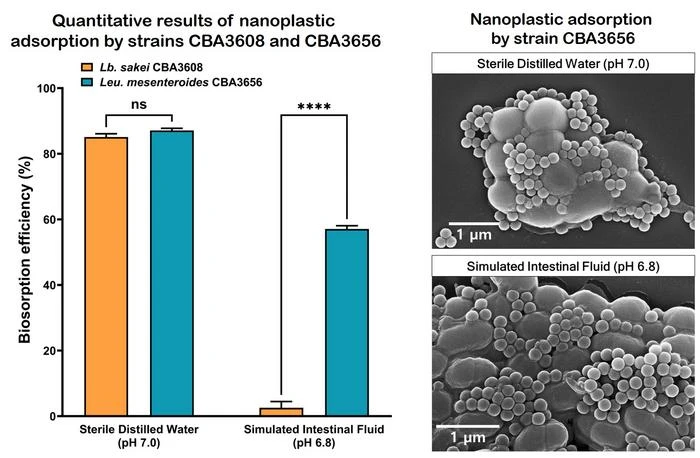
The researchers screened kimchi-derived lactic acid bacteria for their ability to adsorb polystyrene nanoplastics (PS-NPs), a standard laboratory proxy for the nanoscale plastic particles humans ingest. Under standard lab conditions, L. mesenteroides CBA3656 bound 87% of available nanoplastics—on par with a reference strain, Latilactobacillus sakei CBA3608, which managed 85%.
The real separation came in a simulated intestinal environment, designed to mimic the pH, bile salts, and enzymatic activity of the human gut. CBA3608 collapsed. Its adsorption rate fell to just 3%. CBA3656 held at 57%.
That gap—from roughly equal performance to a nearly twentyfold difference—matters because any candidate probiotic must function in the hostile chemistry of the actual intestine, not just in a clean buffer solution. A bacterium that loses its grip on nanoplastics the moment it encounters bile is biologically interesting but practically useless.
Twice the plastic out the other end
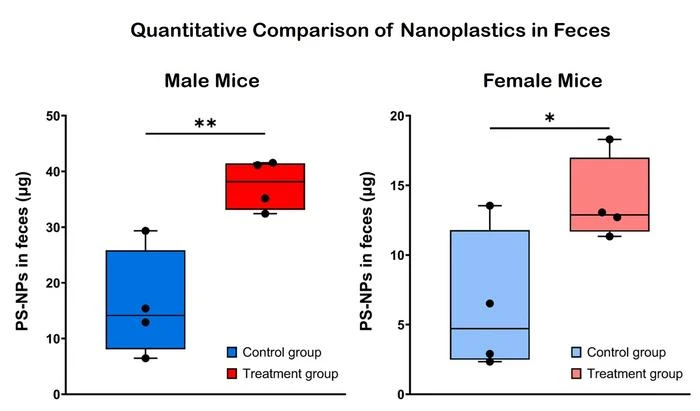
To test whether the in-vitro promise translated to a living system, the team turned to germ-free mice—animals raised without any intestinal microbiome, ensuring that the only bacterium in the gut was the one the researchers introduced. Both male and female mice received oral doses of strain CBA3656 along with polystyrene nanoplastics.
Compared with control mice that swallowed nanoplastics but no probiotic, the treated animals showed a more than twofold increase in nanoplastic concentration in their feces. The interpretation is straightforward: the bacterium bound the plastic particles in the intestine and ferried them out before they could be absorbed.
Germ-free mouse models are a deliberate simplification. The absence of competing microbes makes it easier to attribute effects to the introduced strain, but it also means the intestinal environment bears little resemblance to the crowded, competitive ecosystem of a human gut hosting trillions of resident bacteria. Whether CBA3656 can maintain its adsorption performance amid that microbial competition remains an open question.
Surface chemistry, not metabolism
The mechanism here is biosorption—physical binding of plastic particles to the bacterial cell surface—rather than biodegradation. CBA3656 does not break nanoplastics down. It sticks to them. The distinction matters for two reasons. First, biosorption does not require the bacterium to be metabolically active in any special way; it simply needs the right surface properties. Second, the plastic particles leave the body intact, which avoids the concern that partial degradation might generate even smaller or more toxic fragments.
What gives CBA3656 its surface stickiness under intestinal conditions while CBA3608 loses it is not yet fully characterized. Lactic acid bacteria display a range of surface proteins, polysaccharides, and lipoteichoic acids that vary between species and even between strains of the same species. Any of these could influence how strongly—and how durably—a cell binds to a polystyrene particle in the presence of bile salts and digestive enzymes. The researchers note the performance difference but stop short of identifying the specific cell-surface molecules responsible. Future work pinpointing those structures could open the door to engineering strains with even higher adsorption capacity, or to selecting naturally occurring variants from other fermented food traditions.
Kimchi's expanding portfolio
Kimchi-derived lactic acid bacteria have long been studied for conventional probiotic properties—immune modulation, pathogen inhibition, gut barrier support. This study plants a flag in different territory: interaction with environmental contaminants. It suggests that the microbial diversity of traditional fermented foods harbors capabilities no one was looking for until the nanoplastic problem demanded it.
"Plastic pollution is increasingly recognized not only as an environmental issue but also as a public health concern," said Dr. Se Hee Lee. The team has signaled plans to continue mining kimchi's microbial resources for strains with health and environmental applications.
What this does not prove
The study, published in Bioresource Technology (impact factor 9.0), is early-stage work, and the researchers are careful not to overclaim. Several important caveats deserve attention.
First, the mouse model used germ-free animals. A conventional mouse—or a human—carries a dense intestinal microbiome that could compete with CBA3656 for surface area, alter bile salt profiles, or metabolize the bacterium before it can act. The twofold excretion increase observed here is a proof of concept, not a clinical result.
Second, the study used polystyrene nanoplastics as a model contaminant. Real-world nanoplastic exposure involves a mixture of polymer types—polyethylene, polypropylene, PET, and others—each with different surface charges and chemical properties. Whether CBA3656 adsorbs those with equal efficiency is unknown.
Third, this is an animal study with no human data. The leap from germ-free mice to human clinical relevance involves differences in gut length, transit time, immune function, diet, and microbiome composition that cannot be hand-waved away.
Still, as a demonstration that a food-grade bacterium can physically intercept nanoplastics under conditions at least approximating the gut, the work opens a line of inquiry that barely existed before. The next steps would logically include testing in conventional (non-germ-free) mice, expanding the range of polymer types, and eventually designing human pilot studies—each a substantial undertaking that will take years, not months. For now, the kimchi jar on your kitchen counter just got a little more interesting.
Study details
"Efficient biosorption of nanoplastics by food-derived lactic acid bacterium," published in Bioresource Technology.
Corresponding authors: Tae Woong Whon, PhD, and Se Hee Lee, PhD. First author: Jisu Lee, PhD.
Institution: World Institute of Kimchi (WiKim), Republic of Korea.