Drone footage captures sperm whales headbutting each other for the first time
In 1820, a sperm whale rammed the whaleship Essex twice in the head, sinking it in the middle of the Pacific Ocean. The crew drifted for months. Most died. The survivor accounts became the raw material for Herman Melville's novel Moby Dick and cemented the sperm whale's reputation as an animal capable of using its massive head as a weapon. For two centuries, that reputation rested almost entirely on the word of 19th-century whalers. No scientist had ever documented the behavior.
That changed with a drone, some patience, and fieldwork in the Atlantic.
First footage from the Azores and Balearic Islands
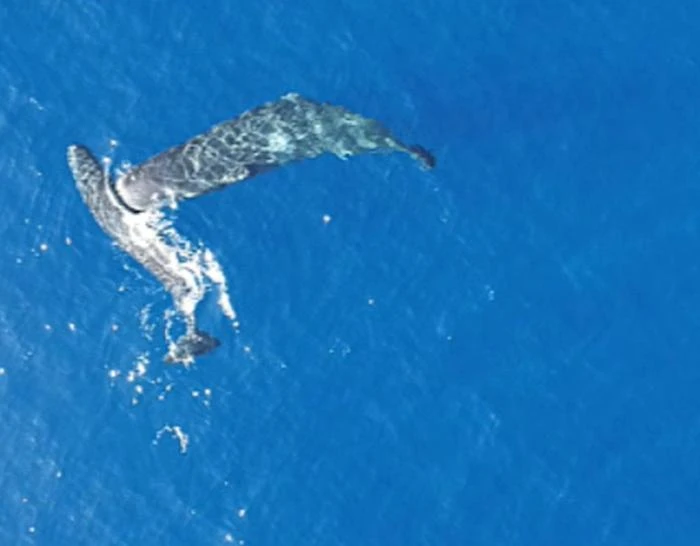
A study published March 23 in Marine Mammal Science reports the first known scientific documentation of sperm whales headbutting one another. Lead author Alec Burslem, who conducted the research while at the University of St Andrews, used drone technology to film the behavior from directly overhead during fieldwork in the Azores and Balearic Islands between 2020 and 2022.
The drones provided a perspective that boat-based observation cannot match. From the surface, much of what sperm whales do near the waterline is obscured by waves and the animals' own bulk. From above, researchers could see whales deliberately pushing and striking each other with their heads, along with the social context surrounding each event - which whales were nearby, how the group was arranged, and what happened before and after the collision.
Sub-adults, not bull males
The most surprising finding was who was doing the headbutting. Previous hypotheses had assumed that head-ramming was a feature of competition between large adult males - bulls fighting for mating access, essentially. The drone footage tells a different story. The whales engaging in headbutting behavior were sub-adults, younger animals that have not yet reached full physical maturity.
This raises questions that the current study cannot answer. If headbutting is not primarily about male-male competition for mates, what function does it serve? Is it play behavior, similar to the rough-and-tumble sparring seen in many young mammals? Is it practice for adult aggression? Does it serve a role in establishing social hierarchies within groups? Or is it something else entirely?
The researchers note that more observations are needed before the function of the behavior can be determined. They have issued an open call to anyone with similar footage to share it for analysis.
The spermaceti organ and the risk of ramming
Sperm whale heads are unusual structures. They contain the spermaceti organ, a massive reservoir of waxy liquid that was once hunted for lamp oil and industrial lubricants. The organ is central to the whale's ability to produce the powerful clicking sounds used for echolocation - the sonar system that allows sperm whales to hunt squid in the deep ocean - and for social communication.
Some researchers have argued that habitual use of the head as a battering ram would be unlikely to evolve because it risks damaging the spermaceti organ and the associated sound-producing structures. An animal that breaks its sonar by headbutting a rival would face serious consequences - inability to hunt, inability to communicate, and likely death.
Others have countered that the head's size and density could absorb impacts, and that the behavior might simply occur underwater where it would be invisible to surface observers. The new footage does not resolve this debate, but it confirms that headbutting occurs at least near the surface and involves forceful contact.
From the Essex to modern whale science
The historical accounts of sperm whales attacking ships were long treated with some skepticism by scientists, partly because no one had observed the behavior under controlled conditions. The Essex sinking in 1820 is the most famous case, but it was not unique. The whaleships Ann Alexander and Kathleen were also reported sunk by sperm whale head strikes in the 19th century.
Owen Chase, first mate of the Essex, described the attacking whale approaching at twice its normal speed with its head half out of the water. Whether those ship-ramming events involved the same behavioral repertoire as the whale-to-whale headbutting documented in this study is unclear. Striking a wooden ship and striking another whale are mechanically different acts, and the motivations may be entirely unrelated.
What the new research establishes is that sperm whales do deliberately use their heads to contact other whales, that the behavior can be filmed and analyzed systematically, and that the animals engaging in it are not the ones scientists expected.
Drones and what remains unseen
The study is limited by the nature of drone observation. Drones can film behavior at or near the surface, but sperm whales spend most of their time at depth, diving routinely to 1,000 meters or more. If headbutting occurs primarily underwater, the surface observations captured here may represent only a small fraction of the total behavior.
The sample size is also small - the study documents specific events rather than providing population-level estimates of how common headbutting is. And the fieldwork was conducted at two locations in the eastern Atlantic, which may not be representative of sperm whale populations elsewhere.
Still, the footage fills a gap that has been open since Melville's day. The sperm whale's head is indeed used as an instrument of deliberate physical contact with other whales. The whalers were right about that much.