Quantum simulator becomes accessible to the world
Austrian researchers realize a toolbox for open-system quantum simulation
Published 2011-02-24 · Original archive entry · Explore research explainers
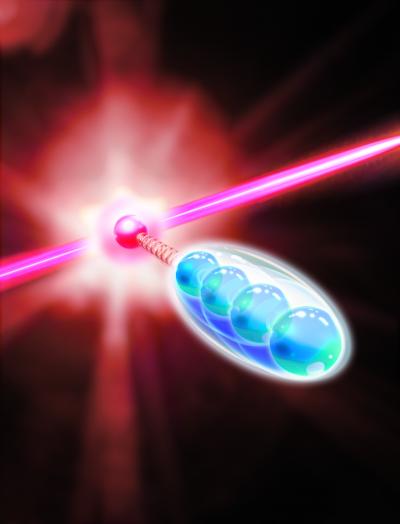
Experimental physicists have put a lot of effort in isolating sensitive measurements from the disruptive influences of the environment. In an international first, Austrian quantum physicists have realized a toolbox of elementary building blocks for an open-system quantum simulator, where a controlled coupling to an environment is used in a beneficial way. This offers novel prospects for studying the behavior of highly complex quantum systems. The researchers have published their work in the scientific journal Nature.
Many phenomena in our world are based on the nature of quantum physics: the structure of atoms and molecules, chemical reactions, material properties, magnetism and possibly also certain biological processes. Since the complexity of phenomena increases exponentially with more quantum particles involved, a detailed study of these complex systems reaches its limits quickly; and conventional computers fail when calculating these problems. To overcome these difficulties, physicists have been developing quantum simulators on various platforms, such as neutral atoms, ions or solid-state systems, which, similar to quantum computers, utilize the particular nature of quantum physics to control this complexity. In a special issue at the end of 2010, the scientific journal Science chose the progress made in this field as one of the scientific breakthroughs of the year 2010.
In another breakthrough in this field, a team of young scientists in the research groups of Rainer Blatt and Peter Zoller at the Institute for Experimental Physics and Theoretical Physics of the University of Innsbruck and the Institute of Quantum Optics and Quantum Information (IQOQI) of the Austrian Academy of Sciences have been the first to engineer a comprehensive toolbox for an open-system quantum computer, which will enable researchers to construct more sophisticated quantum simulators for investigating complex problems in quantum physics.
Using controlled dissipation
The physicists use a natural phenomenon In their experiments that they usually try to minimize as much as possible: environmental disturbances. Such disturbances usually cause information loss in quantum systems and destroy fragile quantum effects such as entanglement or interference. In physics this deleterious process is called dissipation. Innsbruck researchers, led by experimental physicists Julio Barreiro and Philipp Schindler as well as the theorist Markus Müller, have now been first in using dissipation in a quantum simulator with trapped ions in a beneficial way and engineered system-environment coupling experimentally. "We not only control all internal states of the quantum system consisting of up to four ions but also the coupling to the environment," explains Julio Barreiro. "In our experiment we use an additional ion that interacts with the quantum system and, at the same time, establishes a controlled contact to the environment," explains Philipp Schindler. The surprising result is that by using dissipation, the researchers are able to generate and intensify quantum effects, such as entanglement, in the system. "We achieved this by controlling the disruptive environment," says an excited Markus Müller.
Putting the quantum world into order
In one of their experiments the researchers demonstrate the control of dissipative dynamics by entangling four ions using the environment ion. "Contrary to other common procedures this also works irrespective of the initial state of each particle," explains Müller. "Through a collective cooling process, the particles are driven to a common state." This procedure can be used to prepare many-body states, which otherwise could only be created and observed in an extremely well isolated quantum system. The beneficial use of an environment allows for the realization of new types of quantum dynamics and the investigation of systems that have scarcely been accessible for experiments until now. In the last few years there has been continuous thinking about how dissipation, instead of suppressing it, could be actively used as a resource for building quantum computers and quantum memories. Innsbruck theoretical and experimental physicists cooperated closely and they have now been the first to successfully implement these dissipative effects in a quantum simulator.
INFORMATION:
The Innsbruck researchers are supported by the Austrian Science Fund (FWF), the European Commission and the Federation of Austrian Industries Tyrol.
Publication: An Open-System Quantum Simulator with Trapped Ions. Julio T. Barreiro, Markus Müller, Philipp Schindler, Daniel Nigg, Thomas Monz, Michael Chwalla, Markus Hennrich, Christian F. Roos, Peter Zoller und Rainer Blatt. Nature 2011. DOI: 10.1038/nature09801 (http://dx.doi.org/10.1038/nature09801)
Many phenomena in our world are based on the nature of quantum physics: the structure of atoms and molecules, chemical reactions, material properties, magnetism and possibly also certain biological processes. Since the complexity of phenomena increases exponentially with more quantum particles involved, a detailed study of these complex systems reaches its limits quickly; and conventional computers fail when calculating these problems. To overcome these difficulties, physicists have been developing quantum simulators on various platforms, such as neutral atoms, ions or solid-state systems, which, similar to quantum computers, utilize the particular nature of quantum physics to control this complexity. In a special issue at the end of 2010, the scientific journal Science chose the progress made in this field as one of the scientific breakthroughs of the year 2010.
In another breakthrough in this field, a team of young scientists in the research groups of Rainer Blatt and Peter Zoller at the Institute for Experimental Physics and Theoretical Physics of the University of Innsbruck and the Institute of Quantum Optics and Quantum Information (IQOQI) of the Austrian Academy of Sciences have been the first to engineer a comprehensive toolbox for an open-system quantum computer, which will enable researchers to construct more sophisticated quantum simulators for investigating complex problems in quantum physics.
Using controlled dissipation
The physicists use a natural phenomenon In their experiments that they usually try to minimize as much as possible: environmental disturbances. Such disturbances usually cause information loss in quantum systems and destroy fragile quantum effects such as entanglement or interference. In physics this deleterious process is called dissipation. Innsbruck researchers, led by experimental physicists Julio Barreiro and Philipp Schindler as well as the theorist Markus Müller, have now been first in using dissipation in a quantum simulator with trapped ions in a beneficial way and engineered system-environment coupling experimentally. "We not only control all internal states of the quantum system consisting of up to four ions but also the coupling to the environment," explains Julio Barreiro. "In our experiment we use an additional ion that interacts with the quantum system and, at the same time, establishes a controlled contact to the environment," explains Philipp Schindler. The surprising result is that by using dissipation, the researchers are able to generate and intensify quantum effects, such as entanglement, in the system. "We achieved this by controlling the disruptive environment," says an excited Markus Müller.
Putting the quantum world into order
In one of their experiments the researchers demonstrate the control of dissipative dynamics by entangling four ions using the environment ion. "Contrary to other common procedures this also works irrespective of the initial state of each particle," explains Müller. "Through a collective cooling process, the particles are driven to a common state." This procedure can be used to prepare many-body states, which otherwise could only be created and observed in an extremely well isolated quantum system. The beneficial use of an environment allows for the realization of new types of quantum dynamics and the investigation of systems that have scarcely been accessible for experiments until now. In the last few years there has been continuous thinking about how dissipation, instead of suppressing it, could be actively used as a resource for building quantum computers and quantum memories. Innsbruck theoretical and experimental physicists cooperated closely and they have now been the first to successfully implement these dissipative effects in a quantum simulator.
INFORMATION:
The Innsbruck researchers are supported by the Austrian Science Fund (FWF), the European Commission and the Federation of Austrian Industries Tyrol.
Publication: An Open-System Quantum Simulator with Trapped Ions. Julio T. Barreiro, Markus Müller, Philipp Schindler, Daniel Nigg, Thomas Monz, Michael Chwalla, Markus Hennrich, Christian F. Roos, Peter Zoller und Rainer Blatt. Nature 2011. DOI: 10.1038/nature09801 (http://dx.doi.org/10.1038/nature09801)