Seeing in stereo: Engineers invent lens for 3-D microscope
Published 2011-03-22 · Original archive entry · Explore research explainers
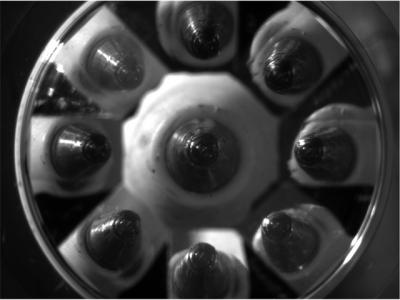
COLUMBUS, Ohio – Engineers at Ohio State University have invented a lens that enables microscopic objects to be seen from nine different angles at once to create a 3D image.
Other 3D microscopes use multiple lenses or cameras that move around an object; the new lens is the first single, stationary lens to create microscopic 3D images by itself.
Allen Yi, associate professor of integrated systems engineering at Ohio State, and postdoctoral researcher Lei Li described the lens in a recent issue of the Journal of the Optical Society of America A.
Yi called the lens a proof of concept for manufacturers of microelectronics and medical devices, who currently use very complex machinery to view the tiny components that they assemble.
Though the engineers milled their prototype thermoplastic lens on a precision cutting machine, the same lens could be manufactured less expensively through traditional molding techniques, Yi said.
"Ultimately, we hope to help manufacturers reduce the number and sizes of equipment they need to miniaturize products," he added.
The prototype lens, which is about the size of a fingernail, looks at first glance like a gem cut for a ring, with a flat top surrounded by eight facets. But while gemstones are cut for symmetry, this lens is not symmetric. The sizes and angles of the facets vary in minute ways that are hard to see with the naked eye.
"No matter which direction you look at this lens, you see a different shape," Yi explained. Such a lens is called a "freeform lens," a type of freeform optics.
Freeform optics have been in use for more than a decade. But Lei Li was able to write a computer program to design a freeform lens capable of imaging microscopic objects.
Then Yi and Li used a commercially available milling tool with a diamond blade to cut the shape from a piece of the common thermoplastic material polymethyl methacrylate, a transparent plastic that is sometimes called acrylic glass. The machine shaved bits of plastic from the lens in increments of 10 nanometers, or 10 billionths of a meter – a distance about 5,000 times smaller than the diameter of a human hair.
The final lens resembled a rhinestone, with a faceted top and a wide, flat bottom. They installed the lens on a microscope with a camera looking down through the faceted side, and centered tiny objects beneath the flat side.
Each facet captured an image of the objects from a different angle, which can be combined on a computer into a 3D image.
The engineers successfully recorded 3D images of the tip of a ballpoint pen – which has a diameter of about 1 millimeter – and a mini drill bit with a diameter of 0.2 millimeters.
"Using our lens is basically like putting several microscopes into one microscope," said Li. "For us, the most attractive part of this project is we will be able to see the real shape of micro-samples instead of just a two-dimensional projection."
In the future, Yi would like to develop the technology for manufacturers. He pointed to the medical testing industry, which is working to shrink devices that analyze fluid samples. Cutting tiny reservoirs and channels in plastic requires a clear view, and the depths must be carved with precision.
Computer-controlled machines – rather than humans – do the carving, and Yi says that the new lens can be placed in front of equipment that is already in use. It can also simplify the design of future machine vision equipment, since multiple lenses or moving cameras would no longer be necessary.
Other devices could use the tiny lens, and he and Li have since produced a grid-shaped array of lenses made to fit an optical sensor. Another dome-shaped lens is actually made of more than 1,000 tiny lenses, similar in appearance to an insect's eye.
INFORMATION:
This research was sponsored by the National Science Foundation. Moore Nanotechnology Systems in Keene, NH, provided the ultraprecision milling machine.
Other 3D microscopes use multiple lenses or cameras that move around an object; the new lens is the first single, stationary lens to create microscopic 3D images by itself.
Allen Yi, associate professor of integrated systems engineering at Ohio State, and postdoctoral researcher Lei Li described the lens in a recent issue of the Journal of the Optical Society of America A.
Yi called the lens a proof of concept for manufacturers of microelectronics and medical devices, who currently use very complex machinery to view the tiny components that they assemble.
Though the engineers milled their prototype thermoplastic lens on a precision cutting machine, the same lens could be manufactured less expensively through traditional molding techniques, Yi said.
"Ultimately, we hope to help manufacturers reduce the number and sizes of equipment they need to miniaturize products," he added.
The prototype lens, which is about the size of a fingernail, looks at first glance like a gem cut for a ring, with a flat top surrounded by eight facets. But while gemstones are cut for symmetry, this lens is not symmetric. The sizes and angles of the facets vary in minute ways that are hard to see with the naked eye.
"No matter which direction you look at this lens, you see a different shape," Yi explained. Such a lens is called a "freeform lens," a type of freeform optics.
Freeform optics have been in use for more than a decade. But Lei Li was able to write a computer program to design a freeform lens capable of imaging microscopic objects.
Then Yi and Li used a commercially available milling tool with a diamond blade to cut the shape from a piece of the common thermoplastic material polymethyl methacrylate, a transparent plastic that is sometimes called acrylic glass. The machine shaved bits of plastic from the lens in increments of 10 nanometers, or 10 billionths of a meter – a distance about 5,000 times smaller than the diameter of a human hair.
The final lens resembled a rhinestone, with a faceted top and a wide, flat bottom. They installed the lens on a microscope with a camera looking down through the faceted side, and centered tiny objects beneath the flat side.
Each facet captured an image of the objects from a different angle, which can be combined on a computer into a 3D image.
The engineers successfully recorded 3D images of the tip of a ballpoint pen – which has a diameter of about 1 millimeter – and a mini drill bit with a diameter of 0.2 millimeters.
"Using our lens is basically like putting several microscopes into one microscope," said Li. "For us, the most attractive part of this project is we will be able to see the real shape of micro-samples instead of just a two-dimensional projection."
In the future, Yi would like to develop the technology for manufacturers. He pointed to the medical testing industry, which is working to shrink devices that analyze fluid samples. Cutting tiny reservoirs and channels in plastic requires a clear view, and the depths must be carved with precision.
Computer-controlled machines – rather than humans – do the carving, and Yi says that the new lens can be placed in front of equipment that is already in use. It can also simplify the design of future machine vision equipment, since multiple lenses or moving cameras would no longer be necessary.
Other devices could use the tiny lens, and he and Li have since produced a grid-shaped array of lenses made to fit an optical sensor. Another dome-shaped lens is actually made of more than 1,000 tiny lenses, similar in appearance to an insect's eye.
INFORMATION:
This research was sponsored by the National Science Foundation. Moore Nanotechnology Systems in Keene, NH, provided the ultraprecision milling machine.