PRESS-NEWS.org - Press Release Distribution
PRESS RELEASES DISTRIBUTION

Millipede family added to Australian fauna

Millipede family added to Australian fauna
2012-08-30
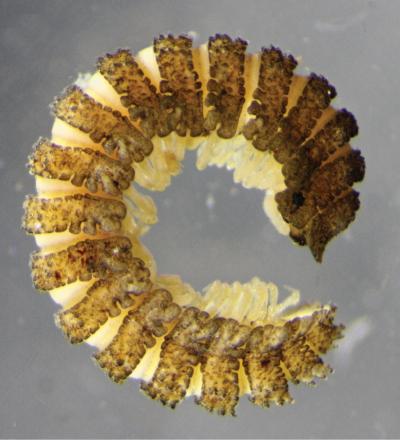
(Press-News.org) An entire group of millipedes previously unknown in Australia has been discovered by a specialist – on museum shelves. Hundreds of tiny specimens of the widespread tropical family Pyrgodesmidae have been found among bulk samples in two museums, showing that native pyrgodesmids are not only widespread in Australia's tropical and subtropical forests, but are also abundant and diverse. The study has been published in the open access journal ZooKeys.

"Most pyrgodesmid species are so small they could be easily overlooked," explained millipede specialist Dr Robert Mesibov, of the Queen Victoria Museum and Art Gallery in Launceston, Tasmania. "What's interesting is how thoroughly overlooked they've been. We now know there are dozens of native species of these millipedes in our warm, wet forests, stretching over more than 2000 km on Australia's east coast."

Six new species and three new genera of the colorful, curiously sculptured millipedes have now been described from Australia, all from the state of Queensland.

"It's a great example of the value of museum collections," said Dr Mesibov. "Scientists from the Queensland Museum and CSIRO Entomology collected bagfuls of leaf litter in hundreds of places over many years. They extracted bugs in bulk from the fresh litter and took out just the ones they were studying, usually beetles. The remaining bugs are in 'residues' stored in the Queensland Museum and the Australian National Insect Collection."

Dr Mesibov said it's not generally appreciated that zoological specialists find most of their new species in museums. "Sure, biological expeditions to previously unexplored places turn up exciting new species. But there are plenty of surprises waiting when you go rummaging through the residues on museum shelves. In this case, it was a whole family of animals not known from Australia."


INFORMATION:

Original source:

Mesibov R (2012) The first native Pyrgodesmidae (Diplopoda, Polydesmida) from Australia. ZooKeys 217: 63. doi: 10.3897/zookeys.217.3809

Additional Information:

The millipede research was supported by a grant from the Australian Biological Resources Study.

Posted by Pensoft Publishers.


[Attachments] See images for this press release:
Millipede family added to Australian fauna

ELSE PRESS RELEASES FROM THIS DATE:

What babies eat after birth likely determines lifetime risk of obesity, rat study suggests

2012-08-30
Rats born to mothers fed high-fat diets but who get normal levels of fat in their diets right after birth avoid obesity and its related disorders as adults, according to new Johns Hopkins research. Meanwhile, rat babies exposed to a normal-fat diet in the womb but nursed by rat mothers on high-fat diets become obese by the time they are weaned. The experiments suggest that what mammalian babies — including humans — get to eat as newborns and young children may be more important to their metabolic future than exposure to unhealthy nutrition in the womb, the Hopkins ...

Gender bias in leading scientific journals

2012-08-30
Fewer women than men are asked to write in the leading scientific journals. That is established by two researchers from Lund University in Sweden, who criticise the gender bias. In the 30 August issue of Nature, researchers have published an article showing that a much lower percentage of women than men are invited to write articles in News & Views in Nature and Perspectives in Science. "We believe that fewer women than men are offered the career boost of invitation-only authorship in each of the two leading science journals" says Daniel Conley, a researcher at Lund ...

Bitter tastes quickly turn milk chocolate fans sour

2012-08-30
Dark chocolate lovers can handle a wider range of bitter tastes before rejection compared to milk chocolate fans, according to Penn State food scientists. In a test of bitterness rejection levels in chocolate, people who prefer milk chocolate quickly detected -- and disliked -- milk chocolate with a bitter substance added to the candy, according to Meriel Harwood, a graduate student in food science. Dark chocolate fans had significantly higher tolerance to the added bitterness than people who like milk chocolate. "In some cases, you may be able to detect a change in ...

Shedding new light on one of diabetes' most dangerous complications

Shedding new light on one of diabetes most dangerous complications
2012-08-30
VIDEO: This movie compares the blood flow dynamics in a cross-section of the foot between a healthy individual and a diabetic patient with PAD. Differences are clearly visible in both the... Click here for more information. WASHINGTON, Aug. 30, 2012—For many diabetics, monitoring their condition involves much more than adhering to a routine of glucose sensing and insulin injections. It also entails carefully monitoring the ongoing toll this disease takes on their body. An ...

Increased sediment and nutrients delivered to bay as Susquehanna reservoirs near sediment capacity

2012-08-30
Reservoirs near the mouth of the Susquehanna River just above Chesapeake Bay are nearly at capacity in their ability to trap sediment. As a result, large storms are already delivering increasingly more suspended sediment and nutrients to the Bay, which may negatively impact restoration efforts. Too many nutrients rob the Bay of oxygen needed for fish and, along with sediment, cloud the waters, disturbing the habitat of underwater plants crucial for aquatic life and waterfowl. "The upstream reservoirs have served previously to help reduce nutrient pollutant loads to ...

Kidney stenting lowers blood pressure in patients with severe hypertension

2012-08-30
Patients with uncontrolled renovascular hypertension saw a significant improvement in their blood pressure with renal artery stent deployment. The multicenter HERCULES trial, evaluating the safety and effectiveness of the RX Herculink Elite Stent, found that patients with higher blood pressure levels at baseline had the most dramatic reduction in blood pressure following intervention. Trial details appear in Catheterization and Cardiovascular Interventions, a journal published by Wiley on behalf of the Society for Cardiovascular Angiography and Interventions (SCAI). Narrowing ...

Water pipe smoking has the same respiratory effects as smoking cigarettes

2012-08-30
A new study published in the journal Respirology reveals that water pipe smoking, such as hookah or bong smoking, affects lung function and respiratory symptoms as much as cigarette smoking. Most users of water pipes and many physicians believe that smoking through a water pipe filters out the toxic components of tobacco and is considerably less harmful than smoking cigarettes. Led by Mohammad Hossein Boskabady, MD, PhD, of Mashhad University of Medical Sciences, researchers set out to compare lung function and respiratory symptoms among water pipe smokers, deep or ...

Immunodeficient patients with secondary lung disease benefit from combined chemotherapy

2012-08-30
A team of researchers at the Medical College of Wisconsin and Children's Hospital of Wisconsin Research Institute defined a new treatment for a potentially fatal lung disease in patients with a primary immunodeficiency known as common variable immunodeficiency (CVID).The findings are published in the Journal of Clinical Immunology. Common variable immunodeficiency (CVID) is the most common primary immunodeficiency that requires regular treatment with medication, specifically immunoglobulin (antibodies) replacement therapy. With immunoglobulin therapy, deaths from infection ...

A model for development

A model for development
2012-08-30
PASADENA, Calif.—As an animal develops from an embryo, its cells take diverse paths, eventually forming different body parts -- muscles, bones, heart. In order for each cell to know what to do during development, it follows a genetic blueprint, which consists of complex webs of interacting genes called gene regulatory networks. Biologists at the California Institute of Technology (Caltech) have spent the last decade or so detailing how these gene networks control development in sea-urchin embryos. Now, for the first time, they have built a computational model of one ...

Does wisdom really come with age? It depends on the culture

2012-08-30
"Wisdom comes with winters," Oscar Wilde once said. And it's certainly comforting to think that aging benefits the mind, if not the body. But do we really get wiser as time passes? There are many way to define what exactly wisdom is, but previous literature suggests that having wisdom means that you are also good at resolving conflict. But conflict is not handled the same way across cultures. Americans have been shown to emphasize individuality and solve conflict in a direct manner, such as by using direct persuasion. In contrast, the Japanese place a greater emphasis ...

LAST 30 PRESS RELEASES:

Expanded school-based program linked to lower youth tobacco use rates in California

TV depictions of Hands-Only CPR are often misleading

What TV gets wrong about CPR—and why it matters for saving lives

New study: How weight loss benefits the health of your fat tissue

Astronomers surprised by mysterious shock wave around dead star

‘Death by a thousand cuts’: Young galaxy ran out of fuel as black hole choked off supplies

Glow with the flow: Implanted 'living skin' lights up to signal health changes

Compressed data technique enables pangenomics at scale

How brain waves shape our sense of self

Whole-genome sequencing may optimize PARP inhibitor use

Like alcohol units, but for cannabis – experts define safer limits

DNA testing of colorectal polyps improves insight into hereditary risks

Researchers uncover axonal protein synthesis defect in ALS

Why are men more likely to develop multiple myeloma than women?

Smartphone-based interventions show promise for reducing alcohol and cannabis use: New research

How do health care professionals determine eligibility for MAiD?

Microplastics detected in rural woodland 

JULAC and Taylor & Francis sign open access agreement to boost the impact of Hong Kong research

Protecting older male athletes’ heart health 

KAIST proposes AI-driven strategy to solve long-standing mystery of gene function

Eye for trouble: Automated counting for chromosome issues under the microscope

The vast majority of US rivers lack any protections from human activities, new research finds

Ultrasound-responsive in situ antigen "nanocatchers" open a new paradigm for personalized tumor immunotherapy

Environmental “superbugs” in our rivers and soils: new one health review warns of growing antimicrobial resistance crisis

Triple threat in greenhouse farming: how heavy metals, microplastics, and antibiotic resistance genes unite to challenge sustainable food production

Earthworms turn manure into a powerful tool against antibiotic resistance

AI turns water into an early warning network for hidden biological pollutants

Hidden hotspots on “green” plastics: biodegradable and conventional plastics shape very different antibiotic resistance risks in river microbiomes

Engineered biochar enzyme system clears toxic phenolic acids and restores pepper seed germination in continuous cropping soils

Retail therapy fail? Online shopping linked to stress, says study

[Press-News.org] Millipede family added to Australian fauna