Tracing the impact of amyloid beta in mild cognitive impairment
Published 2013-01-16 · Original archive entry · Explore research explainers
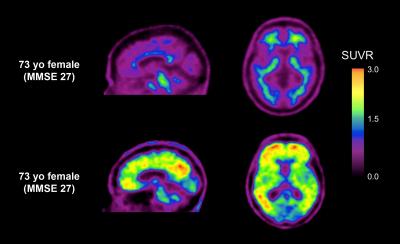
The amount of amyloid β (Aβ) in the brains of people with mild cognitive impairment (MCI) is contributing to early memory loss, and increases with severity of symptoms, finds a study in BioMed Central's open access journal Alzheimer's Research & Therapy. The non-invasive study which used 18F-florbetaben to find Aβ plaques in brain scans to also show that in MCI the affect of Aβ on memory loss is independent of other aspects of mental decline.
Positron emission tomography (PET) has previously relied on carbon-11 labeling of Aβ, however this study uses 18F-florbetaben which can be used for longer and allow more patients to be scanned at lower cost. A higher than normal amount of Aβ was found in half of the PET scans of people with MCI. Interestingly there was a strong association between Aβ and memory loss, but not with other features of neurodegeneration, such as hippocampal atrophy or the white matter hyperintensities frequently seen on MRI later in the development of Alzheimer's disease.
Prof Christopher Rowe, from Austin Health, Australia and the University of Melbourne, who led the study explained why it is important, "MCI is thought to affect between one in five and one in ten of all adults over the age of 65, and, although some of these will go on to develop dementia within a few years, the majority can lead a relatively normal life. Detection of Aβ plaques in MCI indicates early Alzheimer's disease, while a negative scan eliminates this possibility. Consequently a negative scan is very reassuring while a positive scan can lead to earlier and more appropriate medical and social management."
INFORMATION:
Media contact
Dr Hilary Glover
Scientific Press Officer, BioMed Central
Tel: +44 (0) 20 3192 2370
Mob: +44 (0) 778 698 1967
Email: hilary.glover@biomedcentral.com
Notes
1. 18F-florbetaben Abeta imaging in mild cognitive impairment Kevin Ong, Victor L Villemagne, Alex Bahar-Fuchs, Fiona Lamb, Gaël Chételat, Parnesh Raniga, Rachel S Mulligan, Olivier Salvado, Barbara Putz, Katrin Roth, Colin L Masters, Cornelia B Reininger and Christopher C Rowe Alzheimer's Research & Therapy (in press)
Please name the journal in any story you write. If you are writing for the web, please link to the article. All articles are available free of charge, according to BioMed Central's open access policy.
Article citation and URL available on request on the day of publication.
2. Alzheimer's Research & Therapy is the major forum for translational research into Alzheimer's disease. An international peer-reviewed journal, it publishes open access basic research with a translational focus, as well as clinical trials, research into drug discovery and development, and epidemiologic studies. The journal also provides reviews, viewpoints, commentaries, debates and reports. Although the primary focus is Alzheimer's dementia, the scope encompasses translational research into other neurodegenerative diseases.
3. Images are to be credited to Kevin Ong, Victor L Villemagne, Alex Bahar-Fuchs, Fiona Lamb, Gaël Chételat, Parnesh Raniga, Rachel S Mulligan, Olivier Salvado, Barbara Putz, Katrin Roth, Colin L Masters, Cornelia B Reininger and Christopher C Rowe.
4. BioMed Central (http://www.biomedcentral.com/) is an STM (Science, Technology and Medicine) publisher which has pioneered the open access publishing model. All peer-reviewed research articles published by BioMed Central are made immediately and freely accessible online, and are licensed to allow redistribution and reuse. BioMed Central is part of Springer Science+Business Media, a leading global publisher in the STM sector. @BioMedCentral
Positron emission tomography (PET) has previously relied on carbon-11 labeling of Aβ, however this study uses 18F-florbetaben which can be used for longer and allow more patients to be scanned at lower cost. A higher than normal amount of Aβ was found in half of the PET scans of people with MCI. Interestingly there was a strong association between Aβ and memory loss, but not with other features of neurodegeneration, such as hippocampal atrophy or the white matter hyperintensities frequently seen on MRI later in the development of Alzheimer's disease.
Prof Christopher Rowe, from Austin Health, Australia and the University of Melbourne, who led the study explained why it is important, "MCI is thought to affect between one in five and one in ten of all adults over the age of 65, and, although some of these will go on to develop dementia within a few years, the majority can lead a relatively normal life. Detection of Aβ plaques in MCI indicates early Alzheimer's disease, while a negative scan eliminates this possibility. Consequently a negative scan is very reassuring while a positive scan can lead to earlier and more appropriate medical and social management."
INFORMATION:
Media contact
Dr Hilary Glover
Scientific Press Officer, BioMed Central
Tel: +44 (0) 20 3192 2370
Mob: +44 (0) 778 698 1967
Email: hilary.glover@biomedcentral.com
Notes
1. 18F-florbetaben Abeta imaging in mild cognitive impairment Kevin Ong, Victor L Villemagne, Alex Bahar-Fuchs, Fiona Lamb, Gaël Chételat, Parnesh Raniga, Rachel S Mulligan, Olivier Salvado, Barbara Putz, Katrin Roth, Colin L Masters, Cornelia B Reininger and Christopher C Rowe Alzheimer's Research & Therapy (in press)
Please name the journal in any story you write. If you are writing for the web, please link to the article. All articles are available free of charge, according to BioMed Central's open access policy.
Article citation and URL available on request on the day of publication.
2. Alzheimer's Research & Therapy is the major forum for translational research into Alzheimer's disease. An international peer-reviewed journal, it publishes open access basic research with a translational focus, as well as clinical trials, research into drug discovery and development, and epidemiologic studies. The journal also provides reviews, viewpoints, commentaries, debates and reports. Although the primary focus is Alzheimer's dementia, the scope encompasses translational research into other neurodegenerative diseases.
3. Images are to be credited to Kevin Ong, Victor L Villemagne, Alex Bahar-Fuchs, Fiona Lamb, Gaël Chételat, Parnesh Raniga, Rachel S Mulligan, Olivier Salvado, Barbara Putz, Katrin Roth, Colin L Masters, Cornelia B Reininger and Christopher C Rowe.
4. BioMed Central (http://www.biomedcentral.com/) is an STM (Science, Technology and Medicine) publisher which has pioneered the open access publishing model. All peer-reviewed research articles published by BioMed Central are made immediately and freely accessible online, and are licensed to allow redistribution and reuse. BioMed Central is part of Springer Science+Business Media, a leading global publisher in the STM sector. @BioMedCentral