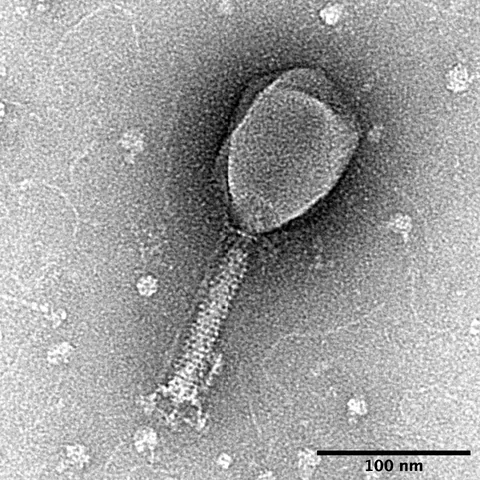
Viruses that infect bacteria are unusually specific tools. That makes them interesting to researchers—and makes choosing the right one difficult. A prediction system is most useful when it reduces the number of combinations scientists must test while still finding the combinations that work.
- Research published
- Nature Microbiology · 29 September 2026
- Inputs
- Bacterial and phage genomes
- Purpose
- Prioritizing laboratory matches
Original publication: 29 Sep 2026 · The date above refers to this brief.
What the new study reports
Noonan and colleagues trained a genome-based framework using six datasets covering 115,037 interactions. They experimentally tested 1,240 predicted E. coli phage–host interactions, reporting an AUROC of 0.84. Model-guided five-phage cocktails achieved up to 97.5% strain coverage in the evaluated setting. These measures concern bacterial matching, not recovery of patients.
Source 1 ↗Why the strain matters as much as the species
A species name is a broad starting point. For a matching problem, the useful question is whether a particular candidate infects the particular bacterial strain being tested. Choosing a tool because it worked against a related organism can leave the most important compatibility question unanswered.
Think of a prediction as a ranked laboratory shopping list. Its job is to bring promising candidates nearer the top. The experiment must still check the actual pairing under the conditions that matter. This makes a model useful even when its predictions are imperfect—but only if the workflow measures the cost of missed matches as well as the cost of unnecessary tests.
An AUROC is a ranking score, not a success percentage
An AUROC of 0.84 is not a claim that 84% of people were cured, or even that exactly 84% of laboratory decisions were correct. The metric summarizes how well scores distinguish positive from negative examples across thresholds. A real workflow chooses a threshold or a limited number of candidates.
Here is our practical follow-up question: if a laboratory can test only five candidates, how often does that shortlist include a useful match? That question adds capacity and consequences to a ranking score. The answer should be examined in genuinely new strains and candidates, with the cutoff chosen before inspecting their experimental outcomes.
How this connects to medical AI—and why the experiment helps
Our earlier chatbot story separates model performance from performance when people actually use a system. The same evaluation habit applies here: identify the intended task, then check the next step in the workflow. A prediction of compatibility should eventually face a real compatibility experiment.
A laboratory validation is a stronger bridge than a score on training data. It still leaves questions about other settings, sample handling, candidate availability and future bacterial changes. We would want a prospective comparison of the complete selection workflow against a clearly described alternative, recording time, tests used and failures—not only its best example.
The hope: a faster route to an experiment worth running
The attractive near-term goal is to make screening more efficient. A carefully selected panel could help researchers avoid repeatedly testing combinations that have little chance of matching. Our comparison table keeps that operational benefit separate from claims about infection treatment.
For an eventual human application, compatibility is only one step. Delivery, stability, host responses, unwanted genetic properties and resistance during use would need their own evaluation. The published matching result does not answer all of those questions. The next useful news would be a reproducible improvement in the complete experimental workflow, followed by appropriately designed studies of any proposed application.
From a predicted match to a useful application
| Stage | What is being tested | What remains open |
|---|---|---|
| Genome-based ranking | Which pairings deserve an experiment | Performance in new organisms and settings |
| Laboratory match | Whether the specific pairing works in the assay | How conditions change the result |
| Selection workflow | Whether ranking saves time or tests | Missed useful candidates and failure costs |
| Proposed health application | Benefits and harms in the intended use | Clinical outcomes cannot be inferred from matching alone |
Our evaluation framework. Stages are not interchangeable outcomes, and the paper does not complete a clinical trial.
Your questions, answered
What is a bacteriophage?
A virus that infects bacteria. For this research story, the key question is compatibility between a phage and a particular bacterial strain, rather than the general idea of a virus infecting bacteria.
Does 97.5% coverage mean a 97.5% cure rate?
No. Coverage here concerns bacterial strains in the evaluated matching setting. A patient outcome has a different denominator, setting and definition. The two percentages must not be substituted for one another.
Why not trust the highest-scoring match immediately?
A score is a prediction made under a model’s assumptions and training conditions. Confirming the intended laboratory interaction is part of the research workflow, not a redundant step.
What would a useful independent test measure?
Use previously unseen material and a fixed selection rule. Record useful matches found, candidates tested, time, missed matches and failures. That would assess whether the system improves the job it is meant to support.
Limits of this interpretation
- The final journal report differs numerically from earlier preprints; this account uses the final publication.
- Performance and strain coverage in an evaluated setting do not establish patient benefit.
- We did not independently audit the full methods, code or interaction matrices.
Sources & transparency
- Noonan, Moriniere, Rivera-López et al. (2026): Phylogeny-agnostic strain-level prediction of phage–host interactions from genomes using machine learning
Final publisher-indexed abstract and selected main text checked. Direct full HTML retrieval failed; detailed methods, raw interaction matrices and code were not independently assessed. The final journal numbers are used rather than the differing earlier preprint numbers. Short factual report followed by our own evaluation framework. · Accessed 30 Sep 2026
DOI: 10.1038/s41564-026-02482-5
Prepared and source-checked with AI on 30 September 2026. Press-news Team is our collective publication byline, not a claim of medical credentials or human review. No human editorial or clinical review has taken place. We did not conduct the experiments or reanalyse the raw data. We distinguish reported findings from our own explanations and proposed follow-up questions. Access limits are listed with each source. This article explains basic research and research tools; it does not evaluate an individual’s treatment. The photograph is illustrative.
Source check: AI source check — primary research, dates and selected results
Clinical review: Not applicable to this educational guide
Suggest a correction