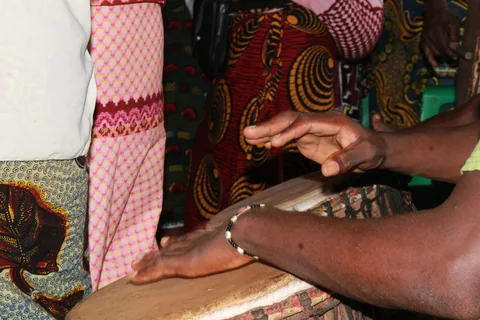
In music lessons at an Athens primary school, some children could feel the beat through a vibrating platform. Later, a researcher handed each child a drumstick. With the vibrations switched off, could they keep time to a metronome or a song? One of the clearest differences came from the choice of music. Many more tapping records could be scored for one song than for the other.
- Sixty children in four classes took part in the analysis. One class in each grade received the extra vibration during music lessons.
- Metronome tapping became more consistent over time in both groups. The study could not establish that the platform conferred a lasting advantage.
- The researchers could score 161 of 180 possible child-assessments for a four-beat excerpt and 112 of 180 for a seven-beat excerpt.
- Paper date
- 21 November 2026
- Setting
- One public primary school in Athens, Greece
- Children analysed
- 60 across grades 3 and 4
- Schedule
- 16 music sessions and three individual assessments
Original publication: 21 Nov 2026 · The date above refers to this brief.
Share of available child-assessments with a usable tapping record
percent of 180 possible observations for each song
Three details to check in a classroom experiment
Who received the assignment?
A whole class drew one condition within its grade.
Who performed the test?
One child at a time tapped to a sound without the training platform.
What could enter the comparison?
Each excerpt required a usable tapping record at a particular assessment.
Turn off the floor before the test
Both sets of classes had the same music activities. One class in each grade also felt vibrations through a platform during training. The individual tests took place before training, after eight sessions and after sixteen. Each child tapped an electronic percussion pad with a drumstick in a quiet space at school. All these assessments used sound alone. The design asked whether anything learned with vibration carried over to ordinary listening. It did not measure how an extra cue helped at the moment a child could feel it.
Source 1 ↗Why a steady tap can still be early
Imagine tapping a fraction of a second before every click of a metronome. Your timing would be consistent from beat to beat, even though you would miss the centre of each click. The researchers measured both how tightly taps clustered within the beat cycle and where they landed in that cycle. The children’s metronome consistency improved across assessments in both groups. For one simpler song, a final difference in grade three coincided with a decline in the sound-only class. Other tasks did not repeat that pattern.
Source 1 ↗The harder song also changed the sample
With 60 children assessed three times, there were 180 possible observations per excerpt. The team could use 161 for One Way or Another, in 4/4, and 112 for Solsbury Hill, in 7/4. That works out to 89.4% and 62.2%. A record could be unusable if there were too few valid taps or if the two repetitions followed different levels of the beat and could not be combined. When the task itself makes a record hard to score, the average among records that remain can favour children who found it easier.
Source 1 ↗What four classes can settle
The training assignment happened by random draw within each grade, at the level of the whole class. Four classes gave the study four independent units of assignment, despite the many taps. Repeating the experiment across more schools would help separate a difference due to training from a difference between two particular classes. Earlier work by Phillips-Silver and Trainor found that how seven-month-old babies were bounced influenced which accent pattern they subsequently preferred listening to. The Athens study asked about a different age, a different sensory experience and a learned movement children had to produce themselves.
Source 1 ↗Source 2 ↗Which children and tapping records contributed?
Full Sensors paper. Checked class allocation, timing and conditions of the assessments, how tapping records qualified, Table 1 and the paper’s interpretation of the metronome and song results. Press-News calculated usable shares from the published counts.
01Did the test use the vibration that children had trained with?
- What was observed
- All individual tapping tests used sound without added vibration.
- Where the conclusion stops
- A group difference would concern a skill carried over from practice.
Source 1 · Section 2.1 and opening of Section 3, tapping assessments
02Were the two song analyses equally complete?
- What was observed
- A usable record was available for 161 child-assessments in one excerpt and 112 in the other.
- Where the conclusion stops
- The analysis of the second excerpt can give greater weight to children who found that task easier.
Source 1 · Section 4.1 and Table 1
Numbers you can inspect
| Measure | Value & unit | Origin & method |
|---|---|---|
| Children analysed | 60 children | Reported Final sample across both grades. Source 1 · Section 2, participants |
| Classes allocated | 4 classes | Reported One class in each condition within each grade. Source 1 · Sections 2.1 and 3.5.1 |
| Assessments per child | 3 assessments | Reported Beginning, middle and end of the programme. Source 1 · Section 2.1 |
| Possible observations per song | 180 child-assessments | Calculated 60 children × 3 assessments. Source 1 · Table 1 and Section 2.1 |
| Usable four-beat song records | 161 child-assessments | Reported Usable observations for One Way or Another. Source 1 · Section 4.1, Table 1 |
| Usable seven-beat song records | 112 child-assessments | Reported Usable observations for Solsbury Hill. Source 1 · Section 4.1, Table 1 |
| Usable share for four-beat song | 89.4 percent | Calculated 161 ÷ 180 × 100, rounded to one decimal. Source 1 · Table 1 |
| Usable share for seven-beat song | 62.2 percent | Calculated 112 ÷ 180 × 100, rounded to one decimal. Source 1 · Table 1 |
| Unusable records for four-beat song | 19 child-assessments | Calculated 180 minus 161. Source 1 · Table 1 |
| Unusable records for seven-beat song | 68 child-assessments | Calculated 180 minus 112. Source 1 · Table 1 |
Compare the actual experiments
These studies answer different questions. Read the unit and endpoint before comparing results.
| Study | Unit & setting | Readout | Interpretation boundary |
|---|---|---|---|
| Infant experiment on feeling the beat Source 2 · Phillips-Silver and Trainor, Experiment 1 and Figure 1 | Seven-month-old infant exposed to rhythmic bouncing | Subsequent listening preference for an accent pattern | Immediate listening preference and later school-age tapping measure different skills. |
| The school study’s test-completeness analysis Source 1 · Section 4.1 and Table 1 | Child at one assessment for one excerpt | Whether the repetitions could yield a usable timing measure | A lower share of usable records changes the group represented by the summary. |
The export includes claims, available numbers, methods and source locations. It contains our reading notes and published summaries; it is not raw participant data or an independent reanalysis.
Evidence update · 22 Nov 2026
First publication. Any calculations in this brief use reported figures. The reading notes identify possible follow-up questions. AI source check; no human editorial or clinical review.
How much of the tapping record could the researchers use?
| Song and time signature | Usable child-assessments | Unusable child-assessments |
|---|---|---|
| One Way or Another (4/4) | 161 of 180 | 19 of 180 |
| Solsbury Hill (7/4) | 112 of 180 | 68 of 180 |
Table 1. A child could contribute at three assessments. The unusable counts are Press-News subtractions from 180. They do not count individual children.
Your questions, answered
Were children standing on a vibrating platform when they took the test?
Vibration was provided during lessons for one group. The individual tapping assessments for all children used sound alone.
How can 60 children produce 180 possible observations for a song?
Each child could contribute a record at the start, middle and end of the programme. Sixty children times three assessments gives 180 potential records.
Did seven beats cause the difference in usable records?
Each meter was represented by one song. The recordings also differ in other ways. Multiple songs in each meter would let a future study address that question.
What would make a repeat experiment easier to interpret?
Assigning more classes in several schools would provide independent repetitions of the teaching comparison. Including multiple songs for each meter and recording why each performance was unusable would help explain differences between the tasks.
Limits of this interpretation
- Just one class per training condition in each grade makes the condition contrasts exploratory. The authors describe these as comparisons between particular classes.
- One song represented each musical meter. The contrast between songs cannot isolate the effect of meter.
- Uneven loss of scorable records can affect which children contribute to each estimate, particularly for the seven-beat excerpt.
Sources & transparency
- Papadogianni-Kouranti et al. (2026) — An Auditory–Tactile Stimulation and Measurement Paradigm for Sensorimotor Synchronization
Full Sensors paper. Checked class allocation, timing and conditions of the assessments, how tapping records qualified, Table 1 and the paper’s interpretation of the metronome and song results. Press-News calculated usable shares from the published counts. · Accessed 22 Nov 2026
DOI: 10.3390/s26237377 - Phillips-Silver and Trainor (2005) — Feeling the Beat: Movement Influences Infant Rhythm Perception
Published Science research report. Checked the infant bouncing experiment and its subsequent listening-preference measure for the comparison with the school study. · Accessed 22 Nov 2026
DOI: 10.1126/science.1110922
Prepared and source-checked with AI for Press-news Team. The source notes identify the material available during preparation. The article received no human editorial or clinical review. The source list supports the reported results and the calculations shown.
Source check: AI source check — primary research and stated source limits
Clinical review: Not applicable to this educational guide
Suggest a correction