The gut contains viruses that infect bacteria, but a map of their genetic signatures is not the same as a list of causes of health or disease. A new cohort study makes that distinction tangible.
- The study included 1,069 people; 953 had measurements of selected short-chain fatty acids, and 805 completed a dietary questionnaire.
- The catalog of 116,740 viral sequence groups was filtered to 8,970 for downstream analyses; 6,572 were associated with at least one measured metabolite.
- These overlapping counts describe different things. Statistical associations do not establish that the viruses caused metabolite changes.
- Paper date
- 17 November 2026
- Cohort
- 1,069 TwinsUK participants
- Dietary subset
- 805 participants
Original publication: 17 Nov 2026 · The date above refers to this brief.
Participants with different types of data
people
From stool sequences to a hypothesis
Sequence
Reconstruct viral sequence groups from bulk stool data.
Compare
Look for co-variation with bacterial and metabolite measures.
Test later
Use independent and experimental work to investigate possible mechanisms.
Viruses within a bacterial ecosystem
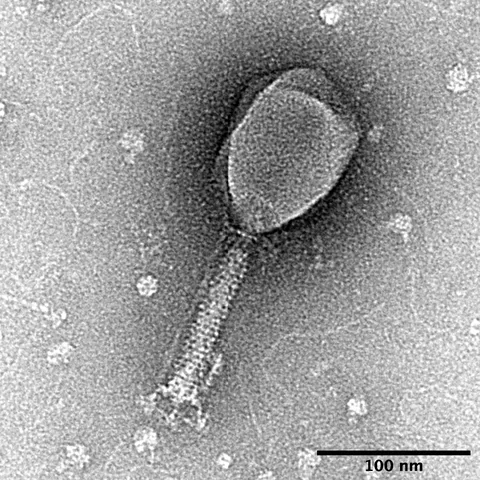
Bacteriophages are viruses that infect bacteria. The authors reconstructed viral sequence groups from stool metagenomic data in the TwinsUK cohort, then compared their abundance with bacterial and metabolite measurements. Because the sequencing used bulk stool material, the signatures may include both free phages and viral DNA integrated into bacterial genomes.
Source 1 ↗A catalog is not a participant count
The study included 1,069 people and assembled 116,740 non-redundant viral operational taxonomic units, or vOTUs. These are sequence-defined groups, not individual people or a direct count of active viral particles. Filtering left 8,970 vOTUs for downstream analyses. Of those, 6,572 were associated with at least one short-chain fatty acid or secondary bile acid under the reported threshold.
Source 1 ↗Different questions, different subsets
Selected short-chain fatty acids were quantified in 953 participants; 805 people also completed a dietary questionnaire. Dietary information was collected within five years of stool sampling, while the study required the main metagenomic and metabolomic measurements within a one-year window. The subsets overlap, so the counts should not be added.
Source 1 ↗What an association leaves unanswered
A phage signal and a metabolite can vary together because both track their bacterial host, diet, environment or other factors. The study reports a predicted host genus matching a metabolite-associated bacterial genus for 3,877 of the 6,572 metabolite-associated vOTUs. The authors describe this as an upper bound for possible host-mediated confounding, not proof of a causal chain.
Source 1 ↗Who is represented?
Of the 1,069 participants, 903 were women. This adult UK twin cohort provides useful data, but it is not a cross-section of every age group or population. The authors disclose connections to ZOE Ltd, including a cofounder and consultants. Independent longitudinal and laboratory work could test the proposed relationships.
Source 1 ↗People, sequence groups and overlapping subsets
Publisher HTML: abstract, selected Results, Methods, Figure 1 caption and competing interests, accessed through a research-search interface. Publisher metadata and abstract also checked. Supplements, source-data files, code and clinical records were not independently audited. No publisher figure reproduced.
01Are 116,740 vOTUs 116,740 participants?
- What was observed
- The catalog contains 116,740 sequence-defined groups, whereas 1,069 people were included.
- Where the conclusion stops
- A vOTU is not a participant or an independently counted active viral particle.
Source 1 · Publisher Results, study population
02Did phages cause the metabolite associations?
- What was observed
- The authors report associations for 6,572 of 8,970 filtered vOTUs.
- Where the conclusion stops
- Cross-sectional co-variation cannot establish a causal mechanism.
Source 1 · Publisher Results, associations between phages and bacterial metabolites
Numbers you can inspect
| Measure | Value & unit | Origin & method |
|---|---|---|
| Main cohort | 1069 people | Reported Participants in the TwinsUK study. Source 1 · Publisher Results, study population |
| Women in main cohort | 903 people | Reported Participants described as female in the main cohort. Source 1 · Publisher Results, study population |
| Short-chain fatty-acid measurements | 953 people | Reported Subset with selected acetate, propionate and butyrate measurements. Source 1 · Publisher Methods, metabolite profiling |
| Dietary questionnaire | 805 people | Reported Subset completing the dietary questionnaire. Source 1 · Publisher Methods, study population |
| Filtered viral groups | 8970 vOTUs | Reported Filtered set used for downstream association analysis. Source 1 · Publisher Methods, taxonomic data quality control |
| Metabolite-associated viral groups | 6572 vOTUs | Reported Filtered viral groups associated with at least one measured metabolite at the reported threshold. Source 1 · Publisher Results, metabolite associations |
| Dietary subset share | 75.3 percent | Calculated 805 divided by 1,069 times 100, rounded to one decimal place; subsets overlap. Source 1 · Publisher Methods, study population |
Compare the actual experiments
These studies answer different questions. Read the unit and endpoint before comparing results.
| Study | Unit & setting | Readout | Interpretation boundary |
|---|---|---|---|
| Sequence catalog Source 1 · Publisher Discussion, bulk metagenomic data | Viral sequence groups reconstructed from stool | vOTU detection and bacterial co-abundance | Signals can include both free phage and integrated viral DNA. |
| Metabolite association Source 1 · Publisher Results, metabolite associations | Filtered vOTUs and measured metabolites | Statistical co-variation | Not a direct test that phages change metabolites. |
The export includes claims, available numbers, methods and source locations. It contains our reading notes and published summaries; it is not raw participant data or an independent reanalysis.
Evidence update · 17 Nov 2026
First publication. Reported observations, arithmetic and proposed follow-up questions are separated. No raw-data reanalysis. AI source check; no human editorial or clinical review.
Four numbers that answer different questions
| Reading question | What the paper reports | What remains open |
|---|---|---|
| 1,069 | People in the main cohort | Not the number of distinct phages |
| 953 | Participants with selected short-chain fatty-acid measurements | A subset, not an extra group to add |
| 805 | Participants completing the dietary questionnaire | Collected within five years of stool sampling |
| 8,970 / 6,572 | Filtered viral sequence groups / those linked to a measured metabolite | Associations, not proven effects |
Original Press-News reading framework. Follow-up questions are our interpretation, not experiments performed by the authors.
Your questions, answered
Are there 116,740 participants?
No. That number refers to non-redundant viral sequence groups; the cohort included 1,069 people.
Do the 953 and 805 participant counts add up to the cohort?
No. They describe overlapping measurements and questionnaire subsets.
Did the study show that phages cause metabolite changes?
No. Its associations are observational and may reflect bacterial hosts or other shared factors.
Can a person use these findings to choose a diet?
This study does not test an individual dietary intervention or establish a personalized recommendation.
Limits of this interpretation
- The study is observational and does not establish that a phage caused a metabolite change.
- Bulk metagenomic reconstruction can combine free phage and host-integrated viral sequence signals.
- The cohort was predominantly female adult UK twins; its results may not generalize to all populations.
- Dietary and laboratory samples were not necessarily collected at the same time.
- The authors disclose financial connections to ZOE Ltd.
Sources & transparency
- Louca, Khan Mirzaei, Kouraki et al. (2026): Population-level characterisation of the human gut phageome and its association with microbial metabolites
Publisher HTML: abstract, selected Results, Methods, Figure 1 caption and competing interests, accessed through a research-search interface. Publisher metadata and abstract also checked. Supplements, source-data files, code and clinical records were not independently audited. No publisher figure reproduced. · Accessed 17 Nov 2026
DOI: 10.1038/s41467-026-79230-0
Prepared and source-checked with AI. Press-news Team is the collective publication byline, not a medical reviewer. No human editorial or clinical review has taken place. This educational article examines research methods and laboratory or observational findings, not individual diagnosis or treatment. We did not conduct these experiments or reanalyse raw data. Reported results, our interpretation and proposed future tests are separated. Source-access limits are recorded below. Photographs are illustrative.
Source check: AI source check — selected primary results, captions and study boundaries
Clinical review: Not applicable to this educational guide
Suggest a correction