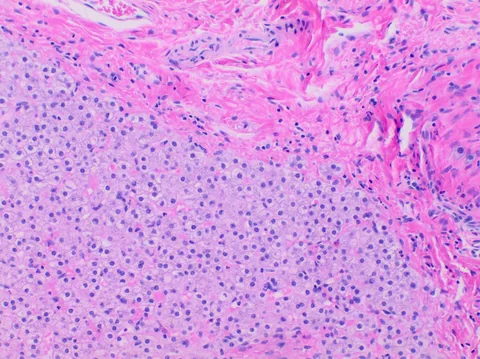
A signal measured while injury is developing may mean something different during repair. This paper’s useful contribution is a chain of experiments that asks where a lipid-regulating enzyme fits into that changing process.
- Time and tissue context belong beside a molecular measurement.
- Biopsy association and a controlled perturbation play different causal roles.
- Name the comparator population instead of shortening it to healthy controls.
- Publication
- Signal Transduction and Targeted Therapy · 8 October 2026
- Research question
- Lipid regulation during experimental repair
- Human evidence here
- Observational biopsy context
Original publication: 8 Oct 2026 · The date above refers to this brief.
Three evidence layers in a repair hypothesis
Map the pattern
Describe changes in PLPP2 and lipid-related readouts across the sampled injury and repair settings. Timing and tissue context matter.
Probe the mechanism
Perturbations and laboratory assays test whether changing a component changes the readout. Keep viability or metabolism proxies separate from tissue repair.
Check the setting
Compare model evidence with observations in human tissue. An association in a biopsy does not by itself establish treatment benefit.
The experimental finding
Li and colleagues connect PLPP2 with phosphatidylethanolamine metabolism and liver repair. Time-course profiling and hepatocyte-specific mouse perturbations support the pathway model; removing PLPP2 worsened experimental injury. Human biopsy associations add context, rather than testing a treatment.
Source 1 ↗Put time on the horizontal axis of the explanation
Imagine measuring a repair-associated signal only once. A low measurement could reflect an early phase, impaired repair or a different balance of sampled cells. This is an illustration of possible interpretations, not a diagnosis based on this study.
Our proposed reading aid is a timeline that places the trigger, the molecular sampling and the functional assessment on the same axis. Before comparing two groups, ask whether they were observed at biologically comparable stages. A matching clock time may still leave an important difference in state.
The human comparator deserves its full name
The methods describe 36 people with drug-induced liver injury and 31 without it who had hepatic hemangioma. The latter are not a random sample of healthy volunteers. Our sum, 36 + 31 = 67, describes the stated biopsy-group coverage, not an intervention denominator.
Source 1 ↗A biopsy and a gene perturbation answer different questions
An association can tell the reader where to look next. A targeted perturbation can ask whether a specified component matters for an experimental output. Their combination is useful when each retains its proper role.
Our suggested evidence diagram uses separate arrows for observation and manipulation. Put the biopsy groups on the observation branch, the experimental change on the manipulation branch, and identify the measured outcome on each. Connecting the branches should not erase differences in species, setting or selection into the sample.
A phase-specific claim needs a phase-specific challenge
We would propose changing the pathway at prespecified stages, measuring initial injury and later repair separately, and checking whether comparable pathway engagement has the same effect in each stage. This is a suggested future design, not an additional experiment we performed.
The distinction matters because a favorable later measurement could arise from less initial injury or faster recovery. Both can be interesting, but they describe different mechanisms. A clear report would show how its design distinguishes them and whether other cell compartments alter the result.
Specificity is part of the hopeful next step
The authors acknowledge unresolved organ specificity and translational safety questions.
Source 1 ↗What would make the mechanism more transferable?
Our proposed next comparison would retain tissue exposure, pathway engagement and functional output as separate measurements. A molecule reaching a tissue is different from changing the intended target there; changing a target is different from improving the intended outcome.
Read this beside our DUSP4 rescue explainer. The shared question is whether a local molecular explanation remains persuasive when the context changes. We do not merge the two pathways or assume one study validates the other. The opportunity is a sharper experimental account of repair, with the missing links visible before any clinical claim is made.
A comparator label you can check
Human group descriptions checked against the methods. The total is arithmetic on printed coverage, not a new clinical analysis.
01Are biopsy groups an intervention trial?
- What was observed
- The human evidence consists of selected tissue comparisons.
- Where the conclusion stops
- No randomized treatment effect follows.
Source 1 · Human liver samples; Figure 3
02Does an experimental mechanism establish clinical utility?
- What was observed
- Perturbations support a pathway model.
- Where the conclusion stops
- Specificity and translational questions remain.
Source 1 · PLPP2 perturbation results; Discussion
Numbers you can inspect
| Measure | Value & unit | Origin & method |
|---|---|---|
| DILI biopsy group | 36 people | Reported Group described in Human liver samples. Source 1 · Human liver samples |
| Non-DILI hemangioma group | 31 people | Reported Comparator condition retained in full. Source 1 · Human liver samples |
| Combined stated group coverage | 67 people | Calculated 36 + 31; coverage only, not outcome events. Source 1 · Human liver samples |
Compare the actual experiments
These studies answer different questions. Read the unit and endpoint before comparing results.
| Study | Unit & setting | Readout | Interpretation boundary |
|---|---|---|---|
| Li et al. 2026 · profiling Source 1 · Figure 1 | Experimental liver time course | Changing molecular pattern | Timing does not alone establish a causal effect. |
| Li et al. 2026 · perturbation Source 1 · PLPP2 perturbation results | Mouse hepatocytes | Experimental injury and repair | Model-specific functional evidence. |
| Li et al. 2026 · biopsies Source 1 · Figure 3; Human liver samples | Selected human tissue groups | PLPP2 association | Not treatment efficacy or validated prognosis. |
The export includes claims, available numbers, methods and source locations. It contains our reading notes and published summaries; it is not raw participant data or an independent reanalysis.
Evidence update · 9 Oct 2026
First publication. Printed measurements retain their denominators, source locations and dispersion labels. Calculations and proposed follow-up tests are identified. No raw experimental or participant data were reanalysed. AI source check; no human editorial or clinical review.
Keep timing, causality and translation on separate branches
| Evidence question | What to record | Our proposed follow-up |
|---|---|---|
| When did the signal change? | Sampling stage relative to injury and repair | Compare biologically aligned stages |
| Does the component matter? | Perturbation, specificity and measured output | Separate less injury from faster repair |
| Where is the human context? | Biopsy selection and comparator condition | Check selection and alternative explanations |
| Can the mechanism travel? | Exposure, engagement and function separately | Test the intended tissue and setting |
Our experimental-reading framework. It does not estimate patient benefit or recommend an intervention.
Your questions, answered
Were the 31 comparators healthy volunteers?
The methods identify people without DILI who had hepatic hemangioma.
Is 67 the size of a treatment trial?
No. It is our sum of the two described biopsy groups.
Does higher PLPP2 prove better prognosis?
A biopsy association alone does not establish a validated prediction rule. This guide makes no prognostic-performance claim.
What is the most useful next question?
Whether the same specific pathway change has a reproducible effect at defined repair stages and in the intended tissue. That is our proposed test.
Limits of this interpretation
- Mouse injury experiments and selected human biopsies have different evidence roles.
- The comparator group had hepatic hemangioma.
- Association is not validated prognostic utility.
- This guide does not evaluate a human treatment or supply dosing advice.
Sources & transparency
- Li, Wang, Chen et al. (2026): Phospholipid phosphatase 2 drives liver repair and regeneration after acute liver injury
Publisher HTML abstract, Figure 1 time-course design, PLPP2 perturbation results, Figure 3 biopsy context, Human liver samples methods and Discussion limits assessed. Supplementary cohort details and raw omics were not reanalysed. Coverage concerns experimental logic and biopsy comparators, not clinical efficacy, prognosis or treatment advice. · Accessed 9 Oct 2026
DOI: 10.1038/s41392-026-02825-y
Prepared and source-checked with AI. Press-news Team is the collective publication byline, not a medical reviewer. No human editorial or clinical review has taken place. This educational article explains methods and basic or preclinical research; it provides no individual diagnosis or treatment recommendations. We did not conduct these experiments or reanalyse raw data. Findings, our interpretation and suggested future tests are separated. Source-access limits are recorded below. Photographs are illustrative.
Source check: AI source check — specified primary passages, denominators and experimental boundaries
Clinical review: Not applicable to this educational guide
Suggest a correction