Emissions from human activity modify biogenic secondary organic aerosol formation
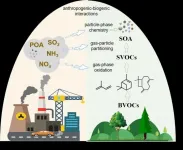
Despite their extremely small size, submicron atmospheric aerosols are critical pollutants with climate change, air quality, and human health implications. Of these particles, secondary organic aerosols (SOA) form when volatile organic compounds (VOCs) oxidize to lower volatility products that bond with and increase aerosol particle size, or in some cases, they may simply exist by themselves. SOA constitutes a significant fraction of the global aerosol mass. Scientists are attempting to improve future aerosol modeling, but several discrepancies still exist between model-simulated and field-observed SOA budgets. ''Large uncertainties in model assessments of SOA budgets and correspondingly, its climate effects, ...
Read the release