Core design strategy for fire-resistant batteries
Development of a strategy for reducing 'electrolyte-electrode interface resistance,' which limits the commercialization of all-solid-state batteries; new material design strategy to increase performance by improving the cathode material
Published 2021-01-11 · Original archive entry · Explore research explainers
All-solid-state batteries are the next-generation batteries that can simultaneously improve the stability and capacity of existing lithium batteries. The use of non-flammable solid cathodes and electrolytes in such batteries considerably reduces the risk of exploding or catching fire under high temperatures or external impact and facilitates high energy density, which is twice that of lithium batteries. All-solid-state batteries are expected to become a game changer in the electric vehicle and energy storage device markets. Despite these advantages, the low ionic conductivity of solid electrolytes combined with their high interfacial resistance and rapid deterioration reduce battery performance and life, thus limiting their commercialization.
The Korea Institute of Science and Technology (KIST) is proud to announce that the research team of Dr. Sang-baek Park at the Center for Energy Materials Research, in collaboration with the research team of Professor Hyun-jung Shin of Sungkyunkwan University, has developed a breakthrough material design strategy that can overcome the problem of high interfacial resistance between the solid electrolyte and the cathode, which is an obstacle to the commercialization of all-solid-state batteries.
Unique physical phenomena occur at the interface where two different substances meet. Unlike the atoms inside the bulk of a substance, which hold hands with other atoms around themselves and form stable bonds, the atoms at the interface, having no neighboring atom of the same substance on one side, are likely to form a different atomic arrangement.
In all-solid-state batteries having a solid electrode-solid electrolyte interface, a phenomenon occurs that disturbs the atomic arrangement and limits charge transfer, thereby increasing resistance and accelerating deterioration. Methods of coating an appropriate material on the surface of the cathode and the electrolyte or inserting an intermediate layer are currently being studied to solve the above-mentioned problem. However, this further increases the costs and lowers the overall activity and energy density of the batteries.
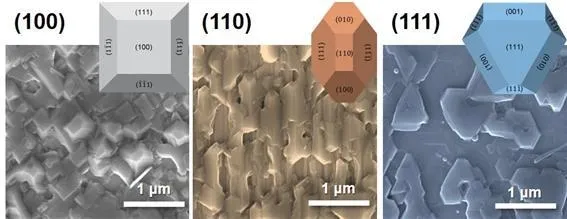
In order to solve these problems, the KIST-Sungkyunkwan University joint research team first systematically identified the crystal structure of the material that directly affects the solid interface. Using epitaxial film technology (a semiconductor manufacturing technology) to grow a thin film along the direction in which the crystals of the substrate were formed, cathode films having different exposed crystal planes were obtained under varying conditions. The effect of the exposed crystal plane on the interface between the solid electrolyte and the cathode material was analyzed in detail, disregarding other factors such as particle size and contact area that could affect the result.
The results indicated that the leakage of the transition metal from the cathode material into the electrolyte was suppressed by the closely-packed structure of the exposed crystal plane, which improved the stability of the all-solid-state battery. In addition, when the interface of the crystals was arranged in parallel with the direction of movement of the electrons, the movement of ions and electrons along the crystals was not hindered, resulting in reduced resistance and improved output.
"This means that improving the cathode material itself by increasing the density of the crystal plane and adjusting the direction of the interface between the crystals can ensure high performance and stability," said Dr. Sang-baek Park, KIST. "We plan to accelerate the development of all-solid-state battery materials by overcoming the instability of the solid electrolyte and solid cathode interface and imparting improved ion-charge exchange characteristics through this study, which has investigated the mechanism of all-solid-state battery degradation."
The Korea Institute of Science and Technology (KIST) is proud to announce that the research team of Dr. Sang-baek Park at the Center for Energy Materials Research, in collaboration with the research team of Professor Hyun-jung Shin of Sungkyunkwan University, has developed a breakthrough material design strategy that can overcome the problem of high interfacial resistance between the solid electrolyte and the cathode, which is an obstacle to the commercialization of all-solid-state batteries.
Unique physical phenomena occur at the interface where two different substances meet. Unlike the atoms inside the bulk of a substance, which hold hands with other atoms around themselves and form stable bonds, the atoms at the interface, having no neighboring atom of the same substance on one side, are likely to form a different atomic arrangement.
In all-solid-state batteries having a solid electrode-solid electrolyte interface, a phenomenon occurs that disturbs the atomic arrangement and limits charge transfer, thereby increasing resistance and accelerating deterioration. Methods of coating an appropriate material on the surface of the cathode and the electrolyte or inserting an intermediate layer are currently being studied to solve the above-mentioned problem. However, this further increases the costs and lowers the overall activity and energy density of the batteries.
In order to solve these problems, the KIST-Sungkyunkwan University joint research team first systematically identified the crystal structure of the material that directly affects the solid interface. Using epitaxial film technology (a semiconductor manufacturing technology) to grow a thin film along the direction in which the crystals of the substrate were formed, cathode films having different exposed crystal planes were obtained under varying conditions. The effect of the exposed crystal plane on the interface between the solid electrolyte and the cathode material was analyzed in detail, disregarding other factors such as particle size and contact area that could affect the result.
The results indicated that the leakage of the transition metal from the cathode material into the electrolyte was suppressed by the closely-packed structure of the exposed crystal plane, which improved the stability of the all-solid-state battery. In addition, when the interface of the crystals was arranged in parallel with the direction of movement of the electrons, the movement of ions and electrons along the crystals was not hindered, resulting in reduced resistance and improved output.
"This means that improving the cathode material itself by increasing the density of the crystal plane and adjusting the direction of the interface between the crystals can ensure high performance and stability," said Dr. Sang-baek Park, KIST. "We plan to accelerate the development of all-solid-state battery materials by overcoming the instability of the solid electrolyte and solid cathode interface and imparting improved ion-charge exchange characteristics through this study, which has investigated the mechanism of all-solid-state battery degradation."
INFORMATION:
This research was carried out as a major project of KIST with the support of the Ministry of Science and ICT (MSIT). The results of this study were published in the latest issue of "Nano Energy" (IF: 16.602, the highest rating of 4.299% by JCR), an international journal in the field of nanotechnology.