Exciting times for efficient heavy-atom-free OLEDs
An international team including researchers from Osaka University reports a novel hybrid emitter that could revolutionize the design of OLEDs
Published 2021-01-12 · Original archive entry · Explore research explainers
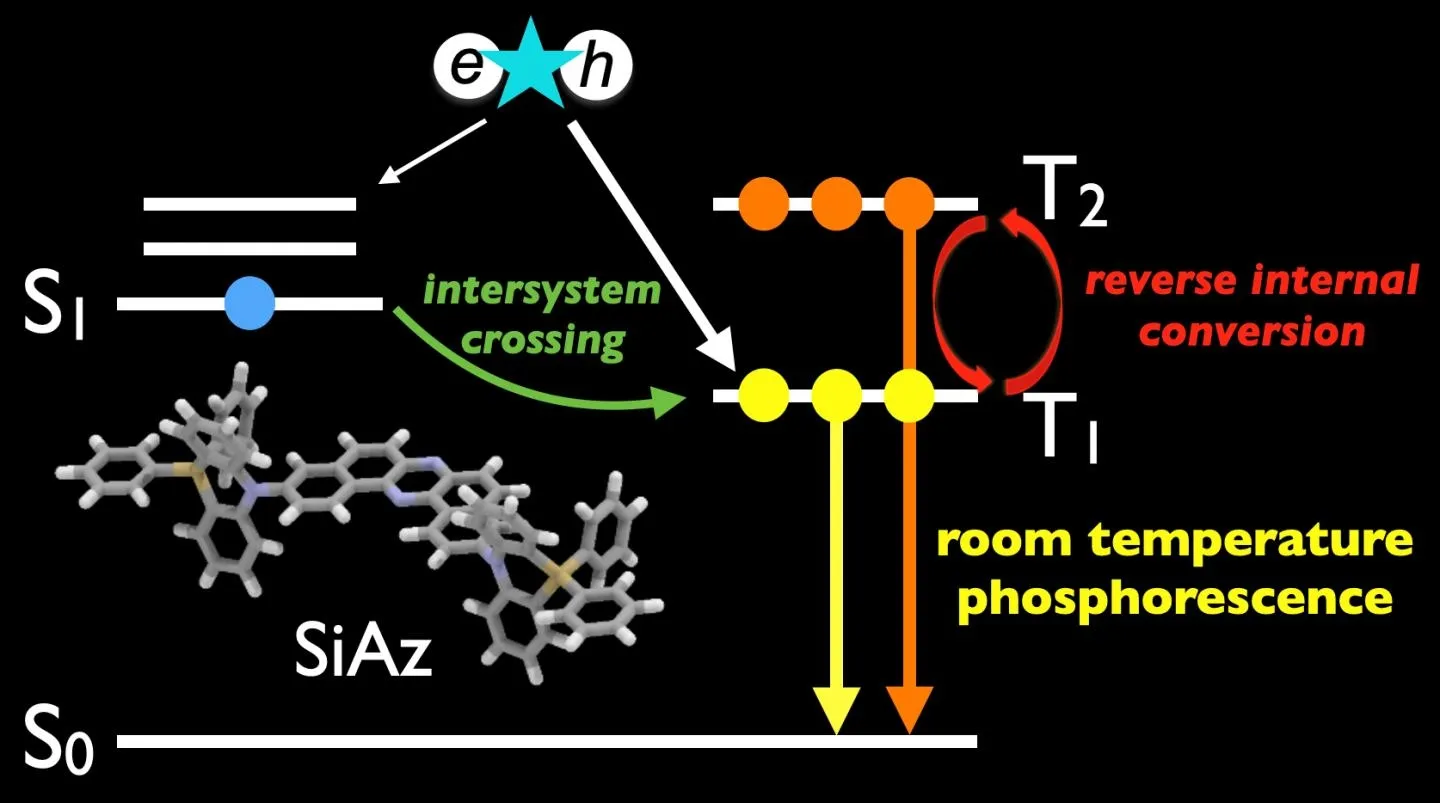
Osaka - Organic light-emitting diode (OLED) displays are now very popular features of many mainstream products including smartphones and televisions. OLEDs have the advantages of being low cost, light, flexible, and easy to modify, making them ideal display materials. However, current OLEDs that achieve commercially viable quantum efficiencies contain rare metal atoms such as iridium and platinum that increase costs and reduce sustainability. Now, an international team including researchers from Osaka University has reported the best performing heavy-atom-free OLED of its kind.
Although OLEDs that do not contain heavy atoms--such as rare metals and halogens--are an obvious choice for reducing the cost and improving the long-term viability of products, the heavy-atom-free emitters that are currently available have limitations.
Materials known as thermally activated delayed fluorescence (TADF) emitters are efficient; however, they typically have broad emission spectra that make them more suitable for use as light sources than as the precise emitters required for display applications. Another type of heavy-atom-free emitter is room-temperature phosphorescence (RTP) emitters; however, the OLEDs using them show very low efficiencies of END
Although OLEDs that do not contain heavy atoms--such as rare metals and halogens--are an obvious choice for reducing the cost and improving the long-term viability of products, the heavy-atom-free emitters that are currently available have limitations.
Materials known as thermally activated delayed fluorescence (TADF) emitters are efficient; however, they typically have broad emission spectra that make them more suitable for use as light sources than as the precise emitters required for display applications. Another type of heavy-atom-free emitter is room-temperature phosphorescence (RTP) emitters; however, the OLEDs using them show very low efficiencies of END