Holograms increase solar energy yield
A newly developed holographic light collector boosts solar panel efficiency for an energy conversion increase of approximately five percent over the course of a year
Published 2021-05-25 · Original archive entry · Explore research explainers
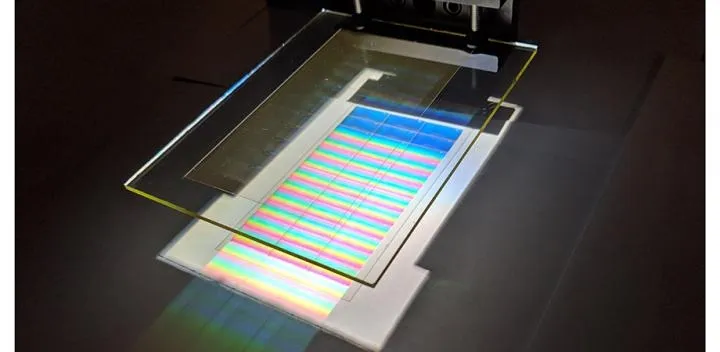
The energy available from sunlight is 10,000 times more than what is needed to supply the world's energy demands. Sunlight has two main properties that are useful in the design of renewable energy systems. The first is the amount power falling on a fixed area, like the ground or a person's roof. This quantity varies with the time of day and the season. The second property is the colors or spectrum of the sunlight.
One way to capture solar energy is to use solar cells that directly turn sunlight into electricity. In a solar module like those that people place on their roof, many cells are assembled on a rigid panel, connected to one another, sealed, and covered with protective glass. The solar cell works best when certain colors of sunlight fall on it, and when the whole area is covered by photocells. However, some panel area is needed to connect the cells, and the solar cell shape may not allow all of the remaining panel area to collect sunlight. These effects make the solar panel less efficient than it could be. Capturing as much of the sunlight on a solar panel as possible is critical to efficiently harnessing solar energy.
Researchers at the University of Arizona recently developed an innovative technique to capture the unused solar energy that illuminates a solar panel. END
One way to capture solar energy is to use solar cells that directly turn sunlight into electricity. In a solar module like those that people place on their roof, many cells are assembled on a rigid panel, connected to one another, sealed, and covered with protective glass. The solar cell works best when certain colors of sunlight fall on it, and when the whole area is covered by photocells. However, some panel area is needed to connect the cells, and the solar cell shape may not allow all of the remaining panel area to collect sunlight. These effects make the solar panel less efficient than it could be. Capturing as much of the sunlight on a solar panel as possible is critical to efficiently harnessing solar energy.
Researchers at the University of Arizona recently developed an innovative technique to capture the unused solar energy that illuminates a solar panel. END