Enhanced photoelectrochemical water splitting with a donor-acceptor polyimide
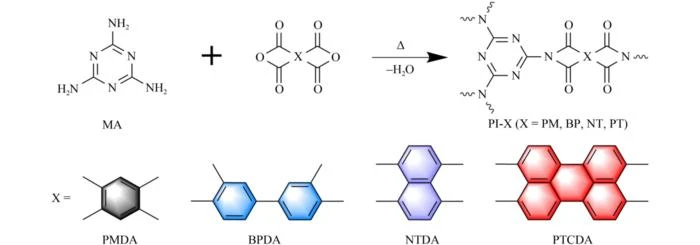
Polyimide (PI) has emerged as a promising organic photocatalyst owing to its distinct advantages of high visible-light response, facile synthesis, molecularly tunable donor-acceptor structure, and excellent physicochemical stability. However, the synthesis of high-quality PI photoelectrode remains a challenge, and photoelectrochemical (PEC) water splitting for PI has been less studied.
A research group of Huiyan Zhang and Sheng Chu from Southeast University prepared PI films by a simple spin-coating method for the first time. They adopted four dianhydrides with different conjugate sizes of aromatic unit (phenyl, biphenyl, naphthalene, perylene) to construct the corresponding D-A PI photoelectrodes, named PI-PM, PI-BP, PI-NT, and PI-PT, respectively. Their PEC properties were investigated, and the influence of the conjugate size of aromatic unit (phenyl, biphenyl, naphthalene, perylene) of electron acceptor on PEC performance was studied.
It was found that the fused ring was prominent in improving the light absorption capacity of PI, but excessive fused rings were unfavorable for the photogenerated charge separation. Of all the samples, the PI-NT film exhibits the highest photocurrent response, which is ascribed to its wide-range light absorption, efficient charge separation and transport, and strong photooxidation capacity. However, the photocurrent response of the PI film presented here needs to be improved for efficient PEC water splitting, which can be enhanced by catalyst modification (e.g., elemental doping, and composite engineering) or optimizing the preparation method of films in subsequent work.
This work is not only a starting point of PI films for PEC water splitting, but also an enlightenment for the rational design of polymer photocatalysts for efficient PEC applications.
END