Neoself-antigens induce autoimmunity in lupus
Reactivation of Epstein–Barr virus infection increases the production of neoself-antigens, which induce an autoimmune response, in patients with lupus
Published 2024-09-13 · Original archive entry · Explore research explainers
Osaka, Japan – Autoimmune diseases are widespread and notoriously difficult to treat. In part, this is because why the immune system attacks its own tissues in patients with these conditions remains poorly understood.
In a study recently published in Cell, researchers from Osaka University have revealed that the body’s own proteins with unusual structure trigger immune cells to unleash a wave of inflammation that leads to autoimmunity.
Autoimmune diseases develop when the body’s immune system mistakenly attacks its own tissues instead of fighting off foreign invaders like bacteria or viruses. However, it has long been a mystery why this happens, as the immune system has many checks and balances to make sure that it only reacts to ‘non-self’ triggers.
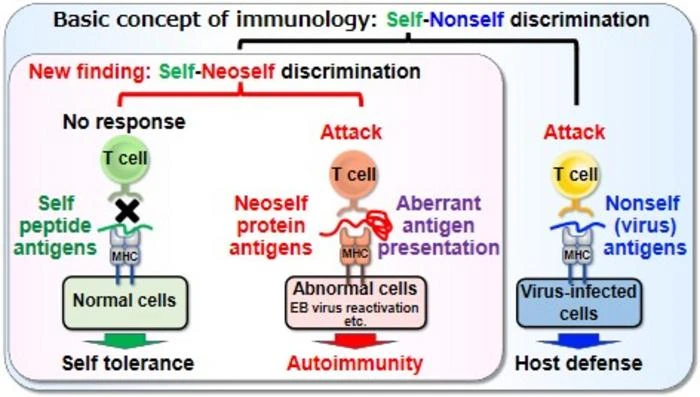
“T cells have been thought to discriminate between small fragments of protein derived from self and non-self proteins presented on the major histocompatibility complex II (MHC-II), and ‘trained’ not to respond self-antigens” explains senior author of the study Hisashi Arase. “However, when the MHC-II is missing a crucial piece called the invariant chain (Ii), it can present larger, misfolded self antigens, called neoself-antigens, to T cells.”
Given that autoantibodies to neoself-antigens are frequently found in patients with autoimmune diseases, the researchers explored T cell reactivity in patients with lupus and in mice, in which Ii was depleted from adult. They also investigated the effect of Epstein–Barr virus (EBV) infection, a risk factor for lupus, on T cell reactivity to neoself-antigens.
“The results were striking,” says Shunsuke Mori, lead author. “We found that approximately 10% of clonally expanded T cell repertoire in lupus patients recognized neoself-antigens. Furthermore, induction of neoself-antigens induced lupus-like disease in mice, meaning that they mounted an immune response to the body’s own tissues, thereby causing autoimmune disease.”
Furthermore, the researchers found that reactivation of EBV, which most people are infected with but is usually dormant, increases the presentation of neoself-antigens on MHC-II through downregulating the expression of Ii, triggering the activation of T cells directed against the body. This could explain why EBV reactivation is linked to the onset or exacerbation of lupus.
“Our findings demonstrate that T cells discriminate self- and neoself-antigens and do not recognize neoself-antigens as self antigens, thus leading to the development of autoimmunity when neoself-antigens are presented on MHC-II,” says Arase.
This study substantially increases our understanding of self-tolerance of T cells as well as the causes of autoimmune disease by identifying neoself-antigens as a distinct class of antigens that trigger an inappropriate immune response. This insight into why the body begins to attack itself could help develop new treatments for autoimmune disorders like lupus.
###
The article, “Neoself-antigens are the primary target for autoreactive T cells in human lupus,” will be published in Cell at DOI: https://doi.org/10.1016/j.cell.2024.08.025
About Osaka University
Osaka University was founded in 1931 as one of the seven imperial universities of Japan and is now one of Japan's leading comprehensive universities with a broad disciplinary spectrum. This strength is coupled with a singular drive for innovation that extends throughout the scientific process, from fundamental research to the creation of applied technology with positive economic impacts. Its commitment to innovation has been recognized in Japan and around the world. Now, Osaka University is leveraging its role as a Designated National University Corporation selected by the Ministry of Education, Culture, Sports, Science and Technology to contribute to innovation for human welfare, sustainable development of society, and social transformation.
Website: https://resou.osaka-u.ac.jp/en
About Immunology Frontier Research Center (IFReC), Osaka University
IFReC was established by the support of the World Premier International Research Center Initiative (WPI) in 2007. IFReC aims to overcome immune-related diseases by clarifying the whole picture of the immune system, and has promoted globally competitive fundamental research with excellent researchers from overseas.
Website: https://www.ifrec.osaka-u.ac.jp/en/
END
In a study recently published in Cell, researchers from Osaka University have revealed that the body’s own proteins with unusual structure trigger immune cells to unleash a wave of inflammation that leads to autoimmunity.
Autoimmune diseases develop when the body’s immune system mistakenly attacks its own tissues instead of fighting off foreign invaders like bacteria or viruses. However, it has long been a mystery why this happens, as the immune system has many checks and balances to make sure that it only reacts to ‘non-self’ triggers.
“T cells have been thought to discriminate between small fragments of protein derived from self and non-self proteins presented on the major histocompatibility complex II (MHC-II), and ‘trained’ not to respond self-antigens” explains senior author of the study Hisashi Arase. “However, when the MHC-II is missing a crucial piece called the invariant chain (Ii), it can present larger, misfolded self antigens, called neoself-antigens, to T cells.”
Given that autoantibodies to neoself-antigens are frequently found in patients with autoimmune diseases, the researchers explored T cell reactivity in patients with lupus and in mice, in which Ii was depleted from adult. They also investigated the effect of Epstein–Barr virus (EBV) infection, a risk factor for lupus, on T cell reactivity to neoself-antigens.
“The results were striking,” says Shunsuke Mori, lead author. “We found that approximately 10% of clonally expanded T cell repertoire in lupus patients recognized neoself-antigens. Furthermore, induction of neoself-antigens induced lupus-like disease in mice, meaning that they mounted an immune response to the body’s own tissues, thereby causing autoimmune disease.”
Furthermore, the researchers found that reactivation of EBV, which most people are infected with but is usually dormant, increases the presentation of neoself-antigens on MHC-II through downregulating the expression of Ii, triggering the activation of T cells directed against the body. This could explain why EBV reactivation is linked to the onset or exacerbation of lupus.
“Our findings demonstrate that T cells discriminate self- and neoself-antigens and do not recognize neoself-antigens as self antigens, thus leading to the development of autoimmunity when neoself-antigens are presented on MHC-II,” says Arase.
This study substantially increases our understanding of self-tolerance of T cells as well as the causes of autoimmune disease by identifying neoself-antigens as a distinct class of antigens that trigger an inappropriate immune response. This insight into why the body begins to attack itself could help develop new treatments for autoimmune disorders like lupus.
###
The article, “Neoself-antigens are the primary target for autoreactive T cells in human lupus,” will be published in Cell at DOI: https://doi.org/10.1016/j.cell.2024.08.025
About Osaka University
Osaka University was founded in 1931 as one of the seven imperial universities of Japan and is now one of Japan's leading comprehensive universities with a broad disciplinary spectrum. This strength is coupled with a singular drive for innovation that extends throughout the scientific process, from fundamental research to the creation of applied technology with positive economic impacts. Its commitment to innovation has been recognized in Japan and around the world. Now, Osaka University is leveraging its role as a Designated National University Corporation selected by the Ministry of Education, Culture, Sports, Science and Technology to contribute to innovation for human welfare, sustainable development of society, and social transformation.
Website: https://resou.osaka-u.ac.jp/en
About Immunology Frontier Research Center (IFReC), Osaka University
IFReC was established by the support of the World Premier International Research Center Initiative (WPI) in 2007. IFReC aims to overcome immune-related diseases by clarifying the whole picture of the immune system, and has promoted globally competitive fundamental research with excellent researchers from overseas.
Website: https://www.ifrec.osaka-u.ac.jp/en/
END
Attachments