Illinois study: Extreme heat impacts dairy production, small farms most vulnerable
Published 2025-03-18 · Original archive entry · Explore research explainers
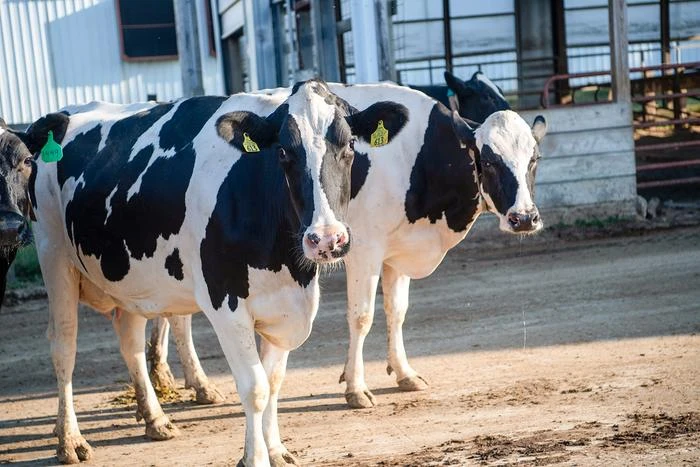
URBANA, Ill. – Livestock agriculture is bearing the cost of extreme weather events. A new study from the University of Illinois Urbana-Champaign explores how heat stress affects U.S. dairy production, finding that high heat and humidity lead to a 1% decline in annual milk yield. Small farms are hit harder than large farms, which may be able to mitigate some of the effects through management strategies.
“Cows are mammals like us, and they experience heat stress just like we do. When cows are exposed to extreme heat, it can have a range of negative physical effects. There is an increased risk of infection, restlessness, and decreased appetite, which leads to a decline in milk yield. For dairy producers, the heat impact is a direct hit on their revenue,” explained study co-author Marin Skidmore, assistant professor in the Department of Agricultural and Consumer Economics (ACE), part of the College of Agricultural, Consumer and Environmental Sciences at the U. of I. She conducted the study with Jared Hutchins, assistant professor in ACE, and Derek Nolan, Illinois Extension specialist and teaching assistant professor in the Department of Animal Sciences at the U. of I.
Skidmore and her colleagues analyzed milk production data from nine U.S. Midwest states. They included over 56 million cow-level production records from 18,000 dairy farms from 2012 to 2016. They adjusted the milk data for protein and fat content to more accurately estimate milk quality, which determines the price.
“Previous studies have focused on fluid milk yield. But in our dairy marketing system, milk is sold on components. When you calculate revenue, it’s not just about how many gallons of milk, but whether it’s high-quality milk with high protein and fat content,” Skidmore said.
The researchers combined quality-adjusted production data with daily weather data for temperature and humidity. They calculated temperature-humidity index measurements, which most accurately reflect the heat stress a cow experiences, as high heat and humidity make it harder for the cow to cool down through sweating.
They found that, on average, 1% of annual milk yield is lost to heat stress. This may not sound like a lot, but it amounts to about 1.4 billion pounds of milk (adjusted for energy content) over five years for the 18,000 herds included in the study. Based on average milk prices, this is equivalent to about $245 million in lost revenue.
Most of the losses are due to low- and moderate-stress days because those are more common; however, yield loss per cow due to an extreme-stress day is more than double that of a moderate-stress day.
Heat stress disproportionately affects smaller farms, the study showed. Herds with fewer than 100 cows lost an average of 1.6% of annual yield, and while they supplied less than 20% of total output in the sample, they represented 27% of total damages.
Producers can implement various forms of mitigation strategies, such as open barn sides, fans, and sprinklers. Larger farms are better able to do so, but it’s not possible to fully protect against heat stress.
“There are a number of different adaptive methods, but there is no silver bullet. You can install more sprinklers and sophisticated ventilation systems. You could change the timing of calving to avoid these warmer periods, but that incurs other risks, and it is a complex issue,” Skidmore explained.
“Lower levels of heat intensity are potentially manageable with some of the practices available. At those levels, the largest farms are not really taking on noticeable losses, and that’s where we start to see the difference between small and large farms. But there is a level of heat stress where it’s so hot and humid that you can’t completely manage it.”
The researchers also project potential losses forward to 2050, using the average predictions from 22 different climate models. Under most scenarios, extreme heat days are predicted to be much more frequent, and milk yield losses are expected to increase about 30% by 2050.
If policy makers consider dairy production a priority, small farms will require greater support to remain competitive in the future, Skidmore stated.
“If there's interest in continuing to have a healthy and robust small dairy production presence in the U.S., that probably will require financial incentives to help farmers implement mitigation strategies, as well as investments in further research on how to manage the highest levels of heat stress,” she concluded.
The paper, “Vulnerability of US dairy farms to extreme heat,” is published in Food Policy [DOI:10.1016/j.foodpol.2025.102821]. Funding was provided by a Center for the Economics of Sustainability Seed Grant.
END
“Cows are mammals like us, and they experience heat stress just like we do. When cows are exposed to extreme heat, it can have a range of negative physical effects. There is an increased risk of infection, restlessness, and decreased appetite, which leads to a decline in milk yield. For dairy producers, the heat impact is a direct hit on their revenue,” explained study co-author Marin Skidmore, assistant professor in the Department of Agricultural and Consumer Economics (ACE), part of the College of Agricultural, Consumer and Environmental Sciences at the U. of I. She conducted the study with Jared Hutchins, assistant professor in ACE, and Derek Nolan, Illinois Extension specialist and teaching assistant professor in the Department of Animal Sciences at the U. of I.
Skidmore and her colleagues analyzed milk production data from nine U.S. Midwest states. They included over 56 million cow-level production records from 18,000 dairy farms from 2012 to 2016. They adjusted the milk data for protein and fat content to more accurately estimate milk quality, which determines the price.
“Previous studies have focused on fluid milk yield. But in our dairy marketing system, milk is sold on components. When you calculate revenue, it’s not just about how many gallons of milk, but whether it’s high-quality milk with high protein and fat content,” Skidmore said.
The researchers combined quality-adjusted production data with daily weather data for temperature and humidity. They calculated temperature-humidity index measurements, which most accurately reflect the heat stress a cow experiences, as high heat and humidity make it harder for the cow to cool down through sweating.
They found that, on average, 1% of annual milk yield is lost to heat stress. This may not sound like a lot, but it amounts to about 1.4 billion pounds of milk (adjusted for energy content) over five years for the 18,000 herds included in the study. Based on average milk prices, this is equivalent to about $245 million in lost revenue.
Most of the losses are due to low- and moderate-stress days because those are more common; however, yield loss per cow due to an extreme-stress day is more than double that of a moderate-stress day.
Heat stress disproportionately affects smaller farms, the study showed. Herds with fewer than 100 cows lost an average of 1.6% of annual yield, and while they supplied less than 20% of total output in the sample, they represented 27% of total damages.
Producers can implement various forms of mitigation strategies, such as open barn sides, fans, and sprinklers. Larger farms are better able to do so, but it’s not possible to fully protect against heat stress.
“There are a number of different adaptive methods, but there is no silver bullet. You can install more sprinklers and sophisticated ventilation systems. You could change the timing of calving to avoid these warmer periods, but that incurs other risks, and it is a complex issue,” Skidmore explained.
“Lower levels of heat intensity are potentially manageable with some of the practices available. At those levels, the largest farms are not really taking on noticeable losses, and that’s where we start to see the difference between small and large farms. But there is a level of heat stress where it’s so hot and humid that you can’t completely manage it.”
The researchers also project potential losses forward to 2050, using the average predictions from 22 different climate models. Under most scenarios, extreme heat days are predicted to be much more frequent, and milk yield losses are expected to increase about 30% by 2050.
If policy makers consider dairy production a priority, small farms will require greater support to remain competitive in the future, Skidmore stated.
“If there's interest in continuing to have a healthy and robust small dairy production presence in the U.S., that probably will require financial incentives to help farmers implement mitigation strategies, as well as investments in further research on how to manage the highest levels of heat stress,” she concluded.
The paper, “Vulnerability of US dairy farms to extreme heat,” is published in Food Policy [DOI:10.1016/j.foodpol.2025.102821]. Funding was provided by a Center for the Economics of Sustainability Seed Grant.
END
Attachments