Earthquake Sensors Reveal Why Plowed Soil Stops Absorbing Rain
University of Washington / Science
A counterintuitive problem hiding in plain sight
Tilling is supposed to help water reach plant roots. You break up the soil, create channels, let rain percolate down. That is the logic, and it has guided farming for thousands of years. But the opposite happens. Plowed soil loses its ability to absorb water. Rain pools on the surface, forms a muddy crust, and runs off. Over time, the soil erodes and the risk of flooding rises.
The link between tilling and soil degradation has been known for some time. What has been missing is a clear physical explanation, and a way to watch the process unfold in real time. A team led by researchers at the University of Washington has now provided both, using an unlikely tool borrowed from earthquake science.
Fiber optics in the field
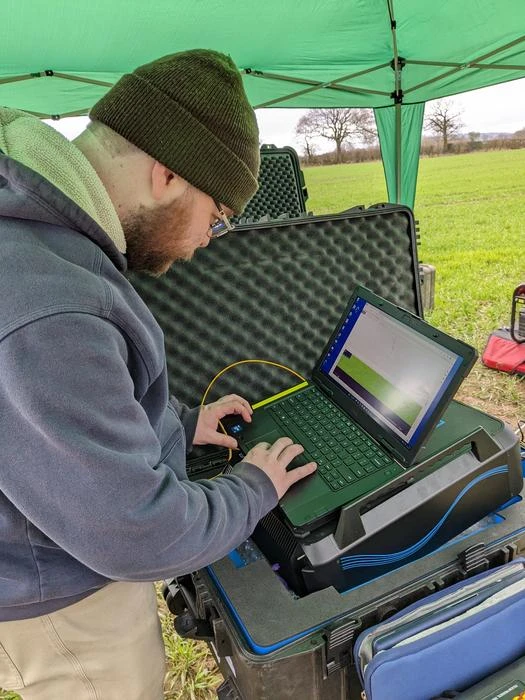
For the past decade, geophysicists have been experimenting with a technique called distributed acoustic sensing, or DAS. The idea is simple in concept: send pulses of laser light down a fiber optic cable and measure how the cable stretches. That strain reflects ground motion, and the system is sensitive enough to pick up not just earthquakes but the speed at which sound waves travel through the material surrounding the cable, a property called seismic velocity.
When soil gets wet, seismic velocity changes. Sound moves slower through saturated ground than through dry dirt. This gave the research team an idea: could they use seismic velocity to track how different farming methods affect soil moisture in real time?
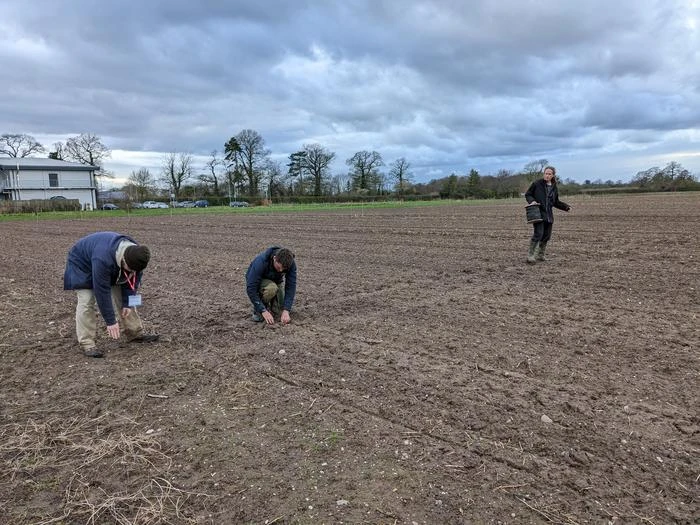
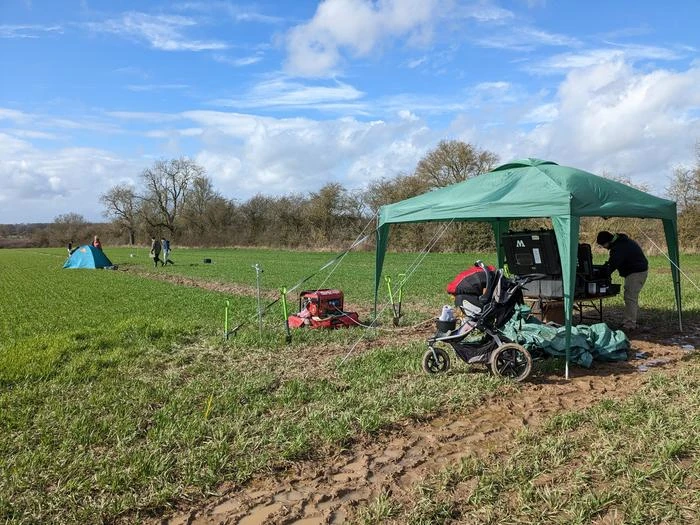
They found an ideal testing ground at an experimental farm affiliated with Harper Adams University near Newport in the United Kingdom. The farm has maintained consistent cultivation regimes across different plots for more than two decades. Some rows have never been tilled. Others are tilled to 10 centimeters. Others to 25 centimeters. Different levels of tractor compaction were also tested by varying tire pressure.
40 hours of continuous listening
The researchers lined the experimental plots with fiber optic cable and recorded ground motion continuously for 40 hours during a period of light to moderate rainfall. They combined the seismic data with weather observations over the same window.
Lead author Qibin Shi, formerly a postdoctoral researcher at UW and now at the Chinese Academy of Sciences, developed models to translate seismic velocity data into soil moisture measurements. The results showed clear differences between cultivation strategies.
In no-till plots, rainfall caused gradual, even changes in seismic velocity, consistent with water percolating steadily through intact capillary networks. In heavily tilled plots, the response was sharply different. The capillary channels, tiny interconnected pores that give healthy soil its sponge-like quality, had been broken apart by repeated plowing. Without those channels, water could not infiltrate. It sat on the surface instead.
Compaction from tractor tires made things worse. The combination of deep tilling and heavy machinery created soil that was structurally compromised at multiple levels.
Better resolution than anything before
Traditional soil moisture monitoring relies on point sensors, individual probes stuck into the ground at specific locations. These give readings at one spot. DAS, by contrast, measures conditions along the entire length of the cable, providing spatial resolution that previous tools could not match. The temporal resolution is also superior: continuous data rather than periodic snapshots.
David Montgomery, a UW professor of Earth and space sciences and co-author on the study, noted that this is the first time seismological methods have provided a clear physical explanation for why tilling, one of humanity's oldest agricultural practices, degrades soil structure in ways that reduce water absorption.
Applications beyond the farm
The researchers see potential uses well beyond agriculture. Real-time soil moisture data could improve flood prediction models, refine estimates of atmospheric water content used in weather forecasting, and help map liquefaction risk for earthquake hazard assessments. For farmers, the technology could provide continuous monitoring of soil health at relatively low cost, since fiber optic cable is inexpensive and DAS systems can be operated remotely.
But there are limitations to acknowledge. The study covered a 40-hour window with light to moderate rainfall at a single location in England. Different soil types, climates, and crop systems may respond differently. The experimental farm's two-decade history of consistent treatment makes it unusually well-controlled; real-world farms have messier management histories. And while the DAS technique provides excellent spatial coverage, interpreting the data still requires careful modeling that may not be straightforward for all soil conditions.
The study was published March 19 in Science. Senior author Marine Denolle, a UW associate professor, said the team wanted to find out whether seismic tools designed for monitoring earthquakes could reveal how soil responds to different treatment regimes. The answer turned out to be yes, and with a clarity that older monitoring methods could not achieve.