A beta blocker that activates with violet light -- and researchers can now see why
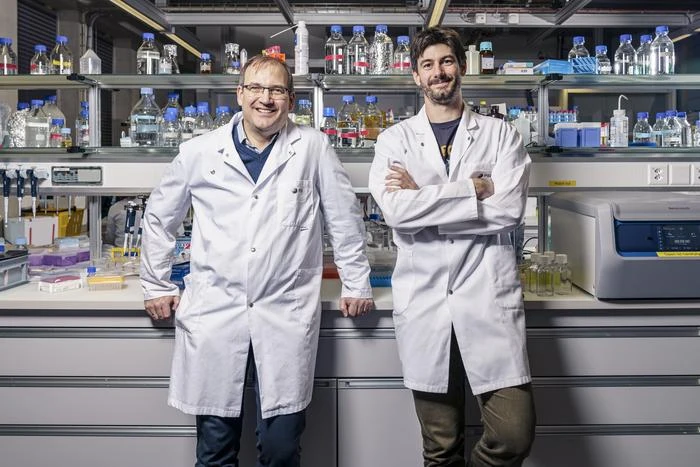
Paul Scherrer Institute / Angewandte Chemie International Edition
Take a pill, and every organ in your body gets the drug whether it needs it or not. A beta blocker prescribed for heart rhythm problems will also hit the identical receptors in your lungs. A blood pressure medication will lower pressure everywhere, not just where it is dangerously high. This lack of spatial precision is one of the oldest problems in pharmacology, and photopharmacology -- the science of building drugs that activate only when hit with a specific wavelength of light -- is one of the most elegant proposed solutions.
The concept is simple in principle: swallow a drug that is inactive, then shine light on the specific body part where you want it to work. The drug switches on locally, does its job, and remains inert everywhere else. Side effects, in theory, plummet.
What has been missing is a detailed understanding of what actually happens at the molecular level when these light-switchable drugs change shape at their target receptors. Now, researchers at Switzerland's Paul Scherrer Institute (PSI) have captured exactly that -- the first atomic-resolution snapshots of a photoswitchable beta blocker transforming at its receptor in real time. The study appears in Angewandte Chemie International Edition.
Photoazolol-1: a beta blocker with a built-in toggle
The molecule at the center of the study, photoazolol-1, is modeled after conventional beta blockers that have been prescribed for decades to treat high blood pressure and cardiac arrhythmias. Like those drugs, it works by binding to beta-adrenergic receptors -- proteins embedded in cell membranes, primarily in the heart and in smooth muscle tissue like the airways. These receptors normally respond to adrenaline and noradrenaline, triggering stress responses: faster heart rate, higher blood pressure. Beta blockers inhibit the receptors, dampening those responses.
Photoazolol-1, developed by collaborators at Spain's Consejo Superior de Investigaciones Cientificas in Barcelona, contains an additional chemical group -- an azobenzene group -- that functions as a molecular light switch. When hit with violet light, this group flips its configuration within picoseconds (trillionths of a second), transforming the molecule from a straight shape into a bent, bulkier form.
Not off -- just turned down
The PSI team's central finding upended a common assumption. When photoazolol-1 switches from its straight form to its bent form, it does not pop out of the receptor's binding pocket. It stays put. But its grip loosens.
In its straight configuration, the molecule fits snugly into the binding site of a beta-adrenergic receptor found primarily in the lungs. It blocks the receptor efficiently, preventing adrenaline from docking. When light bends the molecule, it still occupies the binding pocket -- meaning adrenaline still cannot get in -- but the binding is less effective. The receptor is partially released from inhibition rather than fully freed.
"We often talk about receptors as switches, which implies that there are only on and off versions," said postdoctoral researcher Quentin Bertrand, one of the study's first authors. "But in reality, receptors are more like regulators that can be used to amplify or weaken a process."
This nuance matters for drug design. A light-switchable drug that acts as a dimmer -- modulating receptor activity rather than toggling it -- offers finer control than a simple on-off mechanism. Clinicians could potentially tune the degree of receptor blockade by adjusting light exposure.
Filming molecules in trillionths of a second
Capturing these molecular transformations required the SwissFEL, PSI's X-ray free-electron laser. The instrument produces ultrashort, extremely intense pulses of X-ray light that can freeze molecular motion at the picosecond timescale. Each pulse generates something like a single frame of a film. String enough frames together, and you get a time-resolved movie of a drug changing shape at its receptor.
Previous experiments by the Spanish collaborators had already shown the functional effect -- heart cells exposed to photoazolol-1 changed their beating rate when irradiated with light. What the SwissFEL data provided was the structural explanation: why the molecule behaves differently in its two shapes.
The bent shape reverts -- green light speeds it up
One practical detail: the bent configuration is thermally unstable. Left alone, it gradually reverts to the straight, more potent form. For faster reactivation, the molecule can be exposed to green light, which drives the reverse transformation. This reversibility is a feature, not a bug -- it means the drug can be cycled between more active and less active states repeatedly.
From structural insight to rational design
The study's implications reach beyond this single molecule. Photopharmacology has relied heavily on trial and error -- synthesizing light-switchable drug candidates and testing whether the shape change happens to affect their binding. Knowing the atomic-level details of how shape change alters receptor interaction should allow researchers to design photoswitchable drugs more rationally.
"Designing such molecules is often a guessing game," Bertrand said. "Now we have shown that with SwissFEL, we can observe in detail what happens when light-switchable drugs are transformed at the receptor."
The PSI team, which includes the spin-off company leadXPro (located next to PSI and focused on membrane protein drug development), plans to extend the approach to other receptor-drug systems. Light-switchable versions of histamine -- relevant to autoimmune reactions -- and adenosine receptor ligands, including caffeine and Parkinson's disease medications, are on the roadmap. The project is supported by the Swiss National Science Foundation.
None of this is close to clinical use. The distance between atomic-resolution structural data and an approved photopharmacological therapy remains vast. But the structural groundwork laid here -- understanding not just that light changes a drug's effect, but precisely how and why -- is the kind of mechanistic insight that turns a speculative field into an engineering problem.