Graphene receivers bring energy-efficient 6G hardware closer to reality
Thanks to the 5th generation (5G) technology, we now enjoy unprecedented levels of connectivity. Nevertheless, wireless data traffic is facing an increasing demand for an even higher capacity and faster data transfer —a demand that, according to Edholm’s law, could exceed the terabit per second before 2035. Scientists are thus beginning to develop 6G, a technology that will accommodate higher speeds (around 1 terabit per second), ultra-low latency (below a millisecond), and advanced wireless connectivity.
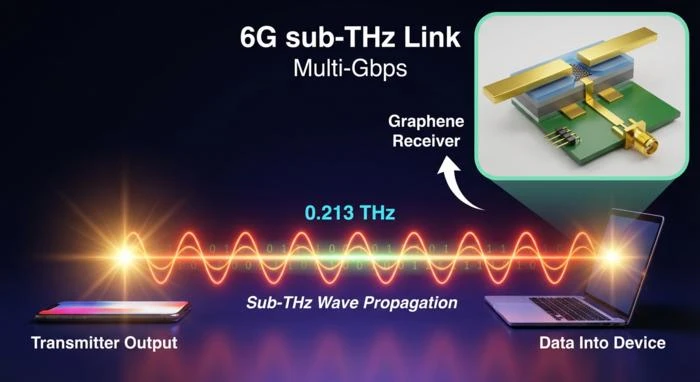
Transitioning from 5G to 6G, however, entails one major challenge: moving from the microwave to the sub-terahertz (sub-THz) frequency range, where data signals can meet the demanding requirements in both capacity and reduced signal attenuation. The challenge lies in finding receivers (key components for signal detection) that operate efficiently in this frequency regime.
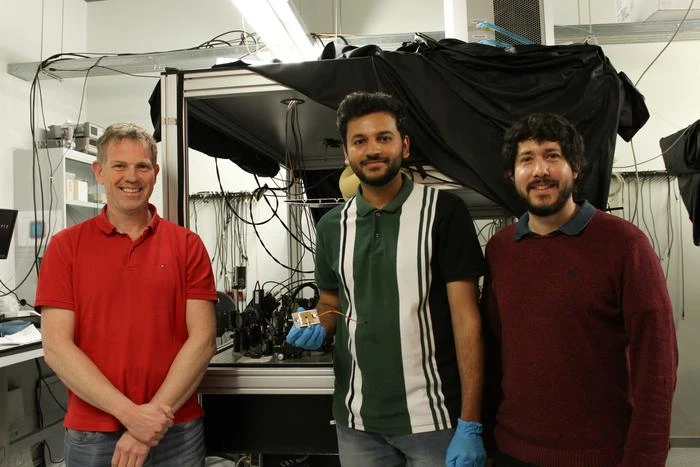
ICFO researchers, Dr. Karuppasamy Pandian Soundarapandian, Dr. Sebastián Castilla, and Dr. Simone Marconi, led by ICREA Prof. Frank Koppens, have now presented a promising solution in Nature Communications, demonstrating, for the first time, a sub-THz graphene receiver. The study was conducted in collaboration with ETH Zurich, the University of Ioannina, the Catalan Institute of Nanoscience and Nanotechnology (ICN2), and other institutions.
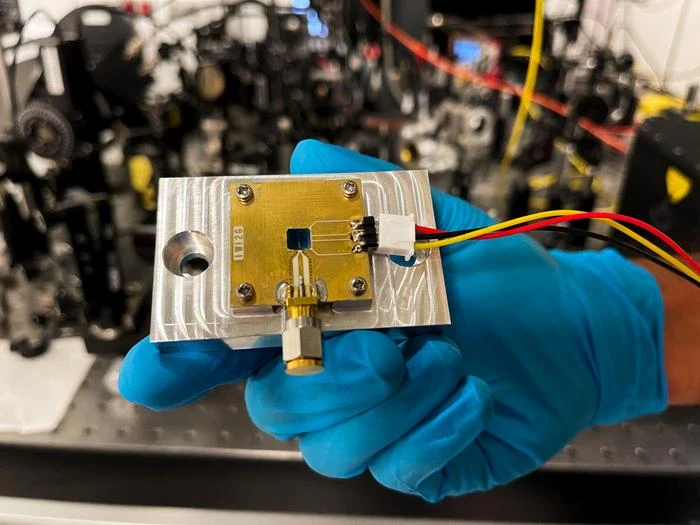
Previous sub-THz receivers were either energy-consuming or bulky, and not suitable for on-chip integration. The current approach, in contrast, simultaneously meets all the requirements that future 6G technologies must satisfy, including multi-gigabit-per-second data rates, low complexity, compactness (0.018 mm²), CMOS compatibility (the standard technology used for constructing integrated circuit chips), and near-zero energy consumption during operation.
“Graphene is uniquely effective as a sub-THz receiver because it converts tiny induced changes in electron temperature into strong electric signals with zero energy consumption, all while operating at room temperature,” explains Dr. Karuppasamy Pandian Soundarapandian, first co-author of the article.
Previous graphene detectors, however, were either too slow or not sensitive enough to perform wireless signal demodulation. The key to overcoming these longstanding limitations was the integration of high-quality graphene with a carefully designed radiofrequency circuit and sub-THz cavity containing an antenna and a back mirror, which enhances the interaction between sub-THz radiation and graphene, boosting the speed and sensitivity required for reliable wireless signal detection.
“Ours is the first system-level validation showing that an atomically thin material can serve as a zero-power, ultra-compact sub-THz receiver,” shares Dr. Sebastián Castilla, first co-author of the article. And he adds: “this advancement transforms graphene devices from promising laboratory detectors into practical miniaturized building blocks for future 6G wireless technology.”
Reference:
K. Pandian Soundarapandian, S. Castilla, et. al., High-Speed Graphene-based Sub-Terahertz Receivers enabling Wireless Communications for 6G and Beyond, Nat Comm (2026).
DOI: https://doi.org/10.1038/s41467-026-69186-6
END
Transitioning from 5G to 6G, however, entails one major challenge: moving from the microwave to the sub-terahertz (sub-THz) frequency range, where data signals can meet the demanding requirements in both capacity and reduced signal attenuation. The challenge lies in finding receivers (key components for signal detection) that operate efficiently in this frequency regime.
ICFO researchers, Dr. Karuppasamy Pandian Soundarapandian, Dr. Sebastián Castilla, and Dr. Simone Marconi, led by ICREA Prof. Frank Koppens, have now presented a promising solution in Nature Communications, demonstrating, for the first time, a sub-THz graphene receiver. The study was conducted in collaboration with ETH Zurich, the University of Ioannina, the Catalan Institute of Nanoscience and Nanotechnology (ICN2), and other institutions.
Previous sub-THz receivers were either energy-consuming or bulky, and not suitable for on-chip integration. The current approach, in contrast, simultaneously meets all the requirements that future 6G technologies must satisfy, including multi-gigabit-per-second data rates, low complexity, compactness (0.018 mm²), CMOS compatibility (the standard technology used for constructing integrated circuit chips), and near-zero energy consumption during operation.
“Graphene is uniquely effective as a sub-THz receiver because it converts tiny induced changes in electron temperature into strong electric signals with zero energy consumption, all while operating at room temperature,” explains Dr. Karuppasamy Pandian Soundarapandian, first co-author of the article.
Previous graphene detectors, however, were either too slow or not sensitive enough to perform wireless signal demodulation. The key to overcoming these longstanding limitations was the integration of high-quality graphene with a carefully designed radiofrequency circuit and sub-THz cavity containing an antenna and a back mirror, which enhances the interaction between sub-THz radiation and graphene, boosting the speed and sensitivity required for reliable wireless signal detection.
“Ours is the first system-level validation showing that an atomically thin material can serve as a zero-power, ultra-compact sub-THz receiver,” shares Dr. Sebastián Castilla, first co-author of the article. And he adds: “this advancement transforms graphene devices from promising laboratory detectors into practical miniaturized building blocks for future 6G wireless technology.”
Reference:
K. Pandian Soundarapandian, S. Castilla, et. al., High-Speed Graphene-based Sub-Terahertz Receivers enabling Wireless Communications for 6G and Beyond, Nat Comm (2026).
DOI: https://doi.org/10.1038/s41467-026-69186-6
END
Attachments