From stillage to storage: Researchers turn bourbon byproducts into supercapacitors
Published 2026-03-25 · Original archive entry · Explore research explainers
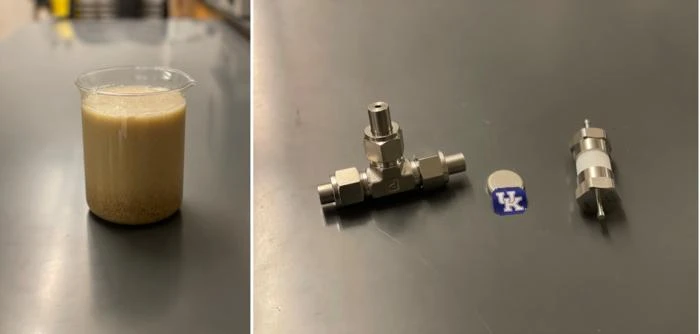
ATLANTA, March 25, 2026 — The state of Kentucky produces 95% of the world’s bourbon, and all that bourbon leaves behind an enormous amount of waste grain, called stillage. Now, researchers at the University of Kentucky have developed a process to transform that stillage into electrodes. With the bourbon byproduct electrodes, they created supercapacitors that could store more energy than similarly sized commercial devices.
The researchers will present their results at the spring meeting of the American Chemical Society (ACS). ACS Spring 2026 is being held March 22-26; it features nearly 11,000 presentations on a range of science topics.
Josiel Barrios Cossio, a graduate student who will be presenting the work, first learned about the scale of American whiskey’s waste problem while working on a research traineeship to examine food, energy and water issues in Kentucky. “From the final volume of bourbon produced, you get 6 to 10 times that amount of stillage as waste,” says Barrios Cossio, “so it's a big deal."
This stillage is a sloppy mash that’s typically sold to farmers as livestock feed or a soil additive. But it is difficult to transport while wet, and it is expensive to dry.
One alternative solution is to directly convert the soupy stillage into more valuable carbon materials using a technique called hydrothermal carbonization, which is like high-intensity pressure cooking. “We could take the stillage as it is, in a dispersion with a lot of water,” says Barrios Cossio, “and use that disadvantage as an advantage.”
The team was interested in carbon materials because they make good electrodes for supercapacitors, a type of energy storage device. Hydrothermal carbonization could offer a plant-based waste as the source for these electrodes. Previous research demonstrated that agricultural byproducts like corn fibers could be converted into carbon materials with this type of heating, but the strategy hasn’t been tried with bourbon stillage, which is made of a blend of grains that must include corn.
So, Barrios Cossio and Marcelo Guzman, a chemist at the University of Kentucky and the principial investigator for the project, set out to convert their local distilleries’ waste into electrodes for supercapacitors.
The first step was to engage with distillery owners, build trust and convince them to let the researchers into their facilities to take samples and “do something fun with it,” says Barrios Cossio. The University of Kentucky chemists have built relationships with distilleries from Kentucky to Illinois and even Canada to use their waste.
The team transformed the soggy stillage into a fine black powder by treating the waste product with heat and pressure in a 10-liter reactor. From there, the black powder was heated, for example, to 392 degrees Fahrenheit (200 degrees Celsius) in a furnace, either on its own to form hard carbon, or with potassium hydroxide to 1,472 F (800 C) to form activated carbon. Hard carbon is like graphite but with carbon sheets that are less neatly stacked, which makes it ideal for adsorbing more lithium ions to boost energy storage capability. Activated carbon is extremely porous, meaning it can store large amounts of charge, and therefore energy, within its large internal surface area.
For a proof-of-concept, the team made double-layer capacitors by sandwiching a liquid electrolyte between activated carbon electrodes. In tests, these coin-sized supercapacitors could store up to 48 watt hours per kilogram, which was on par with commercially available ones.
The researchers also experimented with hybrid lithium-ion supercapacitors, which are designed to compromise between the fast discharge speeds of capacitors and the higher energy storage of batteries. So, they built devices with one capacitor-type activated carbon electrode and one battery-type hard carbon electrode, which were both infused with lithium ions. These stillage-derived supercapacitors stored up to 25 times the energy per kilogram as conventional versions.
The lithium-ion supercapacitors are also a new example of using one agricultural source for two different electrodes in a single device. “It was a huge discovery for me that you can make hybrid devices from this waste,” says Barrios Cossio. “Hybrid devices are not common. Not common and not easy to make.”
The researchers' next steps are to study the energy storage mechanisms of their stillage-derived supercapacitors to optimize them for commercialization. Their goal is to develop larger versions of the supercapacitors, so that one day, this technology could help stabilize the electrical grid as more renewable energy sources are incorporated. More immediately, the team will pursue life cycle analysis as well as economic and technological feasibility evaluations to assess the sustainability of converting distillery waste into energy storage devices.
Overall, the team is excited to have found a prototype solution for a local issue in collaboration with Andrea Balducci’s group at the Friedrich Schiller University Jena, Germany. “This project allowed us to link with a real-world problem with industries at our state level,” says Guzman, “And that was super cool.”
The research was funded by the U.S. National Science Foundation and the University of Kentucky.
Visit the ACS Spring 2026 program to learn more about this presentation, “Bourbon whiskey waste-derived carbons for electric double layer and Lithium-Ion supercapacitors,” and other science presentations.
###
The American Chemical Society (ACS) is a nonprofit organization founded in 1876 and chartered by the U.S. Congress. ACS is committed to improving all lives through the transforming power of chemistry. Its mission is to advance scientific knowledge, empower a global community and champion scientific integrity, and its vision is a world built on science. The Society is a global leader in promoting excellence in science education and providing access to chemistry-related information and research through its multiple research solutions, peer-reviewed journals, scientific conferences, e-books and weekly news periodical Chemical & Engineering News. ACS journals are among the most cited, most trusted and most read within the scientific literature; however, ACS itself does not conduct chemical research. As a leader in scientific information solutions, its CAS Division partners with global innovators to accelerate breakthroughs by curating, connecting and analyzing the world’s scientific knowledge. ACS’ main offices are in Washington, D.C., and Columbus, Ohio.
To automatically receive press releases from the American Chemical Society, contact newsroom@acs.org.
Note to journalists: Please report that this research was presented at a meeting of the American Chemical Society. ACS does not conduct research, but publishes and publicizes peer-reviewed scientific studies.
Follow us: Facebook | LinkedIn | Instagram
Title
Bourbon whiskey waste-derived carbons for electric double layer and Lithium-Ion supercapacitors
Abstract
Bourbon is an American whiskey almost entirely crafted (95%) in Kentucky (KY). Distilleries have increased by 250% over the past 15 years in KY, leading to significant new challenges. One of the industry’s biggest challenges is the spent grain (stillage). For every barrel of bourbon produced, it is estimated that six to ten barrels of stillage remain. Here, bourbon stillage is transformed into carbon materials for conventional (electric-double-layer) and hybrid (lithium-metal-ion) supercapacitor electrodes. The bourbon stillage transformation involves hydrothermal carbonization, hydrochar pyrolysis, and activation with steam, carbon dioxide, phosphoric acid, and potassium hydroxide (KOH). Activated carbons and hard carbons derived from bourbon whiskey waste are physicochemically and electrochemically characterized, and the connection between structure and electrochemical performance is discussed. Physicochemical characterizations include Raman and FTIR spectroscopies, XRD, TGA, SEM-EDS, and nitrogen physisorption analysis. The electrochemical performance was evaluated using cyclic voltammetry, galvanostatic charge/discharge, and electrochemical impedance spectroscopy. Electric Double-Layer supercapacitors (EDLCs) assembled with KOH-activated carbon (AC) demonstrate excellent cyclability (96% capacitance retention after 15,000 cycles), and similar to current commercially available devices, specific energy (14-34 Wh/kg) and power (1,660-3,997 W/kg) densities at variable specific current (0.1-10 A/g). Experiments show that hybrid Lithium-ion Capacitors (LiC) assembled with prelithiated hard carbon and AC displayed energy densities of 66-93 Wh/kg and power densities of 4412-4531 W/kg at current densities ranging from 0.1 to 10 A/g. This research presents an innovative, potentially scalable, and sustainable strategy for repurposing bourbon stillage into efficient, green, and high-performance materials for energy storage applications, with the potential to be adopted by the entire whiskey and ethanol production industry.
END
The researchers will present their results at the spring meeting of the American Chemical Society (ACS). ACS Spring 2026 is being held March 22-26; it features nearly 11,000 presentations on a range of science topics.
Josiel Barrios Cossio, a graduate student who will be presenting the work, first learned about the scale of American whiskey’s waste problem while working on a research traineeship to examine food, energy and water issues in Kentucky. “From the final volume of bourbon produced, you get 6 to 10 times that amount of stillage as waste,” says Barrios Cossio, “so it's a big deal."
This stillage is a sloppy mash that’s typically sold to farmers as livestock feed or a soil additive. But it is difficult to transport while wet, and it is expensive to dry.
One alternative solution is to directly convert the soupy stillage into more valuable carbon materials using a technique called hydrothermal carbonization, which is like high-intensity pressure cooking. “We could take the stillage as it is, in a dispersion with a lot of water,” says Barrios Cossio, “and use that disadvantage as an advantage.”
The team was interested in carbon materials because they make good electrodes for supercapacitors, a type of energy storage device. Hydrothermal carbonization could offer a plant-based waste as the source for these electrodes. Previous research demonstrated that agricultural byproducts like corn fibers could be converted into carbon materials with this type of heating, but the strategy hasn’t been tried with bourbon stillage, which is made of a blend of grains that must include corn.
So, Barrios Cossio and Marcelo Guzman, a chemist at the University of Kentucky and the principial investigator for the project, set out to convert their local distilleries’ waste into electrodes for supercapacitors.
The first step was to engage with distillery owners, build trust and convince them to let the researchers into their facilities to take samples and “do something fun with it,” says Barrios Cossio. The University of Kentucky chemists have built relationships with distilleries from Kentucky to Illinois and even Canada to use their waste.
The team transformed the soggy stillage into a fine black powder by treating the waste product with heat and pressure in a 10-liter reactor. From there, the black powder was heated, for example, to 392 degrees Fahrenheit (200 degrees Celsius) in a furnace, either on its own to form hard carbon, or with potassium hydroxide to 1,472 F (800 C) to form activated carbon. Hard carbon is like graphite but with carbon sheets that are less neatly stacked, which makes it ideal for adsorbing more lithium ions to boost energy storage capability. Activated carbon is extremely porous, meaning it can store large amounts of charge, and therefore energy, within its large internal surface area.
For a proof-of-concept, the team made double-layer capacitors by sandwiching a liquid electrolyte between activated carbon electrodes. In tests, these coin-sized supercapacitors could store up to 48 watt hours per kilogram, which was on par with commercially available ones.
The researchers also experimented with hybrid lithium-ion supercapacitors, which are designed to compromise between the fast discharge speeds of capacitors and the higher energy storage of batteries. So, they built devices with one capacitor-type activated carbon electrode and one battery-type hard carbon electrode, which were both infused with lithium ions. These stillage-derived supercapacitors stored up to 25 times the energy per kilogram as conventional versions.
The lithium-ion supercapacitors are also a new example of using one agricultural source for two different electrodes in a single device. “It was a huge discovery for me that you can make hybrid devices from this waste,” says Barrios Cossio. “Hybrid devices are not common. Not common and not easy to make.”
The researchers' next steps are to study the energy storage mechanisms of their stillage-derived supercapacitors to optimize them for commercialization. Their goal is to develop larger versions of the supercapacitors, so that one day, this technology could help stabilize the electrical grid as more renewable energy sources are incorporated. More immediately, the team will pursue life cycle analysis as well as economic and technological feasibility evaluations to assess the sustainability of converting distillery waste into energy storage devices.
Overall, the team is excited to have found a prototype solution for a local issue in collaboration with Andrea Balducci’s group at the Friedrich Schiller University Jena, Germany. “This project allowed us to link with a real-world problem with industries at our state level,” says Guzman, “And that was super cool.”
The research was funded by the U.S. National Science Foundation and the University of Kentucky.
Visit the ACS Spring 2026 program to learn more about this presentation, “Bourbon whiskey waste-derived carbons for electric double layer and Lithium-Ion supercapacitors,” and other science presentations.
###
The American Chemical Society (ACS) is a nonprofit organization founded in 1876 and chartered by the U.S. Congress. ACS is committed to improving all lives through the transforming power of chemistry. Its mission is to advance scientific knowledge, empower a global community and champion scientific integrity, and its vision is a world built on science. The Society is a global leader in promoting excellence in science education and providing access to chemistry-related information and research through its multiple research solutions, peer-reviewed journals, scientific conferences, e-books and weekly news periodical Chemical & Engineering News. ACS journals are among the most cited, most trusted and most read within the scientific literature; however, ACS itself does not conduct chemical research. As a leader in scientific information solutions, its CAS Division partners with global innovators to accelerate breakthroughs by curating, connecting and analyzing the world’s scientific knowledge. ACS’ main offices are in Washington, D.C., and Columbus, Ohio.
To automatically receive press releases from the American Chemical Society, contact newsroom@acs.org.
Note to journalists: Please report that this research was presented at a meeting of the American Chemical Society. ACS does not conduct research, but publishes and publicizes peer-reviewed scientific studies.
Follow us: Facebook | LinkedIn | Instagram
Title
Bourbon whiskey waste-derived carbons for electric double layer and Lithium-Ion supercapacitors
Abstract
Bourbon is an American whiskey almost entirely crafted (95%) in Kentucky (KY). Distilleries have increased by 250% over the past 15 years in KY, leading to significant new challenges. One of the industry’s biggest challenges is the spent grain (stillage). For every barrel of bourbon produced, it is estimated that six to ten barrels of stillage remain. Here, bourbon stillage is transformed into carbon materials for conventional (electric-double-layer) and hybrid (lithium-metal-ion) supercapacitor electrodes. The bourbon stillage transformation involves hydrothermal carbonization, hydrochar pyrolysis, and activation with steam, carbon dioxide, phosphoric acid, and potassium hydroxide (KOH). Activated carbons and hard carbons derived from bourbon whiskey waste are physicochemically and electrochemically characterized, and the connection between structure and electrochemical performance is discussed. Physicochemical characterizations include Raman and FTIR spectroscopies, XRD, TGA, SEM-EDS, and nitrogen physisorption analysis. The electrochemical performance was evaluated using cyclic voltammetry, galvanostatic charge/discharge, and electrochemical impedance spectroscopy. Electric Double-Layer supercapacitors (EDLCs) assembled with KOH-activated carbon (AC) demonstrate excellent cyclability (96% capacitance retention after 15,000 cycles), and similar to current commercially available devices, specific energy (14-34 Wh/kg) and power (1,660-3,997 W/kg) densities at variable specific current (0.1-10 A/g). Experiments show that hybrid Lithium-ion Capacitors (LiC) assembled with prelithiated hard carbon and AC displayed energy densities of 66-93 Wh/kg and power densities of 4412-4531 W/kg at current densities ranging from 0.1 to 10 A/g. This research presents an innovative, potentially scalable, and sustainable strategy for repurposing bourbon stillage into efficient, green, and high-performance materials for energy storage applications, with the potential to be adopted by the entire whiskey and ethanol production industry.
END