Cactus catalogue could help plant’s prickly problem
Published 2026-03-25 · Original archive entry · Explore research explainers
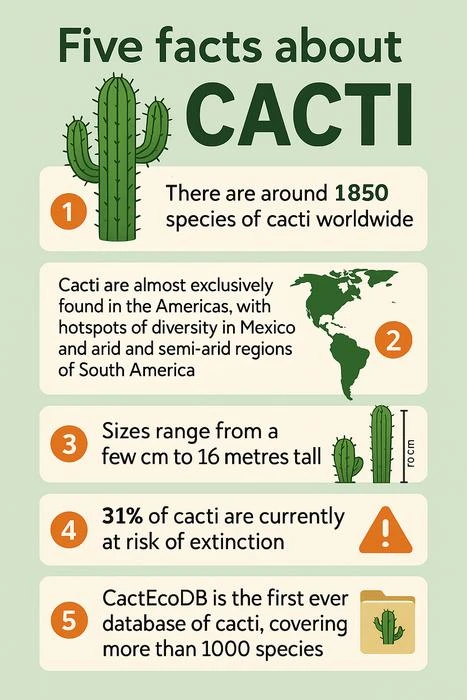
With almost a third of cacti species threatened with extinction, a new open access database of cactus ecology and evolution could help scientists and conservationists save species from the brink.
Researchers from the Universities of Bath and Reading have launched CactEcoDB, the most comprehensive database ever created for the cactus family, offering an unprecedented window into the evolution, ecology and conservation needs of one of the world’s most distinctive and endangered groups of plants.
Cactaceae - the family that includes everything from tiny globular cacti to towering desert giants - comprises around 1,850 species found across the Americas.
Cacti are famous for their extreme adaptations to water scarcity and harsh environments, but they are also under severe threat: 31% of species are currently at risk of extinction, with habitat loss, climate change and illegal trade putting many more in danger.
To help scientists better understand and protect these unique plants, the team behind CactEcoDB assembled an open access dataset drawing on hundreds of data sources collected over seven years and covering more than 1,000 cactus species.
For the first time, the resource integrates in one place:
• curated geographic range maps
• environmental and climate data
• key biological traits, including growth form, height and pollination strategies
• the largest ever time‑calibrated evolutionary family tree for cacti
• species‑level diversification and speciation rates
Dr Jamie Thompson, Leverhulme Research Fellow from the University of Reading and first author of the paper, said: “Unlike for many animal groups, there was no central curated database of cactus biodiversity until now.
“The data needed to understand their conservation, ecology and evolution have been fragmented, incomplete and difficult for researchers to access. Our database fills this critical gap and could be a really powerful tool for studying diversity.”
Dr Nick Priest, from the University of Bath’s Department of Life Sciences and the Centre for Artificial Intelligence, said: "Cacti capture our imagination as icons of endurance and survivors of the planet's inhospitable environments, and yet they are amongst the most threatened plant families on Earth – even the giant saguaro cacti are collapsing in the Arizona summer heat.
“By bringing together this wealth of information in one place, we hope to enable new research that can ultimately support their conservation.”
The new dataset greatly expands on earlier work, offering improved trait coverage, more refined growth‑form categories, expert‑verified range maps based on IUCN assessments, and the most complete phylogeny to date.
By making the resource freely available, the authors hope to support future research, especially studies integrating machine learning in the ecology, evolution and conservation of cacti. They invite the scientific community to contribute additional data as it becomes available.
One of the striking features of the database is the variability of arid climates, especially in rainfall patterns, temperature fluctuations and sand content in soil.
Dr Thompson said: "It's climatic variability that makes deserts such hostile places to live. But, the data are telling us that each group of cacti face different climatic challenges."
This body information is bound to be of interest to a range of people, including cactus enthusiasts, cultivators and conservationists.
"But, because no two deserts are alike, it is going to be tricky working out general rules for how to protect cacti from climate change," says Dr Priest. "AI could be our best hope of finding conservation strategies specific to each major group of cacti."
The CactEcoDB database can be accessed via Figshare.
END
Researchers from the Universities of Bath and Reading have launched CactEcoDB, the most comprehensive database ever created for the cactus family, offering an unprecedented window into the evolution, ecology and conservation needs of one of the world’s most distinctive and endangered groups of plants.
Cactaceae - the family that includes everything from tiny globular cacti to towering desert giants - comprises around 1,850 species found across the Americas.
Cacti are famous for their extreme adaptations to water scarcity and harsh environments, but they are also under severe threat: 31% of species are currently at risk of extinction, with habitat loss, climate change and illegal trade putting many more in danger.
To help scientists better understand and protect these unique plants, the team behind CactEcoDB assembled an open access dataset drawing on hundreds of data sources collected over seven years and covering more than 1,000 cactus species.
For the first time, the resource integrates in one place:
• curated geographic range maps
• environmental and climate data
• key biological traits, including growth form, height and pollination strategies
• the largest ever time‑calibrated evolutionary family tree for cacti
• species‑level diversification and speciation rates
Dr Jamie Thompson, Leverhulme Research Fellow from the University of Reading and first author of the paper, said: “Unlike for many animal groups, there was no central curated database of cactus biodiversity until now.
“The data needed to understand their conservation, ecology and evolution have been fragmented, incomplete and difficult for researchers to access. Our database fills this critical gap and could be a really powerful tool for studying diversity.”
Dr Nick Priest, from the University of Bath’s Department of Life Sciences and the Centre for Artificial Intelligence, said: "Cacti capture our imagination as icons of endurance and survivors of the planet's inhospitable environments, and yet they are amongst the most threatened plant families on Earth – even the giant saguaro cacti are collapsing in the Arizona summer heat.
“By bringing together this wealth of information in one place, we hope to enable new research that can ultimately support their conservation.”
The new dataset greatly expands on earlier work, offering improved trait coverage, more refined growth‑form categories, expert‑verified range maps based on IUCN assessments, and the most complete phylogeny to date.
By making the resource freely available, the authors hope to support future research, especially studies integrating machine learning in the ecology, evolution and conservation of cacti. They invite the scientific community to contribute additional data as it becomes available.
One of the striking features of the database is the variability of arid climates, especially in rainfall patterns, temperature fluctuations and sand content in soil.
Dr Thompson said: "It's climatic variability that makes deserts such hostile places to live. But, the data are telling us that each group of cacti face different climatic challenges."
This body information is bound to be of interest to a range of people, including cactus enthusiasts, cultivators and conservationists.
"But, because no two deserts are alike, it is going to be tricky working out general rules for how to protect cacti from climate change," says Dr Priest. "AI could be our best hope of finding conservation strategies specific to each major group of cacti."
The CactEcoDB database can be accessed via Figshare.
END