‘Spin-flip’ in metal complexes can help solar cells leap beyond limits
Researchers successfully capture singlet-fission–amplified excitons with a molybdenum-based emitter, achieving 130% quantum yield and opening a path beyond solar cell efficiency limits
Fukuoka, Japan—In the fight against climate change, solar power is a promising alternative to fossil fuels. Every second, Earth receives an enormous amount of energy from the Sun. Yet solar cells capture only a fraction of it, constrained by a “physical ceiling” that seemed impossible to break.
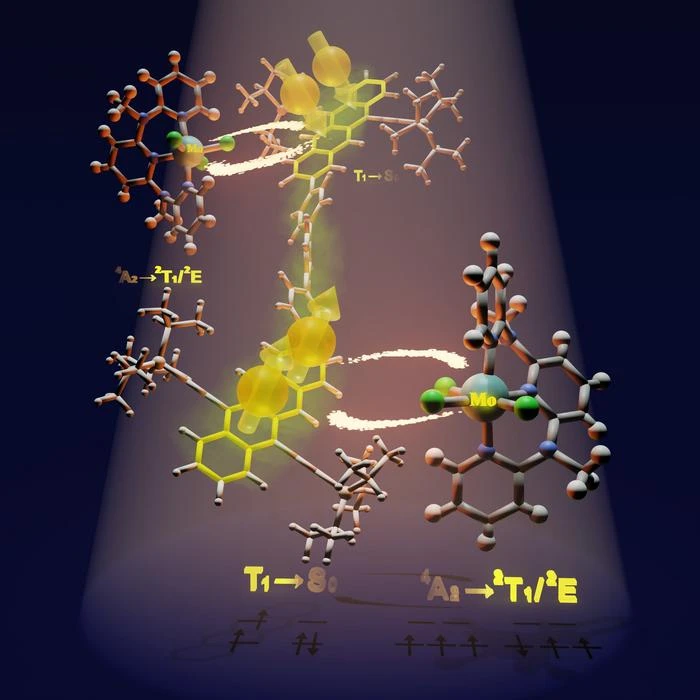
In a paper published in the Journal of the American Chemical Society on March 25, a research team led by Kyushu University in Japan, in collaboration with Johannes Gutenberg University (JGU) Mainz in Germany, used a molybdenum-based metal complex called “spin-flip” emitter to harvest multiplied energy from singlet fission (SF)—a “dream technology” for light conversion. This technology pushes energy conversion efficiency to about 130%, surpassing the 100% barrier and opening new possibilities for higher-performance solar cells.
To picture how a solar cell generates electricity, imagine a relay race among tiny particles. Photons from sunlight strike a semiconductor and pass their energy to electrons, activating them and driving an electric current.
But the “runners” in sunlight vary in ability. Lower-energy infrared photons cannot excite electrons, while higher-energy ones, like blue light, lose their excess as heat. As a result, solar cells can use only about one-third of the sunlight. This ceiling, known as the Shockley–Queisser limit, has long challenged scientists.
“We have two main strategies to break through this limit,” says Yoichi Sasaki, Associate Professor at Kyushu University’s Faculty of Engineering. “One is to convert lower-energy infrared photons into higher energy visible photons. The other, what we explore here, is to use SF to generate two excitons from a single exciton photon.”
Normally, one photon can generate at most one spin-singlet exciton after electronic excitation. SF can split this high-energy singlet exciton into two lower-energy spin-triplet excitons, theoretically doubling the energy. While some organic semiconductors like tetracene exhibit this process, capturing the SF-born excitons remains challenging.
“The energy can be easily ‘stolen’ by a mechanism called Förster resonance energy transfer (FRET) before multiplication occurs,” Sasaki explains. “We therefore needed an energy acceptor that selectively captures the multiplied triplet excitons after fission.”
The team turned to metal complexes—molecules whose structures can be flexibly designed—and discovered that a molybdenum-based “spin-flip” emitter serves as an ideal harvester. In such molecules, an electron flips its spin during absorption or emission of near-infrared light, enabling the system to accept the triplet energy produced in SF. By carefully tuning the energy levels, the researchers suppressed the wasteful FRET process, allowing the multiplied excitons from SF to be selectively extracted.
“We could not have reached this point without the Heinze group from JGU Mainz,” Sasaki says. Adrian Sauer, a graduate student from the group visiting Kyushu University on exchange and the paper’s second author, brought the team’s attention to a material long studied there, leading to the collaboration.
By pairing this complex with tetracene-based materials in solution, the team successfully harvested energy, achieving quantum yields of around 130%, meaning roughly 1.3 molybdenum-based metal complexes were excited per photon absorbed. This exceeds the conventional 100% limit, indicating that the system generated and harvested more energy carriers than photons received.
This work establishes a new design strategy for exciton amplification, though the team notes that current experiments remain at the proof-of-concept stage. Looking ahead, they plan to bring the two types of materials together in the solid state, aiming for efficient energy transfer and eventual integration into working solar cells.
Meanwhile, they hope the study will inspire further exploration at the intersection of singlet fission and metal complexes, with potential applications ranging from solar cells and LEDs to next-generation quantum technologies.
###
For more information about this research, see “Exploring Spin-State Selective Harvesting Pathways from Singlet Fission Dimers to a Near-Infrared Emissive Spin-Flip Emitter,” Percy Gonzalo Sifuentes-Samanamud, Adrian Sauer, Aki Masaoka, Yuta Sawada, Yuya Watanabe, Ilias Papadopoulos, Katja Heinze, Yoichi Sasaki, and Nobuo Kimizuka, Journal of the American Chemical Society, https://doi.org/10.1021/jacs.5c20500
About Kyushu University
Founded in 1911, Kyushu University is one of Japan's leading research-oriented institutions of higher education, consistently ranking as one of the top ten Japanese universities in the Times Higher Education World University Rankings and the QS World Rankings. Located in Fukuoka, on the island of Kyushu—the most southwestern of Japan’s four main islands—Kyushu U sits in a coastal metropolis frequently ranked among the world’s most livable cities and historically known as Japan’s gateway to Asia. Its multiple campuses are home to around 19,000 students and 8,000 faculty and staff. Through its VISION 2030, Kyushu U will “drive social change with integrative knowledge.” By fusing the spectrum of knowledge, from the humanities and arts to engineering and medical sciences, Kyushu U will strengthen its research in the key areas of decarbonization, medicine and health, and environment and food, to tackle society’s most pressing issues.
END
In a paper published in the Journal of the American Chemical Society on March 25, a research team led by Kyushu University in Japan, in collaboration with Johannes Gutenberg University (JGU) Mainz in Germany, used a molybdenum-based metal complex called “spin-flip” emitter to harvest multiplied energy from singlet fission (SF)—a “dream technology” for light conversion. This technology pushes energy conversion efficiency to about 130%, surpassing the 100% barrier and opening new possibilities for higher-performance solar cells.
To picture how a solar cell generates electricity, imagine a relay race among tiny particles. Photons from sunlight strike a semiconductor and pass their energy to electrons, activating them and driving an electric current.
But the “runners” in sunlight vary in ability. Lower-energy infrared photons cannot excite electrons, while higher-energy ones, like blue light, lose their excess as heat. As a result, solar cells can use only about one-third of the sunlight. This ceiling, known as the Shockley–Queisser limit, has long challenged scientists.
“We have two main strategies to break through this limit,” says Yoichi Sasaki, Associate Professor at Kyushu University’s Faculty of Engineering. “One is to convert lower-energy infrared photons into higher energy visible photons. The other, what we explore here, is to use SF to generate two excitons from a single exciton photon.”
Normally, one photon can generate at most one spin-singlet exciton after electronic excitation. SF can split this high-energy singlet exciton into two lower-energy spin-triplet excitons, theoretically doubling the energy. While some organic semiconductors like tetracene exhibit this process, capturing the SF-born excitons remains challenging.
“The energy can be easily ‘stolen’ by a mechanism called Förster resonance energy transfer (FRET) before multiplication occurs,” Sasaki explains. “We therefore needed an energy acceptor that selectively captures the multiplied triplet excitons after fission.”
The team turned to metal complexes—molecules whose structures can be flexibly designed—and discovered that a molybdenum-based “spin-flip” emitter serves as an ideal harvester. In such molecules, an electron flips its spin during absorption or emission of near-infrared light, enabling the system to accept the triplet energy produced in SF. By carefully tuning the energy levels, the researchers suppressed the wasteful FRET process, allowing the multiplied excitons from SF to be selectively extracted.
“We could not have reached this point without the Heinze group from JGU Mainz,” Sasaki says. Adrian Sauer, a graduate student from the group visiting Kyushu University on exchange and the paper’s second author, brought the team’s attention to a material long studied there, leading to the collaboration.
By pairing this complex with tetracene-based materials in solution, the team successfully harvested energy, achieving quantum yields of around 130%, meaning roughly 1.3 molybdenum-based metal complexes were excited per photon absorbed. This exceeds the conventional 100% limit, indicating that the system generated and harvested more energy carriers than photons received.
This work establishes a new design strategy for exciton amplification, though the team notes that current experiments remain at the proof-of-concept stage. Looking ahead, they plan to bring the two types of materials together in the solid state, aiming for efficient energy transfer and eventual integration into working solar cells.
Meanwhile, they hope the study will inspire further exploration at the intersection of singlet fission and metal complexes, with potential applications ranging from solar cells and LEDs to next-generation quantum technologies.
###
For more information about this research, see “Exploring Spin-State Selective Harvesting Pathways from Singlet Fission Dimers to a Near-Infrared Emissive Spin-Flip Emitter,” Percy Gonzalo Sifuentes-Samanamud, Adrian Sauer, Aki Masaoka, Yuta Sawada, Yuya Watanabe, Ilias Papadopoulos, Katja Heinze, Yoichi Sasaki, and Nobuo Kimizuka, Journal of the American Chemical Society, https://doi.org/10.1021/jacs.5c20500
About Kyushu University
Founded in 1911, Kyushu University is one of Japan's leading research-oriented institutions of higher education, consistently ranking as one of the top ten Japanese universities in the Times Higher Education World University Rankings and the QS World Rankings. Located in Fukuoka, on the island of Kyushu—the most southwestern of Japan’s four main islands—Kyushu U sits in a coastal metropolis frequently ranked among the world’s most livable cities and historically known as Japan’s gateway to Asia. Its multiple campuses are home to around 19,000 students and 8,000 faculty and staff. Through its VISION 2030, Kyushu U will “drive social change with integrative knowledge.” By fusing the spectrum of knowledge, from the humanities and arts to engineering and medical sciences, Kyushu U will strengthen its research in the key areas of decarbonization, medicine and health, and environment and food, to tackle society’s most pressing issues.
END