Breaking the durability–degradability trade-off in polymers
Researchers at The University of Osaka develop a tough material whose degradation can be switched on and off with light
Osaka, Japan — Modern polymer materials face a fundamental challenge: they must remain strong and durable during use, yet ideally degrade when they are no longer needed. Designing materials that satisfy both requirements has long been a major challenge in polymer science.
Researchers at The University of Osaka have now developed a molecular design strategy that reconciles these competing demands. By introducing movable molecular rings (cyclodextrins) into a polymer network, the team created a tough material whose enzymatic degradation can be switched on or off using light.
In conventional polymer materials, strong mechanical properties are typically achieved by forming cross-links between polymer chains, which create a stable three-dimensional network. While this structure improves durability, it also makes the material difficult to break down once it has served its purpose.
To overcome this challenge, the research team designed a polymer system that integrates three key features: light responsiveness, movable cross-links, and enzymatically degradable polymer segments.
The movable cross-links are created using ring-shaped molecules called cyclodextrins, which are derived from naturally occurring saccharides. These rings can slide along the polymer chains, allowing the network structure to redistribute stress under deformation and maintain mechanical toughness.
“The movable cross-links allow the polymer chains to slide and adapt under stress, resulting in a tough material that does not easily break,” explains lead author Xin Zhou.
In addition to mechanical durability, the material was designed so that its degradation can be precisely controlled. The polymer chains contain segments that can be degraded by enzymes, which are naturally occurring biological catalysts.
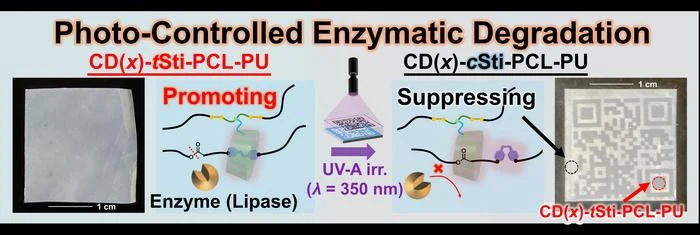
Light irradiation alters the host–guest interactions, thereby controlling the position of the cyclodextrin rings along the polymer chains., alternately shielding or exposing the enzyme-sensitive segments. As a result, enzymatic degradation can be switched on or off depending on the wavelength of light applied.
“The motion of the rings can be controlled by light,” says Yoshinori Takashima, senior author of the study. “By selecting the wavelength of light, we can either accelerate or suppress enzymatic degradation. This molecular design strategy allows us to combine durability with controllable degradability in polymer materials.”
The researchers also demonstrated that degradation can be spatially controlled. By selectively irradiating the material through a photomask, the team was able to 'write' a QR code pattern into the material. When the polymer was subsequently exposed to enzymatic degradation, the QR pattern emerged as the degraded regions became visible.
This work introduces a new molecular design principle for polymer materials that resolves the long-standing trade-off between durability and degradability. Such strategies could enable next-generation functional materials whose lifetime and degradation behavior can be precisely programmed.
Potential applications include smart polymer materials, biomedical materials, and information-encoding materials in which degradation can be controlled in space and time.
###
The article, “Light-Programmable Polyester Networks with Movable Cross-Links for On-Demand Enzymatic Degradation,” will be published in ACS Nano at DOI: https://doi.org/10.1021/acsnano.5c19646
About The University of Osaka
The University of Osaka was founded in 1931 as one of the seven imperial universities of Japan and is now one of Japan's leading comprehensive universities with a broad disciplinary spectrum. This strength is coupled with a singular drive for innovation that extends throughout the scientific process, from fundamental research to the creation of applied technology with positive economic impacts. Its commitment to innovation has been recognized in Japan and around the world. Now, The University of Osaka is leveraging its role as a Designated National University Corporation selected by the Ministry of Education, Culture, Sports, Science and Technology to contribute to innovation for human welfare, sustainable development of society, and social transformation.
Website: https://resou.osaka-u.ac.jp/en
END
Researchers at The University of Osaka have now developed a molecular design strategy that reconciles these competing demands. By introducing movable molecular rings (cyclodextrins) into a polymer network, the team created a tough material whose enzymatic degradation can be switched on or off using light.
In conventional polymer materials, strong mechanical properties are typically achieved by forming cross-links between polymer chains, which create a stable three-dimensional network. While this structure improves durability, it also makes the material difficult to break down once it has served its purpose.
To overcome this challenge, the research team designed a polymer system that integrates three key features: light responsiveness, movable cross-links, and enzymatically degradable polymer segments.
The movable cross-links are created using ring-shaped molecules called cyclodextrins, which are derived from naturally occurring saccharides. These rings can slide along the polymer chains, allowing the network structure to redistribute stress under deformation and maintain mechanical toughness.
“The movable cross-links allow the polymer chains to slide and adapt under stress, resulting in a tough material that does not easily break,” explains lead author Xin Zhou.
In addition to mechanical durability, the material was designed so that its degradation can be precisely controlled. The polymer chains contain segments that can be degraded by enzymes, which are naturally occurring biological catalysts.
Light irradiation alters the host–guest interactions, thereby controlling the position of the cyclodextrin rings along the polymer chains., alternately shielding or exposing the enzyme-sensitive segments. As a result, enzymatic degradation can be switched on or off depending on the wavelength of light applied.
“The motion of the rings can be controlled by light,” says Yoshinori Takashima, senior author of the study. “By selecting the wavelength of light, we can either accelerate or suppress enzymatic degradation. This molecular design strategy allows us to combine durability with controllable degradability in polymer materials.”
The researchers also demonstrated that degradation can be spatially controlled. By selectively irradiating the material through a photomask, the team was able to 'write' a QR code pattern into the material. When the polymer was subsequently exposed to enzymatic degradation, the QR pattern emerged as the degraded regions became visible.
This work introduces a new molecular design principle for polymer materials that resolves the long-standing trade-off between durability and degradability. Such strategies could enable next-generation functional materials whose lifetime and degradation behavior can be precisely programmed.
Potential applications include smart polymer materials, biomedical materials, and information-encoding materials in which degradation can be controlled in space and time.
###
The article, “Light-Programmable Polyester Networks with Movable Cross-Links for On-Demand Enzymatic Degradation,” will be published in ACS Nano at DOI: https://doi.org/10.1021/acsnano.5c19646
About The University of Osaka
The University of Osaka was founded in 1931 as one of the seven imperial universities of Japan and is now one of Japan's leading comprehensive universities with a broad disciplinary spectrum. This strength is coupled with a singular drive for innovation that extends throughout the scientific process, from fundamental research to the creation of applied technology with positive economic impacts. Its commitment to innovation has been recognized in Japan and around the world. Now, The University of Osaka is leveraging its role as a Designated National University Corporation selected by the Ministry of Education, Culture, Sports, Science and Technology to contribute to innovation for human welfare, sustainable development of society, and social transformation.
Website: https://resou.osaka-u.ac.jp/en
END